
Shared Equally 2
Overview
Introduces students to the idea of sharing bills fairly between two people and calculating how much change each person receives. The exercises use simple euro notes and coins to visualise spending and change in everyday contexts.
The sequence begins with a situation where each person has €2 and spends €1. Learners are asked how much change each individual receives, reinforcing the idea that subtraction is used to find the remaining amount.
Next, a more complex example is given: two students share a €4 bill, paying €2 each. With only €5 notes, they must figure out their change. The multiple-choice answers guide them to apply subtraction (€5 − €2) rather than addition.
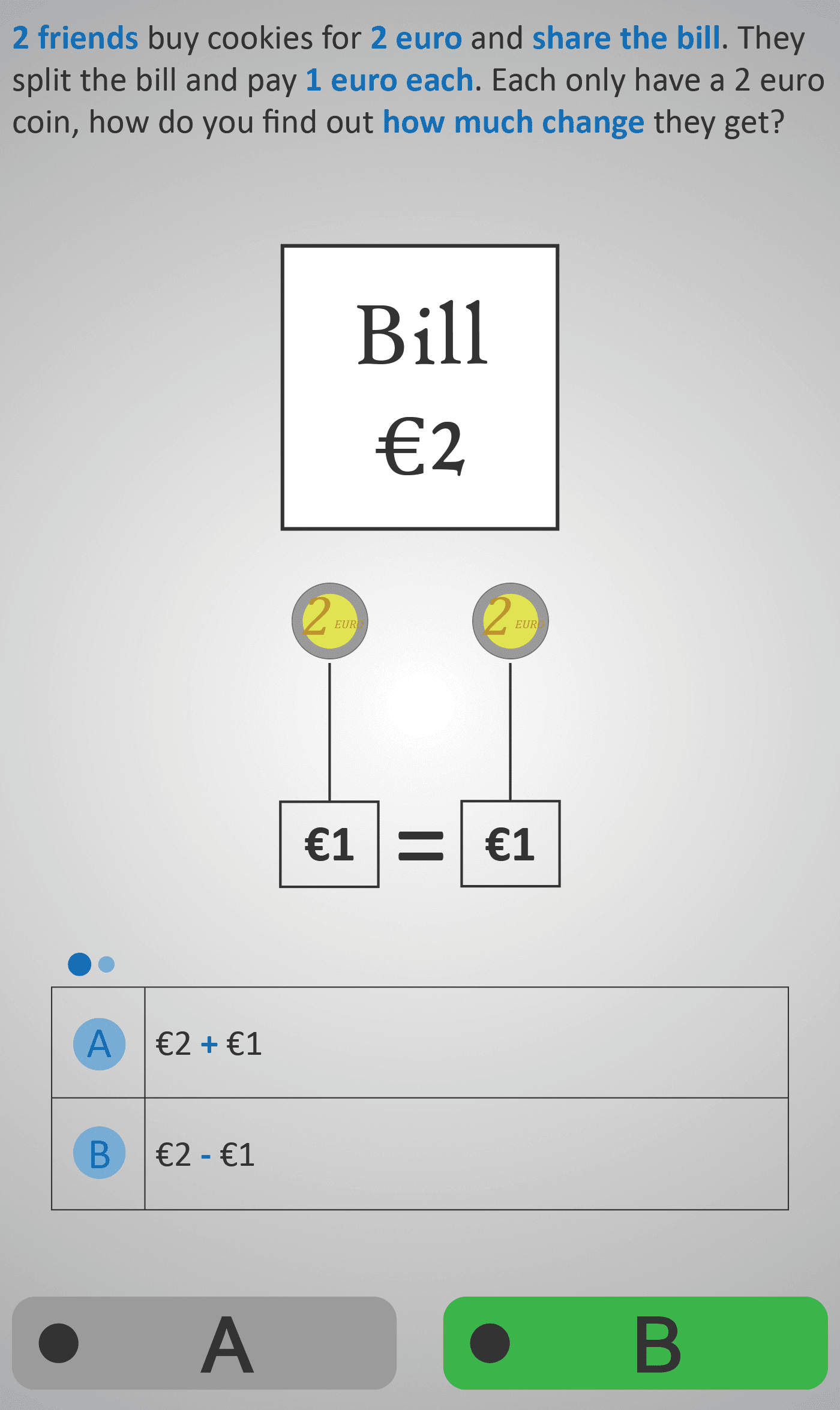
Students then see the outcome clearly illustrated: each friend spends €2 from their €5 and is left with €3. Finally, the exercise revisits the simpler €2 example but reinforces the subtraction step visually, ensuring the learner understands both the arithmetic and the real-life money context.
This Phlow builds money-handling confidence, introduces real-world problem-solving, and strengthens subtraction skills in practical scenarios.
Prerequisite Knowledge Required
- Linked Phlows: Subtract 1 – understanding subtraction as “taking away.”
- Money 2 – recognising and adding euro notes and coins.
- Add & Sub 2 – switching flexibly between addition and subtraction.
Main Category
Money & Arithmetic
Estimated Completion Time
Approx 6–10 seconds per question. 20 questions total. Total time: 2–4 minutes.
Cognitive Load / Step Size
Low — each task builds gently from single-person subtraction to two-person sharing. The use of consistent visuals (notes, coins, and receipts) keeps reasoning clear and intuitive. Transitions are logical and scaffold understanding step by step.
Language & Literacy Demand
Low to Moderate — short sentences and familiar money terms are used throughout. Visuals do most of the explanatory work, so even weaker readers can infer meaning from context. Terms like “share,” “spend,” and “change” are reinforced through repetition.
Clarity & Design
Excellent — euro notes and coins are presented clearly, with visual balance between text and imagery. Each example visually tracks what happens to the money before and after spending, reducing abstraction. The simple two-choice format prevents cognitive overload.
Curriculum Alignment
Irish Curriculum Strand: Measures – Money / Number – Operations
- Use subtraction to find change in real-life contexts.
- Understand equal sharing between two individuals.
- Represent simple financial transactions with visual supports.
- Apply arithmetic reasoning to practical spending problems.
Engagement & Motivation
High — the use of realistic spending situations (buying and sharing) feels relatable and age-appropriate. The theme of fairness and sharing connects with social understanding as well as maths practice, keeping motivation strong.
Error Opportunities & Misconceptions
- Adding instead of subtracting when calculating change.
- Forgetting that each person spends individually (e.g., dividing total change incorrectly).
- Confusing the shared bill with individual contributions.
Visual reinforcement of each step helps prevent these errors and clarifies the “one person’s share” concept.
Transferability / Real-World Anchoring
Very strong — directly linked to real-life situations like splitting a bill or paying for small purchases. Reinforces everyday numeracy and prepares learners for independent money management.
Conceptual vs Procedural Balance
Balanced — students see why subtraction is needed (to find what’s left) and how to apply it in shared contexts. Conceptual fairness and procedural calculation are both emphasised.
Learning Objectives Addressed
- Subtract amounts of money to calculate change.
- Share costs fairly between two people.
- Recognise the connection between subtraction and “what’s left.”
- Build real-world financial confidence through visual problem solving.
What Your Score Says About You
- Less than 5: Needs more practice with subtraction and identifying individual shares.
- 6–7: Understands the process but sometimes confuses shared vs. total amounts.
- 8–9: Consistent and confident with subtraction and money-sharing logic.
- 10 / 10: Excellent mastery — understands both the arithmetic and the real-world reasoning behind sharing and change.