
Total Cost 2
Overview
This exercise helps students practise solving real-life money problems involving costs, payments, and change.
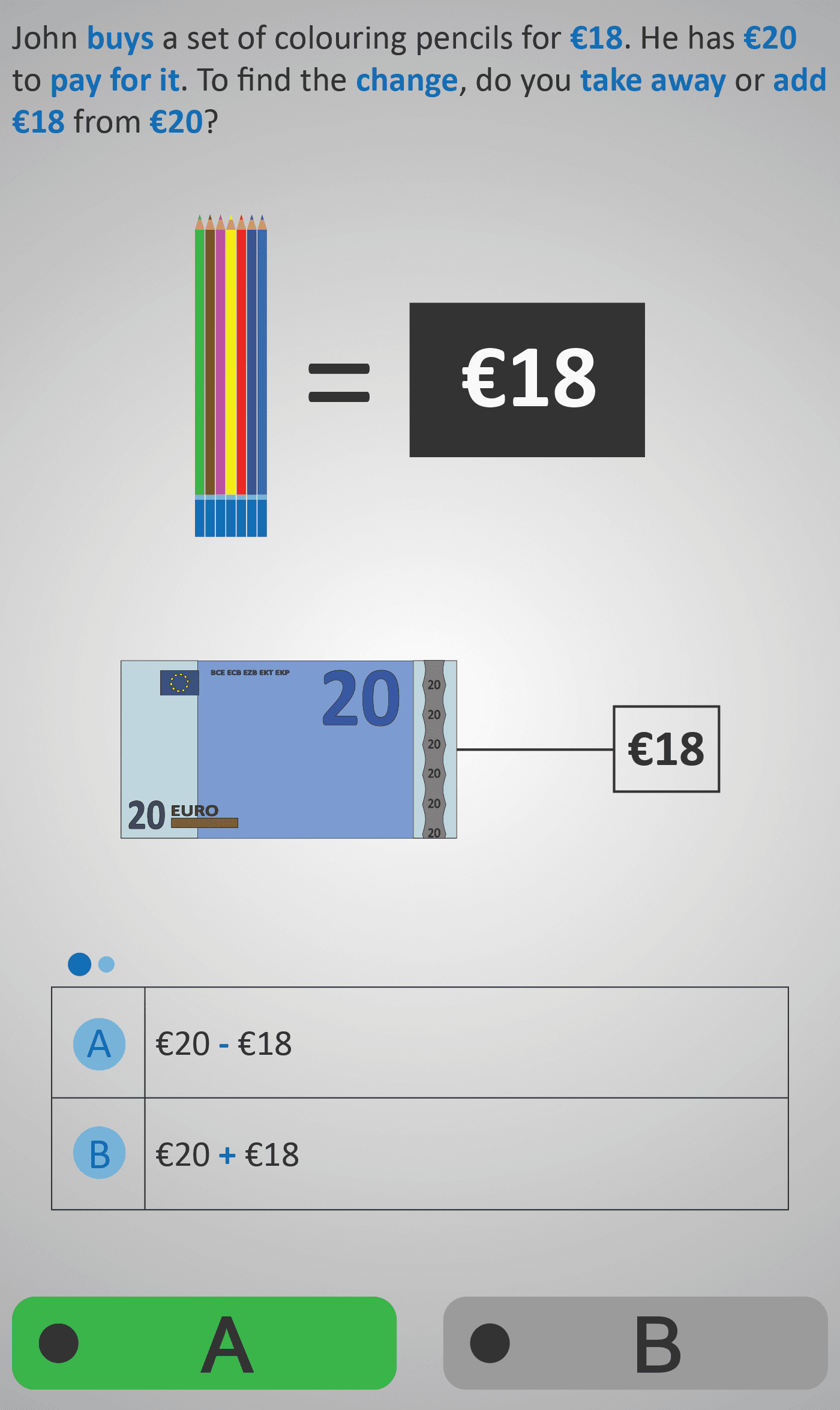
In the first task, John buys colouring pencils for €18 and pays with a €20 note. Students are asked whether they should add or subtract to calculate the change. The correct step is subtraction: €20 − €18.
Next, students work out how much change John receives, with the correct answer being €2.
The second scenario introduces Sarah, who buys food for €7 and pays with a €10 note. Again, students must decide whether to add or subtract. The correct operation is subtraction: €10 − €7.
Finally, students calculate Sarah’s change, which is €3.
This sequence of problems develops:
- Understanding of subtraction as the method for finding change.
- Application of simple arithmetic in money contexts.
- Real-life problem-solving skills using euros.
Prerequisite Knowledge Required
- Linked Phlows: Add 1 / Add 2 – combining small numbers and sums of money.
- Subtract 1 / Subtract 2 – understanding subtraction as “taking away.”
- Coins 2 – recognising euro and cent values.
- Shared Equally 2 – handling practical money-sharing and real-world subtraction.
Main Category
Money & Real-Life Arithmetic
Estimated Completion Time
Approx 6–10 seconds per question. 20 questions total. Total time: 2–4 minutes.
Cognitive Load / Step Size
Low — each scenario introduces one clear decision (add vs subtract) followed by one calculation. The consistent money context and simple two-step structure keep the cognitive demand light and focused on comprehension rather than computation.
Language & Literacy Demand
Low — the sentences are short and use everyday vocabulary (buy, pay, change). Numerical amounts are visually reinforced by euro symbols, reducing reading dependency for learners with weaker literacy skills.
Clarity & Design
Strong — real euro notes and coins (or simple icons) make the tasks relatable and visually clear. The two-step sequence (operation choice → calculation) provides consistent scaffolding. Colour contrast between “cost” and “payment” aids visual processing.
Curriculum Alignment
Irish Curriculum Strand: Measures – Money
- Use addition and subtraction in practical money problems.
- Calculate total cost and change using euro amounts.
- Apply arithmetic reasoning in real-world financial contexts.
- Recognise subtraction as the inverse of addition when handling transactions.
Engagement & Motivation
High — familiar shopping examples make the task relatable and meaningful. The real-life framing (buying, paying, change) increases intrinsic motivation and relevance beyond the classroom.
Error Opportunities & Misconceptions
- Adding instead of subtracting when finding change.
- Reversing the subtraction order (e.g., cost − payment).
- Overlooking the “change” concept as what remains after spending.
Visual cues and repeated scenarios help correct these common errors.
Transferability / Real-World Anchoring
Very Strong — directly applicable to everyday tasks such as shopping, budgeting, and calculating change. Builds life skills and prepares students for more advanced money contexts (e.g., tax, discounts, total receipts).
Conceptual vs Procedural Balance
Balanced — the sequence combines conceptual understanding of when to subtract with procedural practice in performing subtraction accurately. The gradual build reinforces both reasoning and fluency.
Learning Objectives Addressed
- Recognise subtraction as the operation for finding change.
- Apply arithmetic reasoning to everyday money problems.
- Calculate total cost and change accurately.
- Strengthen confidence with euro-based transactions.
What Your Score Says About You
- Less than 5: Needs more practice distinguishing between adding and subtracting in money contexts.
- 6–7: Understands subtraction but may misread which value to subtract from which.
- 8–9: Accurately calculates change in most scenarios.
- 10 / 10: Excellent mastery — confidently applies arithmetic to all money-based problems.