
Triangle 2
Overview
Introduces learners to the classification of triangles based on their sides and angles. Each question presents two triangles, labelled A and B, and asks which one fits a specific description.
Isosceles Triangle
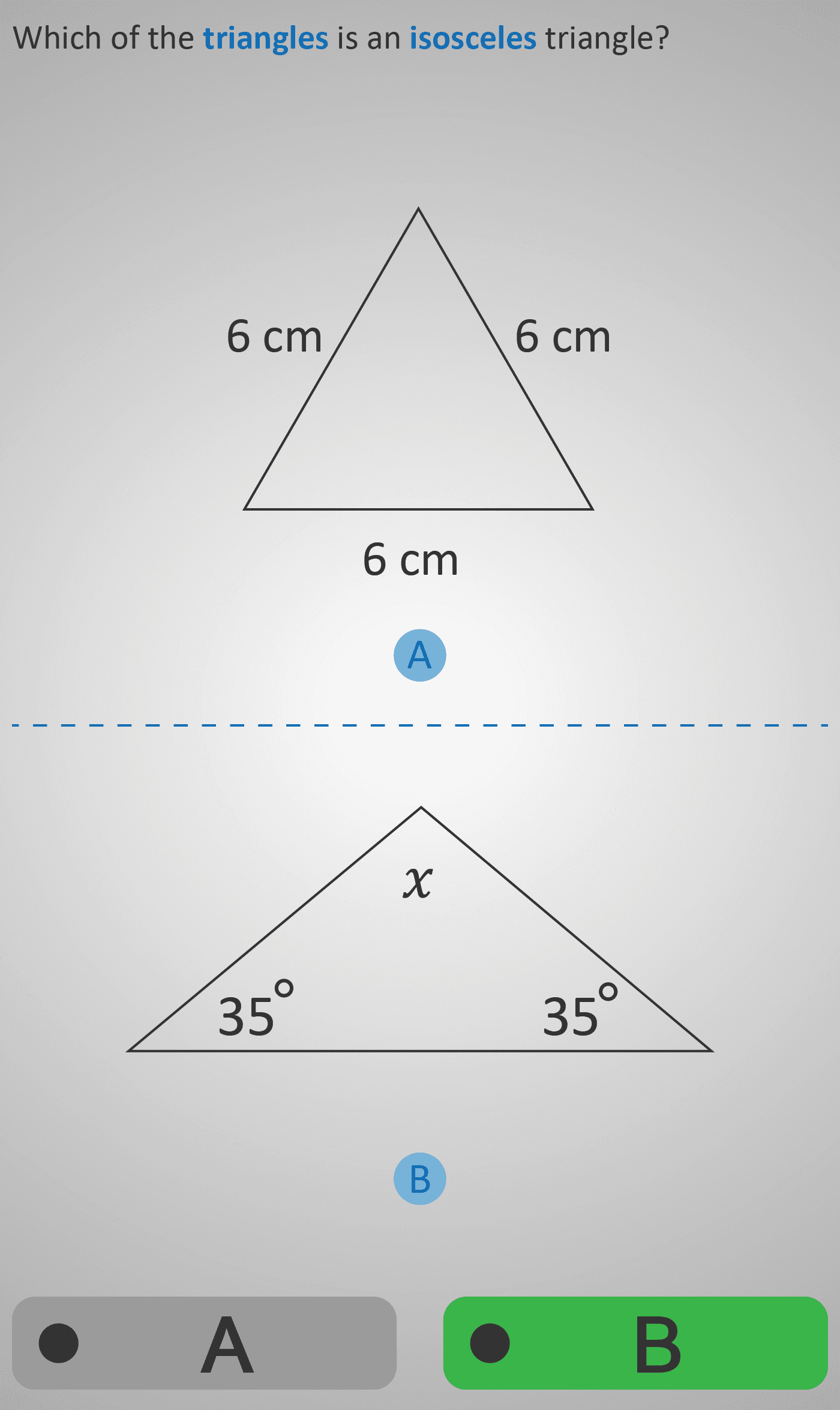
The first screen asks, “Which of the triangles is an isosceles triangle?” Students compare two triangles — one with all sides equal and one with two equal angles of 35°. They learn that an isosceles triangle has two equal sides (or two equal angles), identifying Triangle B as correct.
Equilateral Triangle
The second question focuses on equilateral triangles, reminding learners that all sides and angles are equal. Students choose between one with equal angles (but not all equal) and one with three equal sides, correctly selecting Triangle B.
Right-Angled Triangle
The final screen introduces the right angle symbol, asking which triangle includes a 90° angle. Students identify Triangle A as the right-angled triangle, linking the right-angle box symbol to the concept.
This progression builds understanding of how triangles are classified, encouraging learners to use both numerical and visual cues. By the end, students can confidently recognise and describe isosceles, equilateral, and right-angled triangles.
Prerequisite Knowledge Required
- Linked Phlows: Polygons 2A & 2B – recognising shapes and counting sides/angles.
- Angle 1 / Angle 2 – identifying and comparing angle sizes.
- Measure 2 – understanding centimetres and degrees.
- Hyp–Adj–Opp 1 – recognising sides relative to angles in triangles.
Main Category
Geometry – Properties of Shapes
Estimated Completion Time
Approx 6–10 seconds per question. 20 questions total. Total time: 2–4 minutes.
Cognitive Load / Step Size
Low — each task isolates one property (equal sides, equal angles, or right angle). Progression from visual comparison to concept recognition supports steady cognitive development without overload.
Language & Literacy Demand
Low — questions are concise, using clear geometric terminology like isosceles, equilateral, and right-angled. Visuals provide strong cues, reducing text dependency for understanding.
Clarity & Design
Excellent — diagrams are large, clean, and labelled with clear side lengths and angle measures. The visual contrast between A and B ensures learners focus on defining properties rather than getting distracted by layout.
Curriculum Alignment
Irish Curriculum Strand: Geometry and Measures – 2D Shapes
- Recognise and name types of triangles by side length and angle properties.
- Identify and interpret right angles in geometric figures.
- Understand the relationship between side equality and angle equality.
Engagement & Motivation
Moderate to High — the visual comparison format feels like a quiz, keeping learners engaged. The clear geometric diagrams and immediate feedback support confidence and curiosity.
Error Opportunities & Misconceptions
- Confusing isosceles (two equal sides) with equilateral (three equal sides).
- Misreading the right-angle symbol.
- Assuming equal angles always imply an equilateral triangle.
Repetition and immediate feedback address these misconceptions effectively.
Transferability / Real-World Anchoring
Moderate — identifying triangle types is foundational for real-world applications such as construction, design, and trigonometry. Recognising patterns between sides and angles prepares learners for later work on congruence and theorems.
Conceptual vs Procedural Balance
Conceptual — focuses on understanding geometric properties rather than calculations. Learners build visual recognition skills that underpin future procedural geometry work.
Learning Objectives Addressed
- Identify and classify triangles as isosceles, equilateral, or right-angled.
- Relate side and angle properties to triangle definitions.
- Recognise the right-angle symbol and its meaning.
- Strengthen visual reasoning in geometry.
What Your Score Says About You
- Less than 5: Still developing awareness of triangle types and their defining features.
- 6–7: Recognises some properties but may confuse equal sides with equal angles.
- 8–9: Accurately distinguishes most triangle types using both sides and angles.
- 10 / 10: Excellent mastery — confidently identifies triangle types and explains why.