
Values Ratio 2
Overview
Introduces students to metric conversions in a structured, visual way through a table linking metres and centimetres. Each question builds understanding of how these two units are related by a constant ratio: 1 metre = 100 centimetres.
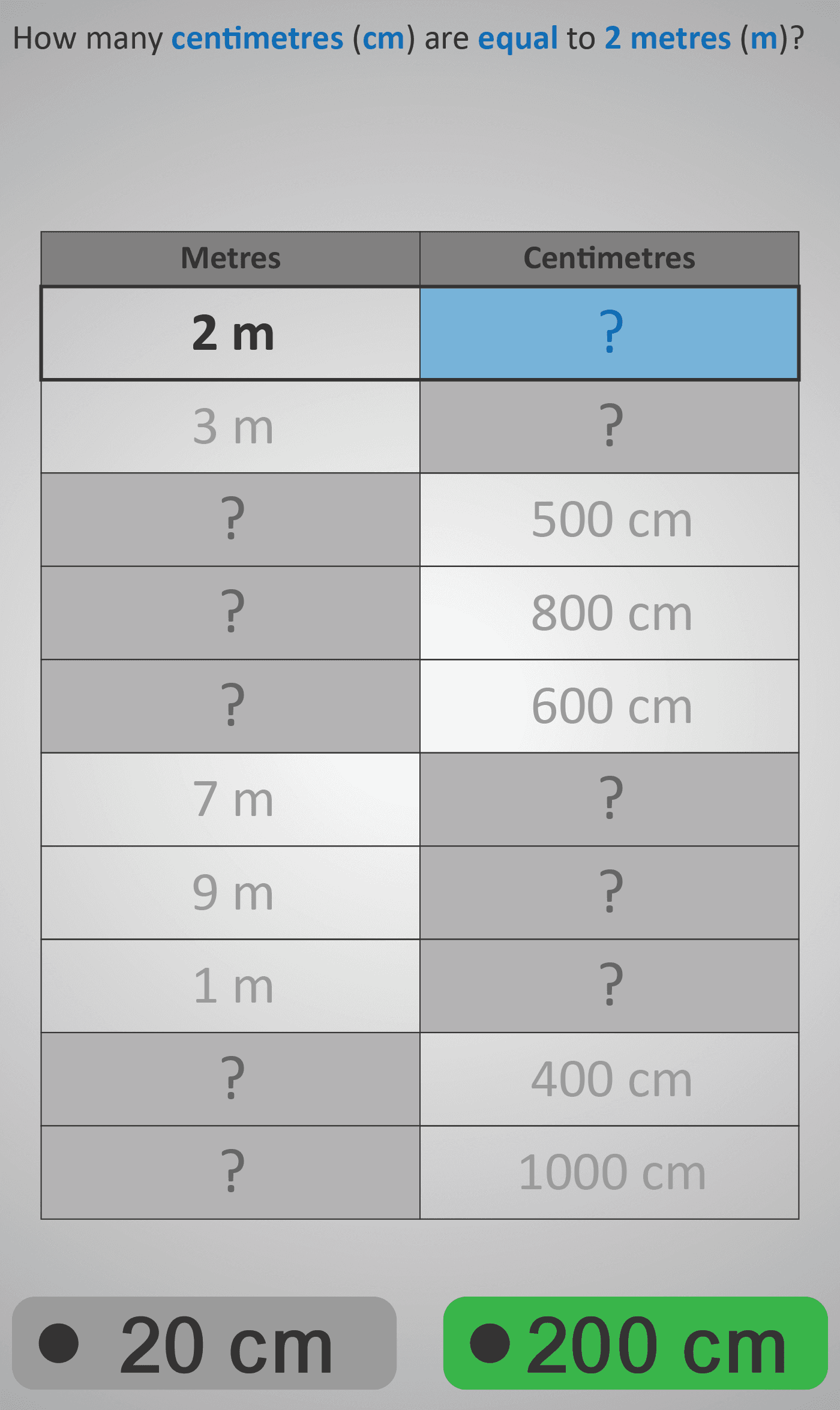
In the first screen, students are asked how many centimetres are equal to 2 metres. The table displays 2 m in the first column, and learners must select the correct corresponding value (200 cm).
In the second screen, the process is repeated for 3 m, confirming that it equals 300 cm and reinforcing the multiplication by 100. Next, the conversion direction reverses. Students are asked how many metres equal 500 cm, prompting division by 100 to find 5 m. Finally, they are asked how many metres equal 800 cm, confirming the correct answer is 8 m.
The exercise alternates between multiplication and division to strengthen both conceptual understanding and procedural fluency. The consistent table layout helps learners spot proportional patterns between rows (e.g., doubling metres doubles centimetres). By the end, students can confidently convert between metres and centimetres in either direction, recognising when to multiply or divide by 100.
Prerequisite Knowledge Required
- Linked Phlows: Measure 1 & 2 – understanding basic units of measurement.
- Estimate 2 – rounding and comparing magnitudes.
- Exchange 2 – practising proportional conversions using money.
- Ratio 1 – understanding multiplicative relationships.
Main Category
Measurement – Unit Conversion and Ratio
Estimated Completion Time
Approx 6–10 seconds per question. 20 questions total. Total time: 2–4 minutes.
Cognitive Load / Step Size
Low — each step introduces only one conversion at a time, supported by a consistent table format. The alternating direction (m → cm, cm → m) offers challenge through pattern reversal without adding complexity.
Language & Literacy Demand
Low — questions use simple, repeated phrasing (“How many centimetres are equal to…”) and strong visual scaffolding via the table. Minimal text ensures accessibility for learners with lower literacy levels.
Clarity & Design
Excellent — the table layout makes proportional relationships explicit, and bold highlighting of the active row focuses attention. Units (m, cm) are clearly labelled and consistently positioned, reducing confusion.
Curriculum Alignment
Irish Curriculum Strand: Measures – Length and Conversions
- Recognise and apply the relationship 1 m = 100 cm.
- Convert between metres and centimetres using multiplication and division.
- Identify proportional patterns between metric units.
- Select appropriate units for measurement contexts.
Engagement & Motivation
Moderate — the real-life context of measurements makes the task relevant and concrete. The structured table supports a sense of progress, with quick reinforcement through alternating conversion types.
Error Opportunities & Misconceptions
- Confusing direction (dividing when multiplication is needed or vice versa).
- Forgetting to use 100 as the conversion factor.
- Mixing up unit labels (e.g., writing 5 m as 5 cm).
The Phlow’s alternating examples and consistent table design correct these misconceptions through pattern recognition and feedback.
Transferability / Real-World Anchoring
High — directly applicable in real contexts (height, distance, fabric length, etc.). Builds foundational understanding for later conversions between other metric units (mm, km, litres, grams).
Conceptual vs Procedural Balance
Balanced — students first grasp the ratio conceptually through pattern observation, then practise the procedure through multiple-choice conversions.
Learning Objectives Addressed
- Understand that 1 metre = 100 centimetres.
- Convert between metres and centimetres using multiplication or division.
- Interpret and complete conversion tables accurately.
- Apply proportional reasoning to measurement problems.
What Your Score Says About You
- Less than 5: Needs further practice understanding unit conversion direction.
- 6–7: Can convert correctly but may confuse multiplying/dividing by 100.
- 8–9: Confidently performs conversions with minimal errors.
- 10 / 10: Excellent mastery — fully fluent in using 1 m = 100 cm to solve both forward and reverse conversions.