
Volume 2
Overview
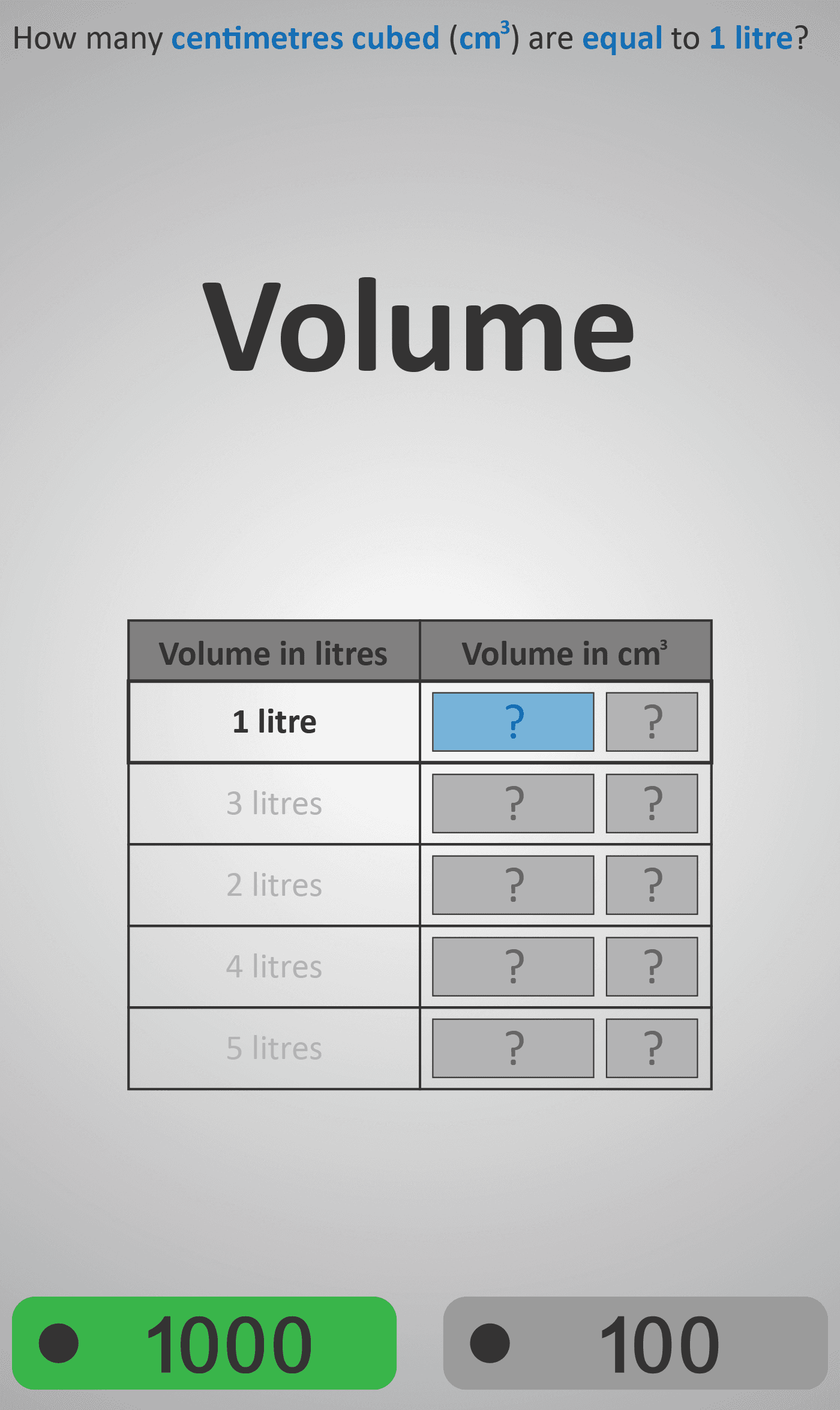
Introduces students to the relationship between litres and cubic centimetres (cm³), reinforcing the conversion of units in measuring volume. Learners first discover that 1 litre = 1,000 cm³ through a multiple-choice question.
The activity then checks their understanding by asking which unit is correct for measuring volume — distinguishing between cm² (area) and cm³ (volume).
Next, students apply this conversion in reverse: converting 5,000 cm³ into litres, recognising that it equals 5 litres. Finally, the exercise reinforces this knowledge by asking which unit is correct for measuring volume in litres, guiding students to choose the appropriate unit of measure.
This sequence helps build fluency in switching between litres and cubic centimetres, while also addressing common misconceptions about units of measurement.
Prerequisite Knowledge Required
- Linked Phlows: Measure 2 – reading and understanding centimetre measurements.
- Area 2 – distinguishing between square and cubic units.
- Estimate 2 – rounding and estimating numerical values.
- Cylinder 2 – recognising 3D shape properties and volume-related dimensions.
Main Category
Measurement – Volume and Unit Conversion
Estimated Completion Time
Approx 6–10 seconds per question. 20 questions total. Total time: 2–4 minutes.
Cognitive Load / Step Size
Low to Moderate — the Phlow introduces a single conversion rule (1 L = 1,000 cm³) and gradually builds confidence through repetition and reversal of direction. Step transitions are small, helping learners avoid confusion between cm² and cm³.
Language & Literacy Demand
Low — brief and direct questions like “Which unit measures volume?” keep reading load light. Technical terms (litre, cubic centimetre) are supported with visual or contextual cues.
Clarity & Design
Excellent — clean use of units and consistent typography for cm², cm³, and L helps students focus on the distinction between 2D and 3D measures. Minimal visual clutter ensures learners attend to units rather than decorative elements.
Curriculum Alignment
Irish Curriculum Strand: Measures – Length, Area, Capacity, and Volume
- Understand that 1 L = 1,000 cm³.
- Convert between litres and cubic centimetres.
- Differentiate between area (cm²) and volume (cm³).
- Choose the correct unit for real-world volume measurement.
Engagement & Motivation
Moderate — the real-world link between containers, bottles, and cubic measures provides relevance. Quick checks and applied conversions maintain engagement without overcomplication.
Error Opportunities & Misconceptions
- Confusing cm² (area) with cm³ (volume).
- Forgetting the ×1,000 or ÷1,000 conversion rule.
- Using inappropriate units for 3D measurement.
Step-by-step progression and alternating direction of conversions directly address these misconceptions.
Transferability / Real-World Anchoring
High — directly applicable to measuring liquid volumes, packaging, and science contexts. Builds foundational knowledge for understanding volume formulas and capacity conversions in higher levels.
Conceptual vs Procedural Balance
Balanced — focuses equally on why the conversion works (relating cubic units to litres) and how to perform it. Reinforces understanding before procedural fluency.
Learning Objectives Addressed
- Recognise and apply the relationship between litres and cubic centimetres.
- Distinguish between area and volume units.
- Accurately convert between metric units of volume.
- Apply correct units in real-world measurement problems.
What Your Score Says About You
- Less than 5: Still confusing units or the litre–cubic centimetre relationship.
- 6–7: Understands the conversion concept but may misapply the ×1,000 or ÷1,000 rule.
- 8–9: Converts confidently and selects appropriate units correctly in most cases.
- 10 / 10: Excellent mastery — can fluently convert between litres and cm³ and apply units accurately in real contexts.