
Algebra 3B
Overview
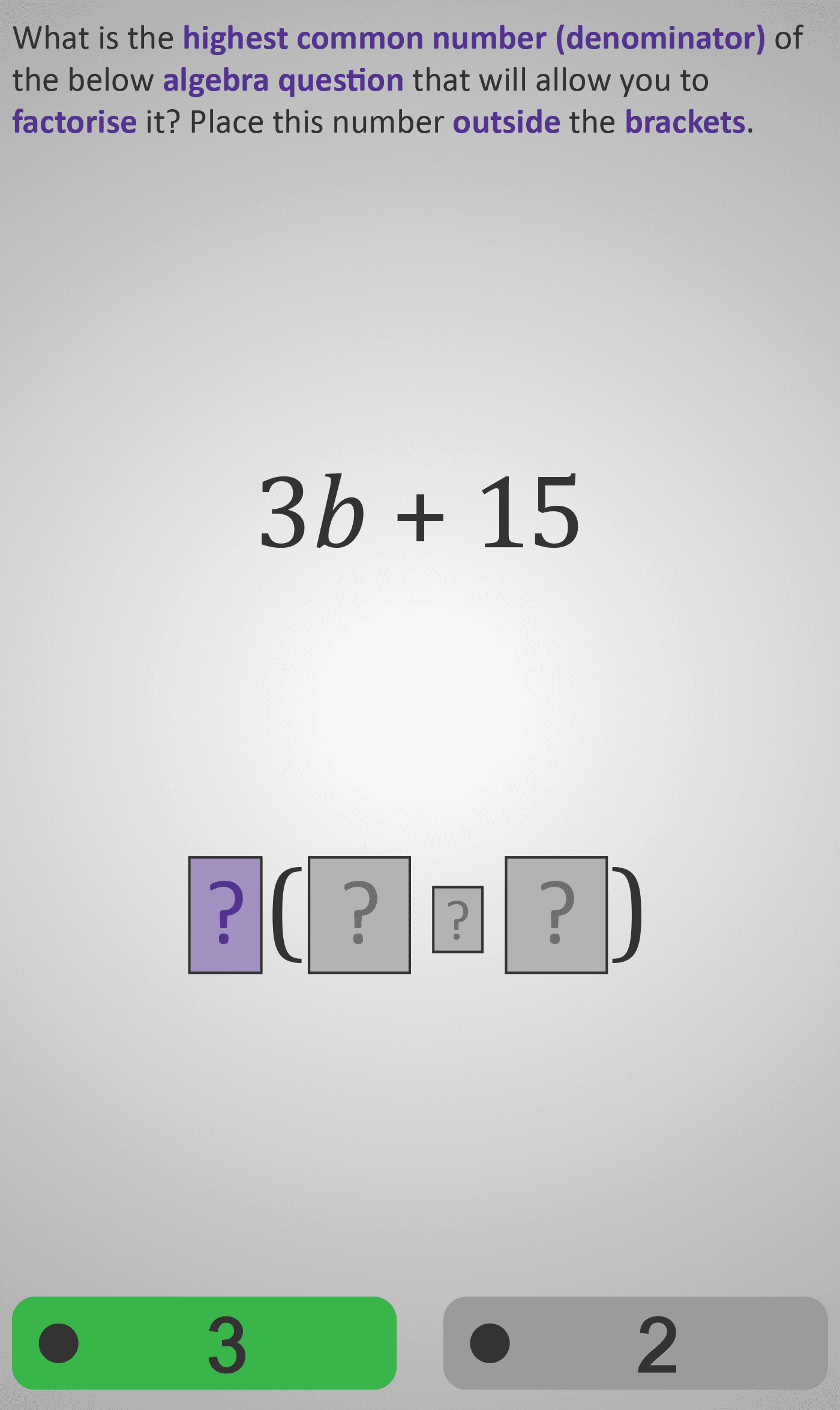
Algebra 3B builds directly on previous learning by teaching students how to factorise simple algebraic expressions — in other words, how to write an expression like 3b + 15 in bracket form. The process is presented step by step to ensure a clear understanding of how factorisation reverses expansion.
Step 1: Find the Common Factor
The sequence begins by asking learners to find the highest common number (factor) shared by both terms. For 3b + 15, they correctly select 3 and place it outside the brackets.
Step 2: Divide Each Term
Next, students divide each term by 3 to find what remains inside:
3b ÷ 3 = b
15 ÷ 3 = 5
Step 3: Determine the Sign
They are then asked whether the sign between the terms inside the brackets is plus or minus — confirming that since the original expression used “+”, the correct sign is plus.
Step 4: Write the Full Expression
Finally, the full factorised expression is revealed: 3b + 15 = 3(b + 5).
By breaking down each stage of reasoning, the Phlow reinforces the link between multiplication (expanding) and division (factorising). The visuals and consistent use of colour highlight how the outside number relates to both inside terms, helping learners generalise this process to more complex examples later.
Prerequisite Knowledge Required
- Linked Phlows: Visual Algebra 2A – multiplying numbers and variables.
- Visual Algebra 2B – connecting algebraic addition and visual models.
- Algebra 3A – expanding brackets using the distributive law.
- Multiples 2 – identifying common factors in numbers.
Main Category
Algebra – Factorising
Estimated Completion Time
Approx 8–12 seconds per question. 30 questions total. Total time: 4–6 minutes.
Cognitive Load / Step Size
Low to Moderate — each question focuses on a single element of the factorisation process (finding the common factor, dividing terms, determining the sign). This step-by-step flow ensures understanding before combining all elements.
Language & Literacy Demand
Low — essential terms (factorise, divide, outside the brackets) are consistently colour-highlighted. Sentences are short, guiding students clearly through each action.
Clarity & Design
Excellent — the algebraic expression is presented clearly, with brackets appearing gradually as the learner builds the factorised form. Purple highlights indicate the active part of the problem, and green buttons provide instant feedback at each stage.
Curriculum Alignment
Irish Curriculum Strand: Algebra – Expressions, Equations, and Relationships
- Identify and extract the highest common factor in algebraic terms.
- Rewrite algebraic expressions in factorised form.
- Recognise the relationship between expanding and factorising.
- Use positive and negative signs correctly when forming bracket expressions.
Engagement & Motivation
High — learners experience success at each micro-step, transforming what can be an abstract process into a visual, interactive puzzle. Immediate reinforcement builds algebraic fluency and confidence.
Error Opportunities & Misconceptions
- Choosing a factor that is not common to all terms.
- Forgetting to divide both terms by the common factor.
- Using the wrong sign between terms inside the bracket.
Each misconception is isolated and addressed through sequential questioning and visual focus.
Transferability / Real-World Anchoring
Moderate — although symbolic, factorisation underpins problem solving in equations, area calculations, and higher algebra. The Phlow helps students recognise structure and efficiency in simplifying expressions.
Conceptual vs Procedural Balance
Balanced — the learner understands why each step works (reverse of expansion) while practising how to perform it correctly through guided procedural steps.
Learning Objectives Addressed
- Identify the highest common factor in algebraic expressions.
- Divide algebraic terms to simplify expressions inside brackets.
- Apply correct signs when forming factorised expressions.
- Recognise factorisation as the inverse of expansion.
What Your Score Says About You
- Less than 5: Beginning to recognise common factors — needs more practice dividing both terms correctly.
- 6–7: Understands the process but may occasionally misplace signs or forget a factor.
- 8–9: Consistently identifies and applies the correct highest common factor.
- 10 / 10: Excellent mastery — confidently factorises simple algebraic expressions with full understanding of each step.