
Algebra 3C
Overview
Introduces students to substitution — replacing a variable with a numerical value to evaluate an algebraic expression. The exercise uses clear, colour-coded equations and step-by-step progression to develop confidence in applying this essential algebra skill.
Step 1: Simple Substitution
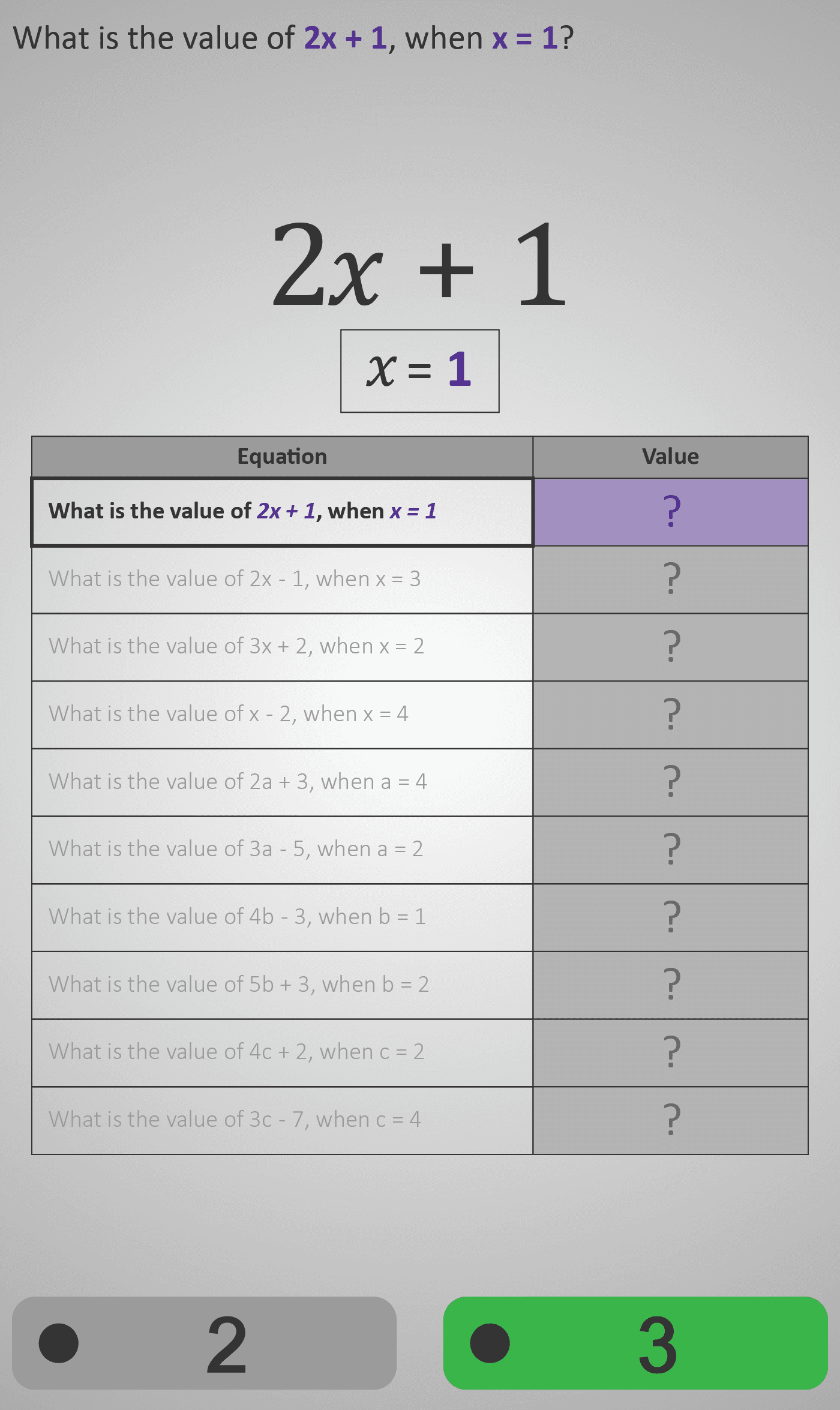
Learners begin with simple linear expressions such as 2x + 1 and are given a specific value for x (for example, x = 1).
They must calculate the corresponding result:
For 2x + 1 when x = 1, the answer is 3.
Step 2: Varying Expressions
The next screens build gradually:
2x − 1, when x = 3, gives 5.
3x + 2, when x = 2, gives 8.
Step 3: Introducing Other Variables
Each question is shown in a table that records previous answers, helping learners see patterns and track progress. The sequence later introduces different variables (a, b, c) with similar structures — for example, 4b − 3 or 5b + 3 — reinforcing generalisation and transfer across different letters.
By solving each in small, guided steps, students develop fluency in substitution, accuracy in arithmetic operations, and understanding of how algebraic expressions connect to numerical calculations.
Prerequisite Knowledge Required
- Linked Phlows: Visual Algebra 2A – understanding variables as symbols for numbers.
- Visual Algebra 2B – combining variables and constants using addition.
- Add & Sub 3 – recalling addition and subtraction facts.
- Algebra 3A – expanding brackets (distributive law foundation).
- Algebra 3B – factorising simple expressions.
Main Category
Algebra – Evaluating Expressions
Estimated Completion Time
Approx 8–12 seconds per question. 30 questions total. Total time: 4–6 minutes.
Cognitive Load / Step Size
Moderate — each question isolates one substitution operation. Repetition across similar equations strengthens recall and reduces cognitive effort, allowing focus on accurate calculation and symbol interpretation.
Language & Literacy Demand
Low — consistent question phrasing (“What is the value of… when x = …?”) builds familiarity. Key algebra terms (value, equation, variable) are reinforced visually and contextually.
Clarity & Design
Excellent — each equation is displayed clearly at the top, with the substitution shown in a boxed form (e.g., x = 2). The table layout tracks previous answers, allowing learners to see how the structure of the equation affects the result. Purple highlighting and consistent colour cues make the active variable and equation easy to follow.
Curriculum Alignment
Irish Curriculum Strand: Algebra – Expressions, Equations, and Relationships
- Substitute values for variables in algebraic expressions.
- Simplify expressions and compute their values accurately.
- Recognise the structure of simple algebraic forms and their numerical outputs.
- Develop fluency in arithmetic operations within algebraic contexts.
Engagement & Motivation
High — the visual table format gives a clear sense of progress and pattern recognition. Each new equation offers immediate feedback, promoting both understanding and confidence as learners see consistent success.
Error Opportunities & Misconceptions
- Replacing the variable incorrectly (e.g., substituting in the wrong place).
- Forgetting the order of operations (e.g., multiplying before adding).
- Confusing different variables (x, a, b, c).
The Phlow’s structured layout and single-step substitution questions reduce these risks and reinforce correct habits.
Transferability / Real-World Anchoring
High — substitution is a foundational skill used in all branches of mathematics, from geometry formulas to finance and physics. Understanding this principle prepares students for equations, functions, and data modelling.
Conceptual vs Procedural Balance
Balanced — learners practise the procedure of substitution repeatedly while developing the conceptual understanding that variables represent numbers that can change.
Learning Objectives Addressed
- Identify variables and substitute given values accurately.
- Perform basic arithmetic operations within algebraic expressions.
- Understand how changes in variable values affect expression outcomes.
- Build fluency and confidence in evaluating algebraic forms.
What Your Score Says About You
- Less than 5: Beginning to understand substitution — needs more practice identifying where to replace values.
- 6–7: Understands the process but may occasionally make calculation errors.
- 8–9: Consistently substitutes and calculates correctly.
- 10 / 10: Excellent understanding — confidently evaluates expressions across multiple variables.