
Algebra 3E
Overview
Introduces students to the essential algebraic process of simplifying expressions by combining like terms. The Phlow guides learners through identifying which terms can be grouped and how to rearrange an expression so it’s easier to work with.
Step 1: Rearranging Terms
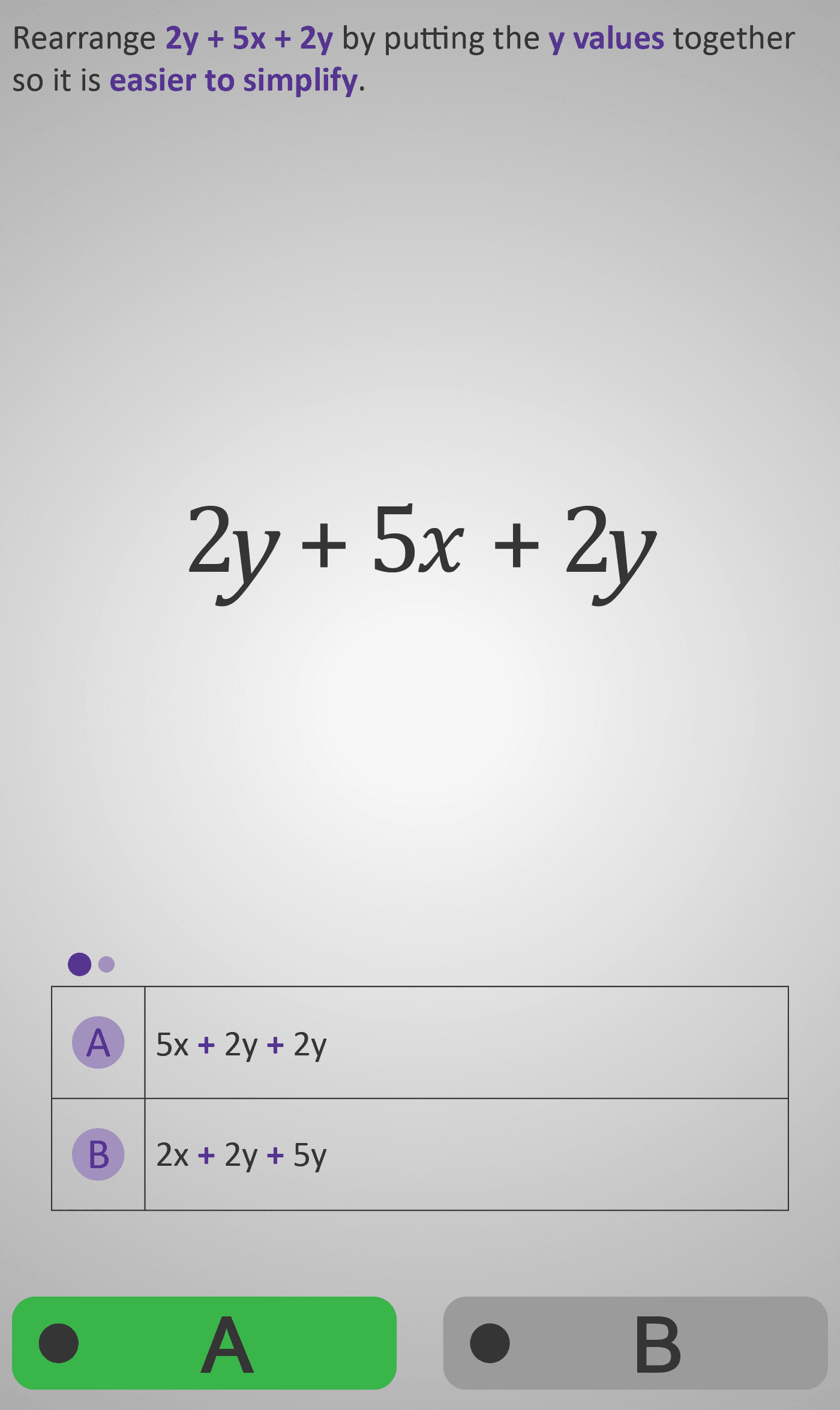
The activity begins with expressions like 2y + 5x + 2y, where students are asked to rearrange the terms to place the y-values together. They correctly choose 5x + 2y + 2y, making the structure clearer.
Step 2: Simplifying the Expression
The next step asks them to simplify it by adding the coefficients of the y terms:
5x + 2y + 2y = 5x + 4y.
Step 3: Introducing Negatives
Later screens introduce examples that include negative terms, such as 7x − 4y − 2x, where students must first rearrange the terms (7x − 2x − 4y) and then simplify them to 5x − 4y.
Each question uses visual cues to highlight the terms being combined, reinforcing the idea that only like variables can be added or subtracted. The process is broken into two clear phases — rearrange then simplify — ensuring conceptual clarity before procedural fluency.
By the end, learners can confidently collect like terms in both positive and negative contexts, understanding how simplification preserves equivalence while making expressions tidier and easier to use in future algebraic problems.
Prerequisite Knowledge Required
- Linked Phlows: Algebra 2A & 2B – introducing variables, coefficients, and addition of algebraic terms.
- Add & Sub 3 – accurate handling of positive and negative numbers.
- Algebra 3C – substituting values into single-variable expressions.
- Algebra 3D – substituting with two variables and expanding.
Main Category
Algebra – Simplifying and Rearranging Expressions
Estimated Completion Time
Approx 8–12 seconds per question. 30 questions total. Total time: 4–6 minutes.
Cognitive Load / Step Size
Moderate — the Phlow isolates each concept (first rearranging, then simplifying). Visual grouping and colour highlighting reduce the cognitive load, allowing students to internalise the concept of “like terms” gradually.
Language & Literacy Demand
Low — instructions are short, clear, and repetitive (“Rearrange...”, “Simplify...”). The phrase like terms is reinforced multiple times alongside examples for intuitive understanding.
Clarity & Design
Excellent — the step-by-step layout and use of purple highlights focus attention on the terms being combined. The sequence from rearrangement to simplification mirrors good mathematical practice, promoting structure and logical reasoning.
Curriculum Alignment
Irish Curriculum Strand: Algebra – Expressions, Equations, and Relationships
- Identify and collect like terms in algebraic expressions.
- Rearrange expressions logically to group similar variables.
- Add and subtract coefficients of identical variables correctly.
- Simplify expressions to more compact equivalent forms.
Engagement & Motivation
High — the combination of simple visuals, active reordering, and quick feedback makes each simplification feel like solving a mini-puzzle. Students gain visible progress with each correct simplification, promoting confidence.
Error Opportunities & Misconceptions
- Attempting to combine different variables (e.g., x and y terms).
- Ignoring negative signs when simplifying.
- Rearranging incorrectly or changing the order of terms inappropriately.
These are addressed visually through guided examples and targeted feedback, with consistent use of dashed boxes highlighting the focus terms.
Transferability / Real-World Anchoring
Moderate — collecting like terms underpins all further algebraic manipulation, including solving equations and simplifying formulas. The skill supports real-world reasoning involving multiple variables (e.g., costs, measurements, or quantities).
Conceptual vs Procedural Balance
Balanced — learners first understand the concept of “like terms” conceptually, then apply it procedurally through rearrangement and simplification across varied examples.
Learning Objectives Addressed
- Identify like and unlike terms in an expression.
- Rearrange expressions to make like terms adjacent.
- Add and subtract coefficients correctly when simplifying.
- Develop fluency and confidence in simplifying multi-term expressions.
What Your Score Says About You
- Less than 5: Beginning to recognise like terms — needs more practice rearranging and grouping correctly.
- 6–7: Understands the process but may mis-handle signs or order.
- 8–9: Consistently identifies and simplifies expressions accurately.
- 10 / 10: Excellent mastery — confidently rearranges and simplifies algebraic expressions with both positive and negative terms.