
Angles 3A
Overview
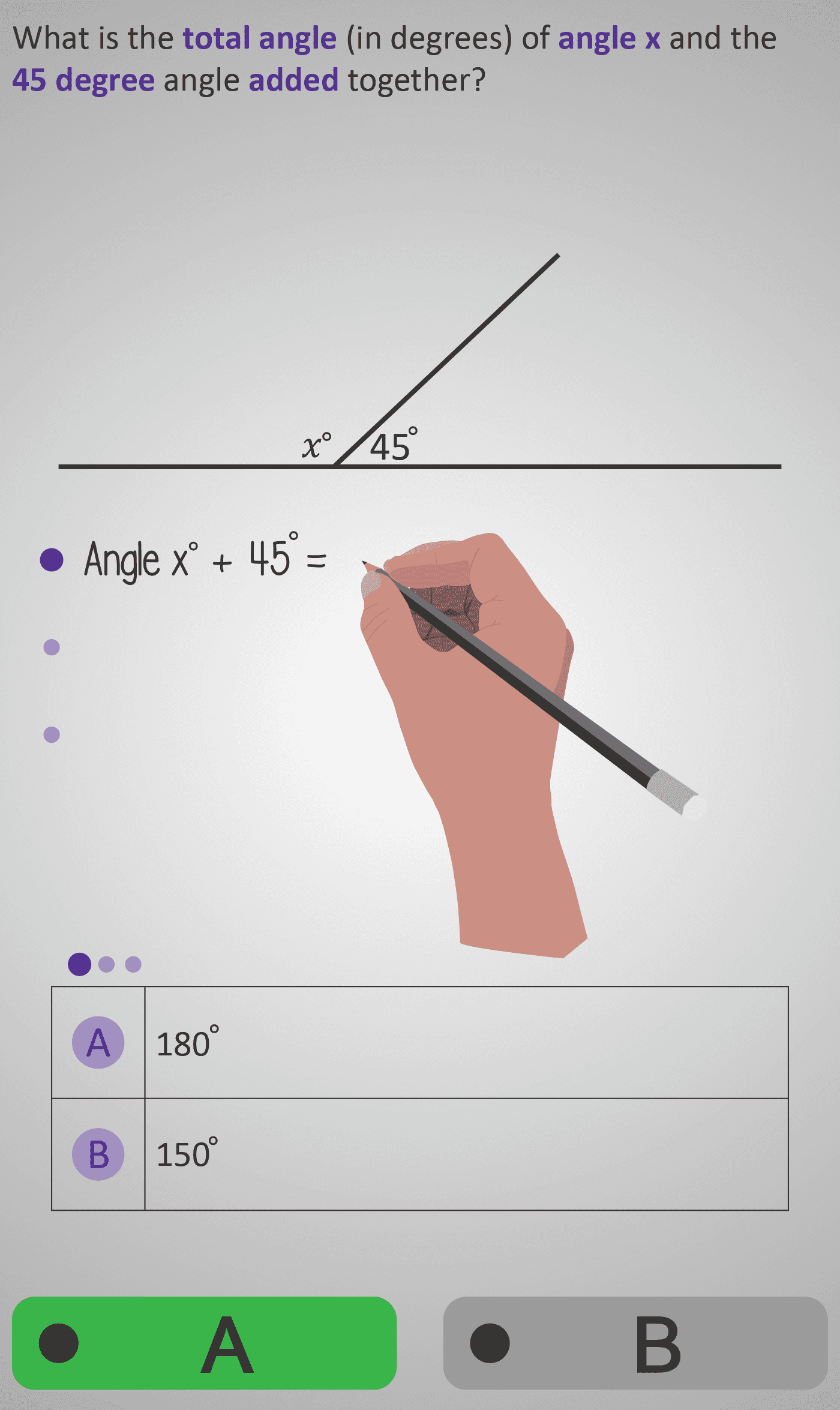
Introduces learners to the foundational geometry rule that angles on a straight line add up to 180°. Students first identify that x° + 45° = 180°, then rearrange this equation to isolate the unknown x°, applying the idea that when terms move across the equals sign, their sign changes.
Step-by-Step Process
Learners then compute:
x° = 180° − 45° = 135°
Through clear visuals and minimal text, the Phlow walks learners through each algebraic and geometric step, building understanding of both the concept (angle sum) and the procedure (rearranging equations). The sequence visually links measurement, equality, and subtraction in a real geometric context.
Prerequisite Knowledge Required
- Angles 2C – Identifying Right and Straight Angles.
- Equations 2A – Understanding the Equals Sign.
- Add 2B – Subtracting Numbers Within 180°.
Main Category
Geometry – Angles and Linear Relationships
Estimated Completion Time
Approx. 8–12 seconds per question (30 questions total). Total Time: 4–6 minutes.
Cognitive Load / Step Size
Moderate — the sequence is scaffolded: first recall the rule, then apply it, then rearrange and calculate. Each step builds directly on the last, maintaining flow and avoiding overload.
Language & Literacy Demand
Low — questions use short, direct sentences (“Find the value of angle x”). The visuals (angles labelled x° and 45°) clearly support comprehension. Students with weaker literacy can still access meaning through the diagram.
Clarity & Design
Strong visual clarity — bold black angle lines and minimal colour distractions. The use of a handwriting animation reinforces procedural thinking, showing each line of reasoning as a visible process. Purple highlights guide focus to key steps and options.
Curriculum Alignment
Irish Junior Cycle Mathematics:
- Strand 3: Geometry and Trigonometry – Learning Outcome 3.5: “Investigate the relationships between angles formed by intersecting lines and parallel lines.”
- Also aligns with Strand 2: Algebra – rearranging simple equations.
Engagement & Motivation
The realistic “hand writing the solution” animation makes the learning feel interactive and human. The sequence gives immediate visual reward as learners see progress unfold, sustaining engagement and confidence.
Error Opportunities & Misconceptions
- Forgetting that angles on a straight line equal 180°.
- Adding instead of subtracting when rearranging.
- Confusing which side of the line the unknown angle belongs to.
Transferability / Real-World Anchoring
High — directly transferable to problems involving parallel lines, triangles, and polygons. Understanding angle relationships also supports later topics like bearings and construction.
Conceptual vs Procedural Balance
Balanced — learners understand why the total is 180° (concept) while practising how to rearrange and calculate (procedure).
Learning Objectives Addressed
- Recall that angles on a straight line sum to 180°.
- Form and rearrange simple angle equations.
- Solve for an unknown angle by subtraction.
- Interpret angle diagrams accurately using algebraic reasoning.
What Your Score Says About You
- Less than 5: Review how to form equations for straight-line angles. Revisit Angles 2C.
- 6–7: Understands the 180° rule but may mix up addition and subtraction.
- 8–9: Correctly solves for missing angles using subtraction.
- 10 / 10: Excellent — can form, rearrange, and solve angle equations with full understanding.