
Angles 3B
Overview
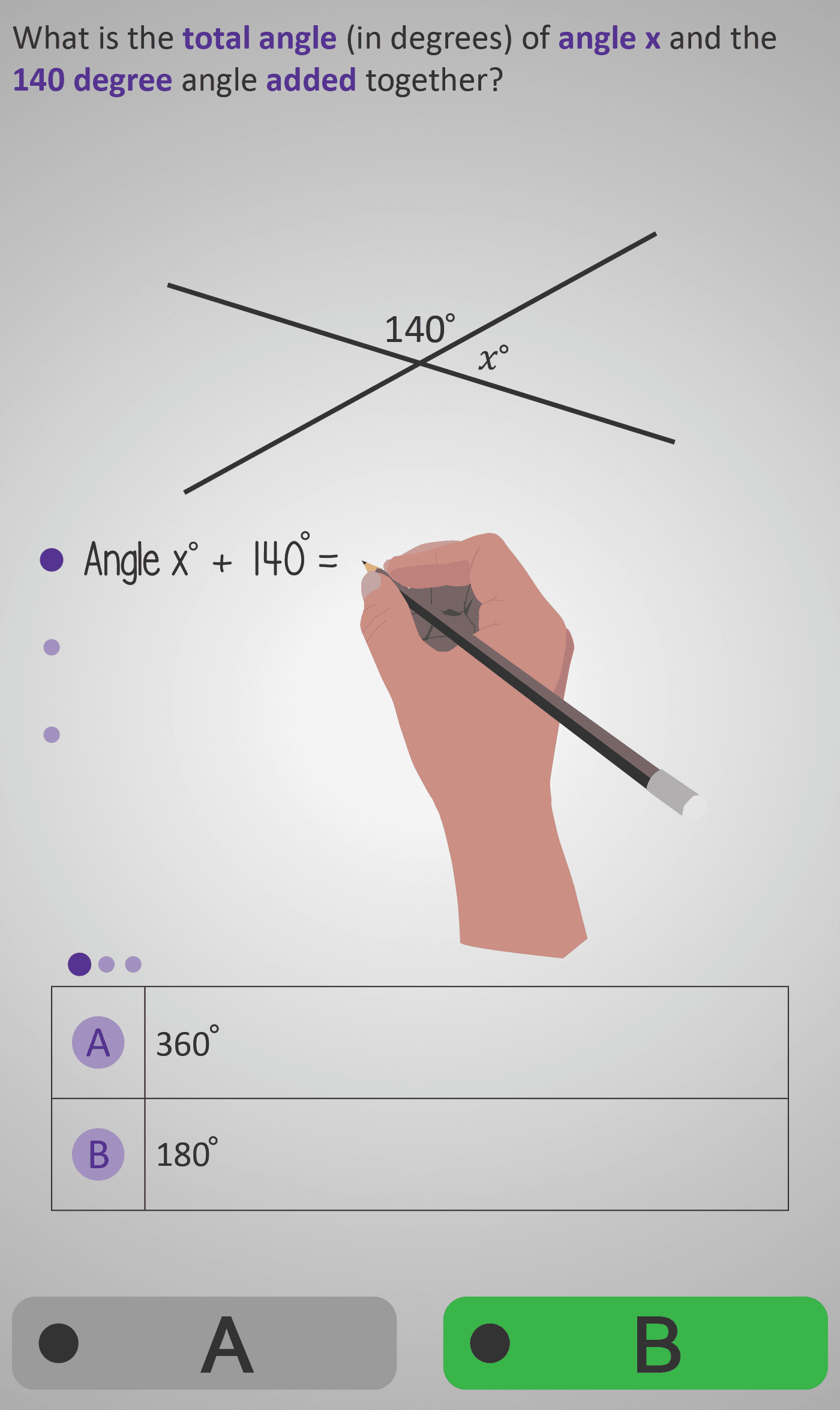
This Phlow guides learners through calculating a missing adjacent angle formed by intersecting straight lines. The example begins with x° + 140° = 180°, showing how the total of two angles on a straight line equals 180°.
Students then isolate the unknown by moving the known value across the equals sign, changing its sign from addition to subtraction:
x° = 180° − 140°
Finally, they compute x° = 40°.
The sequence visualises every reasoning step with a hand writing each line, reinforcing how both geometric understanding and algebraic manipulation combine to solve for unknowns. It connects abstract rules to visible, logical movement on screen — supporting conceptual clarity and procedural fluency.
Prerequisite Knowledge Required
- Angles 3A – Finding Angles on a Straight Line (Simpler Values).
- Equations 2B – Rearranging Simple Expressions.
- Add 2C – Subtracting Within 180°.
Main Category
Geometry – Angles and Linear Relationships
Estimated Completion Time
Approx. 8–12 seconds per question (30 questions total). Total Time: 4–6 minutes.
Cognitive Load / Step Size
Moderate — each question builds directly on Angles 3A but introduces slightly larger or less tidy numbers, ensuring steady progression without overload. The visual cue of balancing the equation anchors abstract reasoning in a clear and logical sequence.
Language & Literacy Demand
Low — text is concise and action-based (“Find the value of angle x”), and visuals carry the main meaning. Terms like value, equals sign, and known angle are reinforced contextually, aiding comprehension even for weaker readers.
Clarity & Design
Excellent clarity — the handwriting animation and bold, simple diagrams minimise distraction. Consistent purple and black colour coding reinforces key components: known angle, unknown angle, and the rule applied. The minimal layout keeps full focus on reasoning steps.
Curriculum Alignment
Irish Junior Cycle Mathematics:
- Strand 3: Geometry and Trigonometry – Learning Outcome 3.5: “Investigate the relationships between angles formed by intersecting lines and parallel lines.”
- Also supports Strand 2: Algebra – isolating unknowns.
Engagement & Motivation
The act of following a “worked example in motion” creates a sense of discovery and control. The visuals replicate a teacher’s demonstration, maintaining engagement as learners anticipate each reasoning step and result.
Error Opportunities & Misconceptions
- Forgetting that adjacent angles on a straight line add to 180°, not 360°.
- Reversing the subtraction (doing 140° − 180° instead of 180° − 140°).
- Confusing vertically opposite and adjacent angles.
Transferability / Real-World Anchoring
Strong — directly applicable to geometry problems involving polygons, parallel lines, and construction drawings. Reinforces proportional reasoning and algebraic problem-solving.
Conceptual vs Procedural Balance
Balanced — learners first confirm the conceptual rule (sum = 180°), then practise the procedural rearrangement. Understanding why subtraction works is embedded through guided demonstration.
Learning Objectives Addressed
- Recognise that adjacent angles on a straight line sum to 180°.
- Form and rearrange an angle equation to isolate the unknown.
- Calculate the missing angle using subtraction.
- Apply reasoning consistently to different intersecting line configurations.
What Your Score Says About You
- Less than 5: Revisit the 180° straight-line rule and practise setting up equations correctly.
- 6–7: Understands the rule but may mix up addition/subtraction when rearranging.
- 8–9: Accurately forms and solves equations for missing angles.
- 10 / 10: Excellent — understands both the geometry and algebraic reasoning behind straight-line angles.