
Angles 3C
Overview
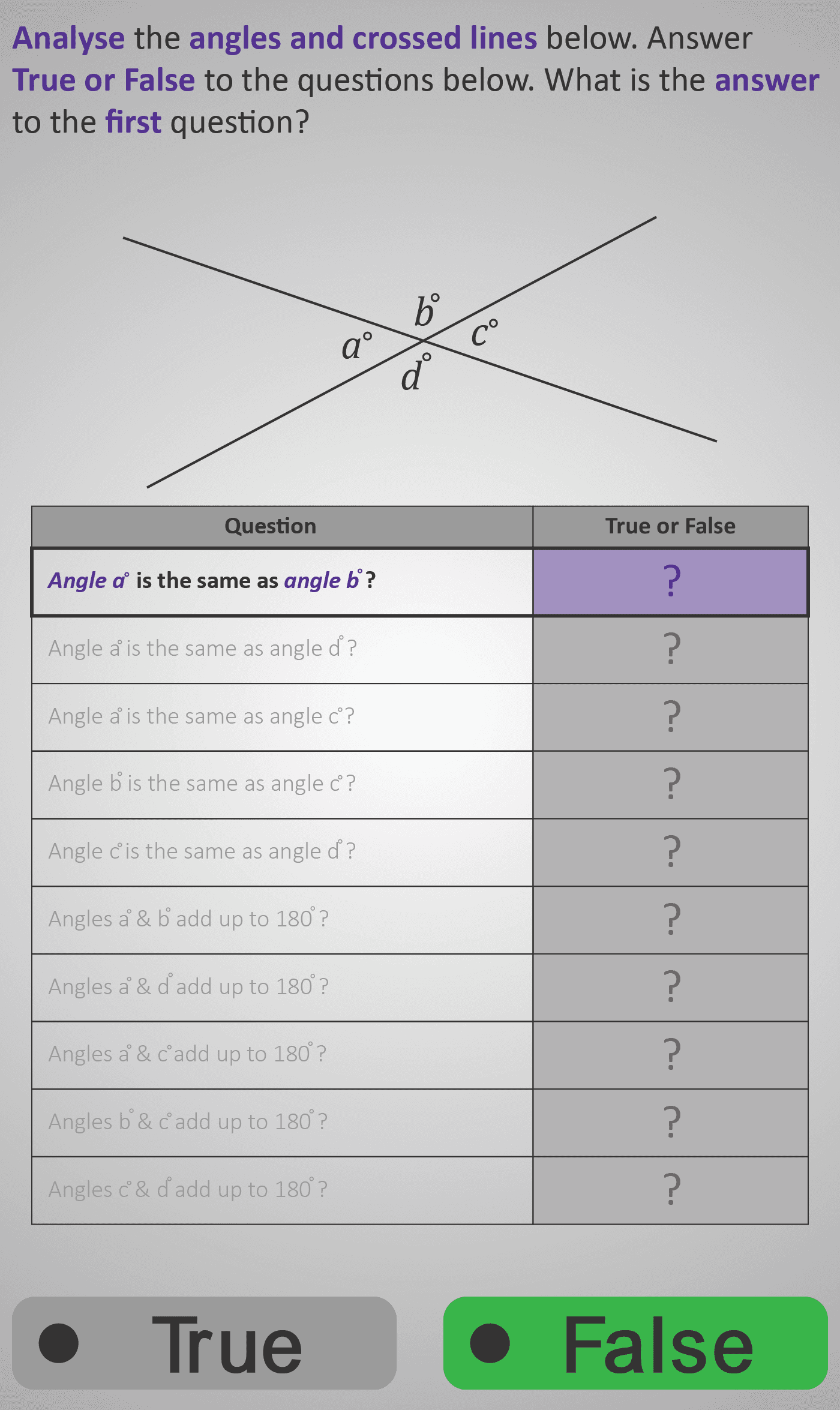
This Phlow deepens learners’ understanding of intersecting lines and the relationships between the four angles they form. The activity uses a True/False table to guide discovery: students examine which angles are equal (vertically opposite) and which add to 180° (adjacent on a straight line).
Through step-by-step questioning, learners see that opposite angles — like a° and c°, or b° and d° — are equal, while adjacent angles — such as a° + b° — form a straight line and therefore sum to 180°.
The exercise trains pattern recognition and geometric reasoning, helping students distinguish between equal and supplementary relationships. This Phlow builds fluency through visual logic rather than memorisation, strengthening students’ ability to interpret angle diagrams accurately.
Prerequisite Knowledge Required
- Angles 3A – Angles on a Straight Line (180° Rule).
- Angles 3B – Adjacent Angles and Rearranging Equations.
- Shapes 2C – Naming Angles and Intersecting Lines.
Main Category
Geometry – Angles and Line Relationships
Estimated Completion Time
Approx. 8–12 seconds per question (30 questions total). Total Time: 4–6 minutes.
Cognitive Load / Step Size
Moderate — each True/False question isolates one relationship, reducing complexity. The repetitive pattern builds automaticity while keeping cognitive effort manageable. Conceptual comparisons (equal vs. supplementary) maintain interest and flow.
Language & Literacy Demand
Low to Moderate — while the format is text-based, phrasing is simple (“Angle a° is the same as angle b°?”). The visual layout (angle labels on diagram plus table) provides strong contextual support for reading comprehension.
Clarity & Design
Highly effective visual design — the intersecting-line diagram is simple, symmetrical, and labelled clearly with a°, b°, c°, and d°. The True/False grid makes reasoning explicit, and colour-coded highlights direct attention to the active question. Green and purple buttons reinforce engagement and clarity.
Curriculum Alignment
Irish Junior Cycle Mathematics:
- Strand 3: Geometry and Trigonometry – Learning Outcome 3.5: “Investigate the relationships between angles formed by intersecting lines and parallel lines.”
- Also supports Strand 2: Algebra – logical equivalence and comparison.
Engagement & Motivation
The True/False structure introduces an element of gamified testing. Students receive quick feedback and visible progression through each pair of angles, creating a sense of discovery and mastery.
Error Opportunities & Misconceptions
- Believing all opposite angles add to 180° rather than being equal.
- Confusing adjacent with opposite angles.
- Overlooking which pairs share a straight line.
Transferability / Real-World Anchoring
Strong — recognising equal and supplementary angles applies directly to geometry, design, construction, and engineering contexts where intersecting lines appear frequently (e.g., bridges, road junctions, architectural drawings).
Conceptual vs Procedural Balance
Conceptual emphasis — rather than performing calculations, students reason about relationships. This strengthens conceptual understanding before procedural computation in later Phlows (e.g., angles in polygons or parallel lines).
Learning Objectives Addressed
- Identify vertically opposite angles as equal.
- Recognise that adjacent angles on a straight line add to 180°.
- Distinguish between equal and supplementary angle pairs.
- Develop reasoning skills using visual angle relationships.
What Your Score Says About You
- Less than 5: Mixing up equal and supplementary angles — revisit Angles 3A and 3B.
- 6–7: Understands some relationships but needs more practice identifying opposites.
- 8–9: Can correctly reason through most intersecting-line relationships.
- 10 / 10: Excellent — fully understands how vertically opposite and adjacent angles relate.