
Angles 3D
Overview
This Phlow introduces learners to the defining features of isosceles triangles. Using clear visuals and step-by-step questioning, students learn that an isosceles triangle has two sides of equal length and two equal base angles.
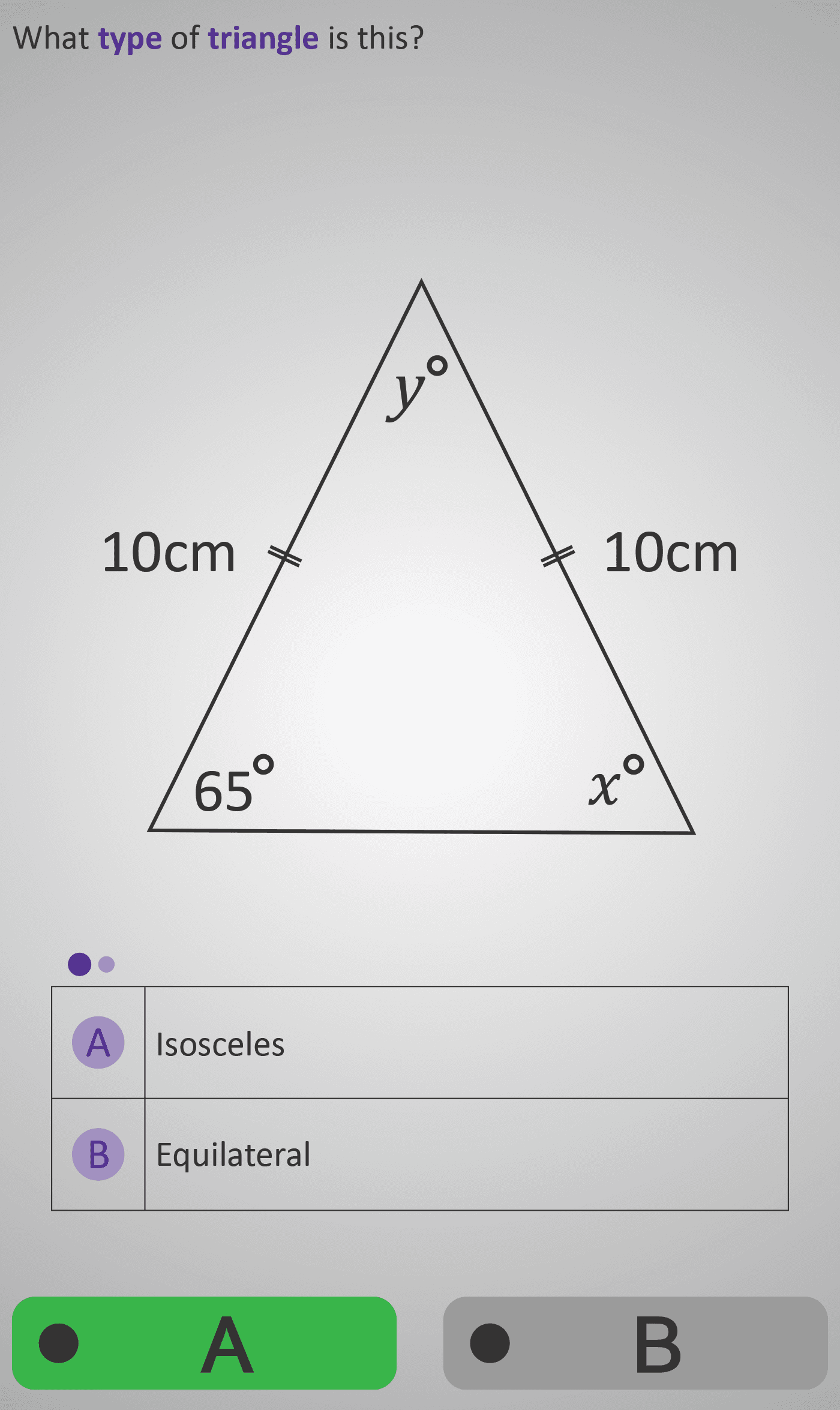
The activity begins with recognising equal sides (both 10 cm), then moves to reasoning about equal angles — for instance, identifying that 65° = x° because they sit opposite the equal sides. Learners also recall that all triangle angles add up to 180°.
By alternating between visual recognition (“What type of triangle is this?”) and structured table questions (“How many sides are equal in length?”), this Phlow builds confidence in distinguishing isosceles from equilateral and scalene triangles while reinforcing core geometric rules.
Prerequisite Knowledge Required
- Angles 2B – Triangle Basics: Angle Sum = 180°.
- Measure 2C – Measuring Angles and Sides.
- Shapes 2B – Types of Triangles.
- Angles 3A – Angles on a Straight Line (optional refresher).
Main Category
Geometry – Angles & Triangles
Estimated Completion Time
Approx. 8–12 seconds per question (30 questions total). Total Time: 4–6 minutes.
Cognitive Load / Step Size
Low to Moderate — each question isolates one fact (sides, angles, or classification), allowing smooth progression from recognition to reasoning. The repetition strengthens understanding without overloading working memory.
Language & Literacy Demand
Low — questions use short, direct phrasing (“How many sides are equal?”) with consistent terminology. Visual cues such as tick marks and degree symbols reduce reading load and help anchor meaning for all learners.
Clarity & Design
The diagram is crisp, symmetrical, and labelled simply with 10 cm, 65°, x°, and y°. The use of matching side markers clarifies equality visually. The two-tone purple interface separates question and answer zones, keeping attention on reasoning.
Curriculum Alignment
Irish Junior Cycle Mathematics:
- Strand 3: Geometry and Trigonometry – Learning Outcome 3.7: “Investigate the properties of triangles and quadrilaterals.”
- Also supports Strand 1: Number – reinforcing angle addition and equality concepts.
Engagement & Motivation
The quiz format makes abstract geometry tangible. Students feel like they are “discovering” properties through reasoning rather than memorising definitions, maintaining curiosity and flow.
Error Opportunities & Misconceptions
- Confusing isosceles with equilateral (thinking all sides are equal).
- Forgetting that base angles — not the vertex angle — are equal.
- Adding angles incorrectly or mislabelling which sides correspond.
Transferability / Real-World Anchoring
Strong — recognising isosceles structures is useful in architecture, engineering, and design (e.g., roof trusses, bridges, and mirrors). Linking equal measures to symmetry supports wider geometric reasoning.
Conceptual vs Procedural Balance
Conceptual emphasis with light procedural reinforcement. Learners understand why two sides and two angles are equal before classifying or calculating.
Learning Objectives Addressed
- Identify that an isosceles triangle has two equal sides.
- Recognise that equal sides produce equal opposite angles.
- Recall that the three angles of a triangle add up to 180°.
- Distinguish between isosceles, equilateral, and scalene triangles.
What Your Score Says About You
- Less than 5: Review how side lengths relate to equal angles — revisit Shapes 2B.
- 6–7: Understands the main properties but sometimes confuses triangle types.
- 8–9: Strong grasp of isosceles triangles and their symmetry.
- 10 / 10: Excellent — can identify and explain isosceles triangles with confidence.