
Angles 3E
Overview
This Phlow introduces learners to reading angles directly from a protractor, building a bridge between visual geometry and numeric measurement. Through interactive examples, students practise aligning the protractor’s centre point with the triangle’s vertex and using the correct numbered scale.
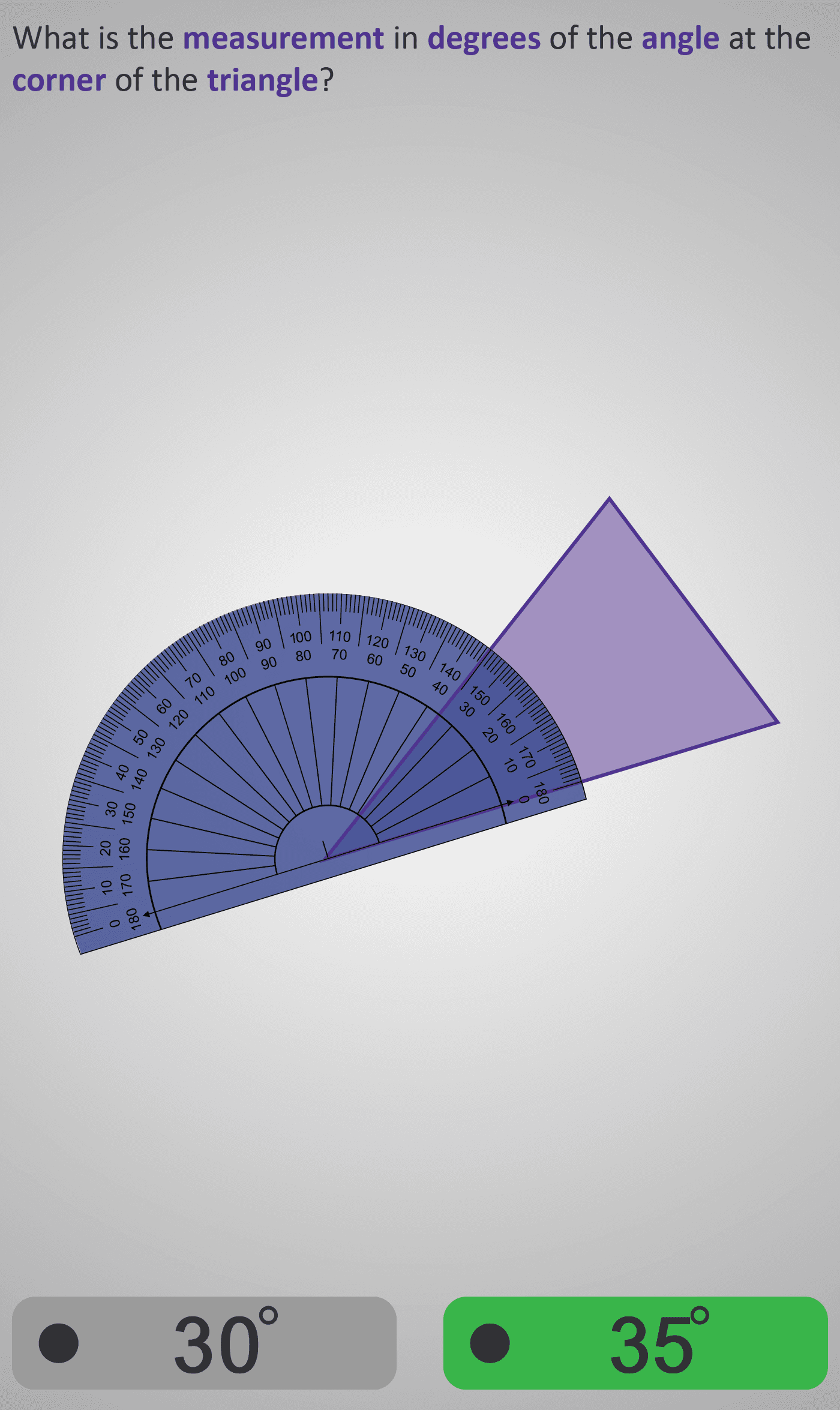
Each screen presents a triangle with a different orientation, prompting the learner to read and select the correct angle measurement (e.g., 35°, 70°, 75°). By showing both the protractor and the angle together, learners develop spatial awareness of how angles open and how to choose the correct direction on the scale.
The activity reinforces precision, estimation, and attention to geometric detail — essential foundations for later work in shape construction, parallel lines, and trigonometry.
Prerequisite Knowledge Required
- Angles 2C – Recognising Acute, Right, and Obtuse Angles.
- Measure 2D – Understanding Degrees as Units of Rotation.
- Shapes 2A – Identifying Corners and Vertices.
- Angles 3D – Understanding Equal and Total Angles in Triangles (optional connection).
Main Category
Geometry – Measurement of Angles
Estimated Completion Time
Approx. 8–12 seconds per question (30 questions total). Total Time: 4–6 minutes.
Cognitive Load / Step Size
Low to Moderate — each question isolates a single visual skill: reading an angle on a protractor. The progression introduces angles in varied orientations to sustain engagement while maintaining visual clarity and manageable cognitive demand.
Language & Literacy Demand
Low — text is concise and instruction-driven (“What is the measurement in degrees of the angle at the corner of the triangle?”). Numerical answers are supported by visual cues, ensuring accessibility even for learners with lower literacy levels.
Clarity & Design
Excellent visual clarity — the protractor and triangle are colour-coded in contrasting purples, with bold degree marks and clear alignment points. The interface draws the eye to the vertex, ensuring accurate focus on the reading task. Minimal text maximises attention on the geometric skill.
Curriculum Alignment
Irish Junior Cycle Mathematics:
- Strand 3: Geometry and Trigonometry – Learning Outcome 3.6: “Measure and construct angles and triangles using appropriate instruments.”
- Also supports Strand 2: Measures – reinforcing degrees and measurement accuracy.
Engagement & Motivation
The use of a real-world tool (the protractor) creates a strong sense of applied learning. Each question provides instant feedback, giving students confidence as they improve accuracy. The variety of triangle positions keeps the task active and enjoyable.
Error Opportunities & Misconceptions
- Reading the wrong scale (inner vs outer).
- Misplacing the protractor’s centre on the vertex.
- Starting from 0° on the wrong side of the baseline.
Each of these common errors is implicitly addressed through visual repetition and reinforcement.
Transferability / Real-World Anchoring
High — protractor use is a practical skill relevant in design, carpentry, architecture, and engineering. Learners also develop foundational skills for coordinate geometry and trigonometric problem-solving.
Conceptual vs Procedural Balance
Procedural emphasis with conceptual support — students learn how to measure (procedure) while reinforcing what an angle represents (concept).
Learning Objectives Addressed
- Accurately measure and identify angles using a protractor.
- Select the correct reading scale (inner or outer) depending on orientation.
- Distinguish between acute, obtuse, and right angles based on degree size.
- Develop precision and confidence in geometric measurement.
What Your Score Says About You
- Less than 5: You may be reading the wrong scale — review how to align the protractor’s centre and baseline.
- 6–7: Understands angle measurement but needs more practice identifying where to start reading.
- 8–9: Measures most angles accurately and recognises acute vs obtuse quickly.
- 10 / 10: Excellent — confidently uses a protractor to measure any angle.