
Angles 3F
Overview
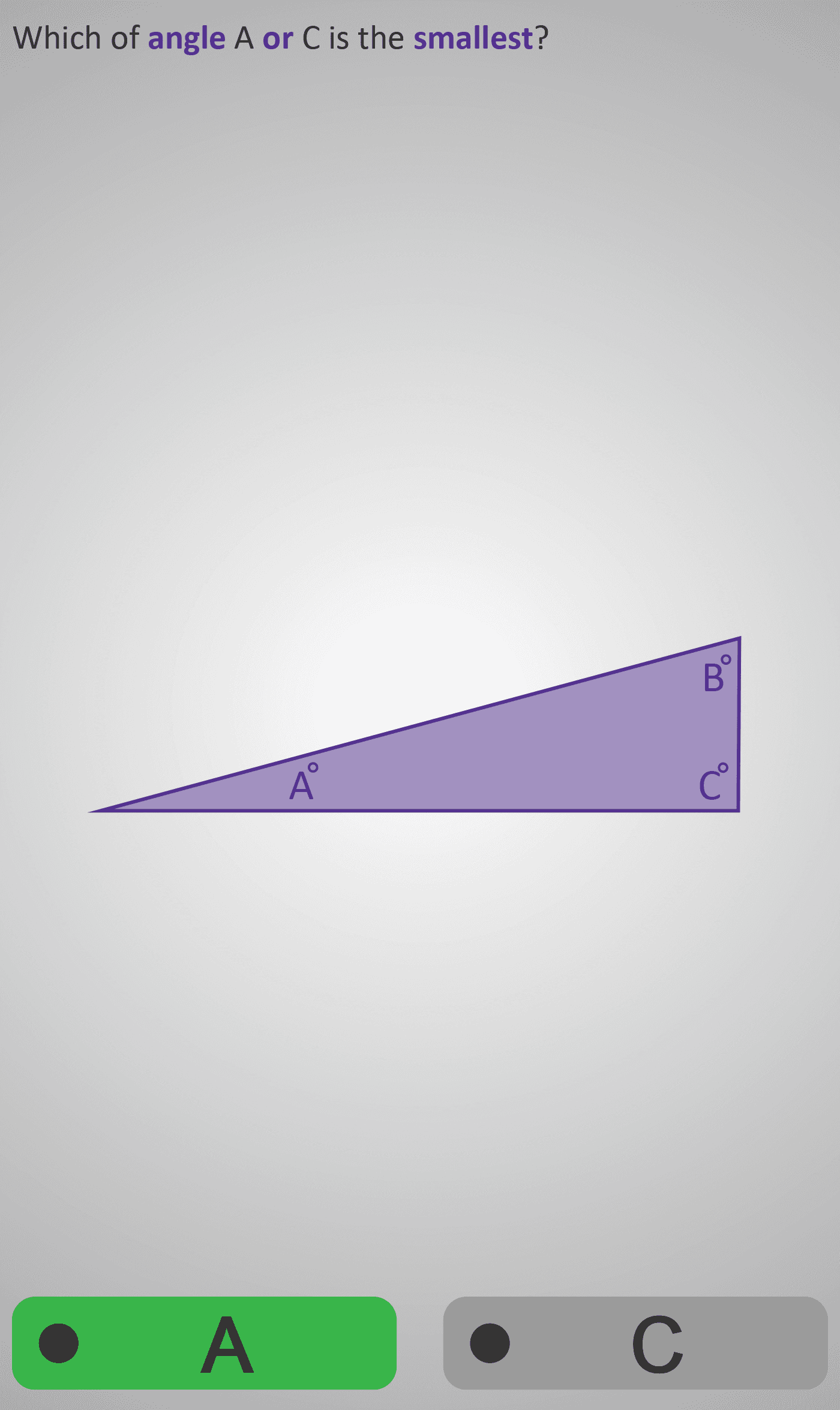
This Phlow helps learners develop geometric intuition by comparing angles visually within a triangle. Each question shows a labelled triangle (A°, B°, C°) and asks students to decide which angle is smallest or largest. By varying the triangle’s shape and orientation, the activity trains learners to estimate and reason about angle magnitude without measuring tools.
Students learn that the largest angle lies opposite the longest side, and the smallest angle lies opposite the shortest side. Through repeated comparison, they begin to recognise acute, right, and obtuse angles by sight — building the perceptual foundation needed for later work in angle calculation, triangle classification, and trigonometric reasoning.
Prerequisite Knowledge Required
- Angles 2C – Recognising and Naming Acute, Right, and Obtuse Angles.
- Angles 3E – Measuring Angles Using a Protractor.
- Shapes 2B – Understanding Sides, Corners, and Vertices of Triangles.
- Angles 3D – Isosceles Triangle Properties (optional link).
Main Category
Geometry – Angles & Triangles
Estimated Completion Time
Approx. 8–10 seconds per question (30 questions total). Total Time: 4–5 minutes.
Cognitive Load / Step Size
Low — the task isolates one visual skill: comparing relative angle sizes. Variation across examples maintains engagement while reinforcing proportional reasoning. Each decision reinforces internal benchmarks of angle size and visual estimation.
Language & Literacy Demand
Low — phrasing is simple (“Which of angle A or C is the smallest?”). Visual cues are dominant, and comprehension depends mainly on perception rather than reading, making it accessible to learners of all literacy levels.
Clarity & Design
Strong visual clarity — each triangle is shaded uniformly in purple with labelled corners (A°, B°, C°). The clean layout and colour contrast direct focus effectively to the geometry, supporting accurate visual comparison.
Curriculum Alignment
Irish Junior Cycle Mathematics:
- Strand 3: Geometry and Trigonometry – Learning Outcome 3.7: “Investigate the relationships between sides and angles in triangles.”
- Supports visual reasoning for Strand 2: Measures and foundational trigonometry topics.
Engagement & Motivation
The visual comparison format is intuitive and game-like. Alternating “largest/smallest” prompts encourage active scanning and mental estimation, keeping learners engaged and reinforcing understanding without calculation.
Error Opportunities & Misconceptions
- Assuming side length and angle size are unrelated.
- Misjudging angle size based on triangle orientation.
- Confusing largest angle with longest side without recognising their relationship.
These misconceptions are addressed through varied triangle orientations and reinforcement of visual reasoning principles.
Transferability / Real-World Anchoring
Strong — recognising relative angle sizes supports spatial reasoning in navigation, design, and engineering. It also underpins future applications involving bearings, scale drawings, and trigonometry.
Conceptual vs Procedural Balance
Conceptual focus — this Phlow emphasises relationships and visual geometry rather than numeric calculation. It lays a vital conceptual foundation before introducing measurement or proofs.
Learning Objectives Addressed
- Identify and compare the sizes of angles in a triangle by sight.
- Understand that the largest angle lies opposite the longest side.
- Recognise that acute angles are smaller than right or obtuse angles.
- Develop geometric intuition for triangle classification.
What Your Score Says About You
- Less than 5: You may be misjudging angle sizes — revisit how triangle sides and angles relate.
- 6–7: You can identify some angle comparisons but need more visual practice.
- 8–9: You can consistently recognise smallest and largest angles visually.
- 10 / 10: Excellent — strong visual understanding of triangle geometry.