
Area 3A
Overview
This Phlow introduces learners to the concept of area as the measure of surface space.
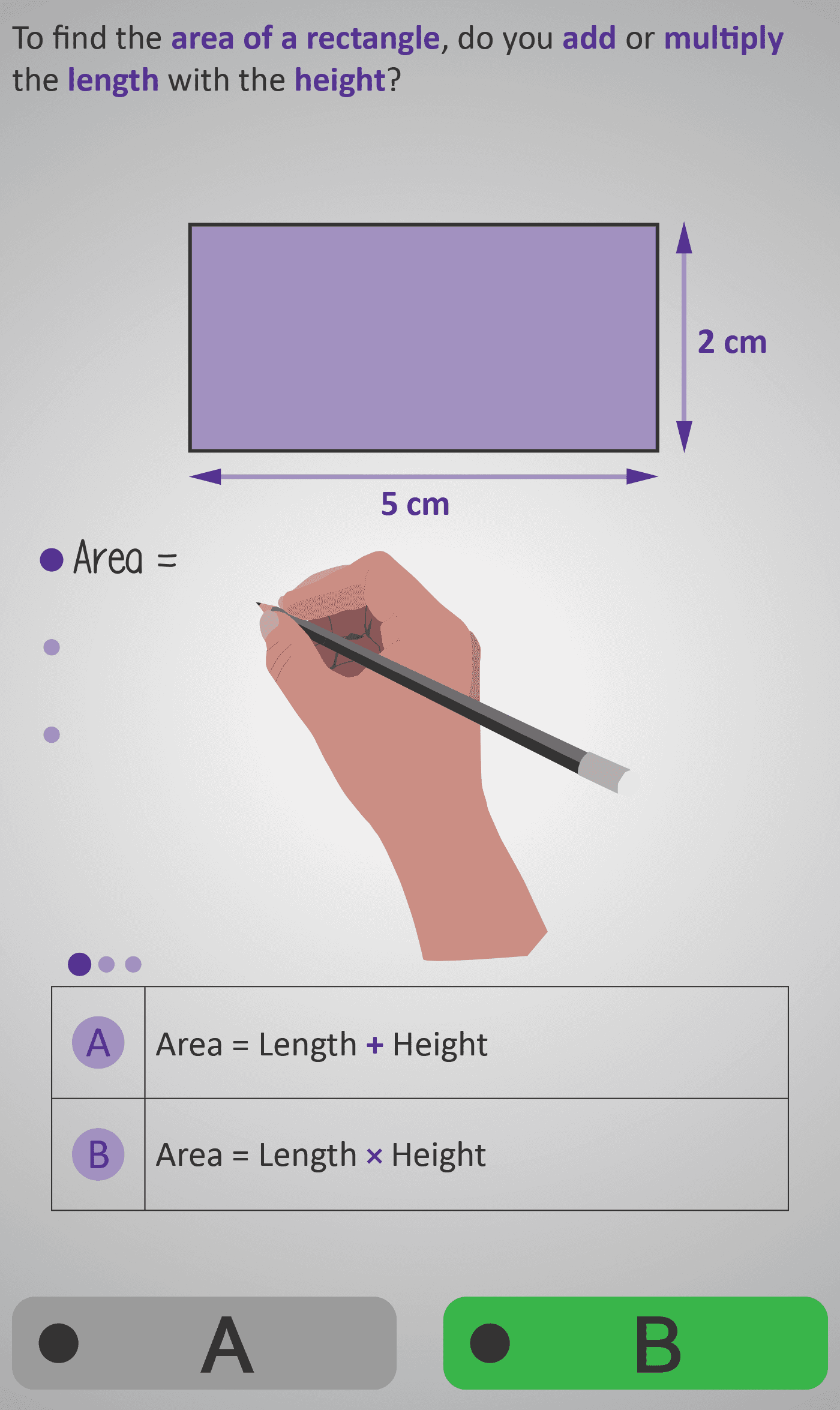
Focusing on rectangles, students discover that area is found by multiplying the length and height
rather than adding them. The example uses clear numbers — 5 cm and 2 cm — to guide learners step-by-step through the formula:
Area = Length × Height.
Students are prompted to select the correct operation (× instead of +), identify the correct pair of dimensions (5 × 2), and then calculate the total area (10 cm²). The gradual questioning approach reinforces both procedural understanding (how to calculate) and conceptual understanding (why area involves multiplication).
By the end, learners understand that area counts how many 1 cm² squares fit into a rectangle and that the unit is always in square centimetres. This sets the foundation for later topics like triangles, composite areas, and real-world measurement.
Prerequisite Knowledge Required
- Number 2B – Understanding multiplication as repeated addition.
- Measure 2A – Understanding length and height units (cm, m).
- Shapes 2B – Recognising rectangles and squares.
Main Category
Measurement – Area & Perimeter
Estimated Completion Time
Approx. 8–10 seconds per question (30 questions total). Total Time: 4–5 minutes.
Cognitive Load / Step Size
Low — each screen isolates a single part of the concept: choosing the correct operation, identifying correct dimensions, and performing the calculation. Simple visuals and consistent numbers reduce extraneous load, allowing full focus on conceptual mastery.
Language & Literacy Demand
Low — questions use short, clear language (“Do you add or multiply the length with the height?”). The repetition of key mathematical terms — area, length, height, multiply — reinforces literacy through context.
Clarity & Design
The layout is clear and instructional. The rectangle is shaded in purple with bold dimension labels (5 cm, 2 cm). The accompanying hand graphic adds a relatable touch and guides the learner’s eye through the written formula. Consistent visual cues (colours, arrows, and units) support intuitive understanding.
Curriculum Alignment
Irish Junior Cycle Mathematics:
- Strand 2 – Measures – Learning Outcome 2.6: “Calculate the area of regular shapes and use appropriate units.”
- Supports Strand 1 – Number by reinforcing multiplication in real contexts.
Engagement & Motivation
Learners build confidence through immediate feedback — each question confirms the link between formula and meaning. The real-world familiarity of rectangles helps students feel competent and successful early on.
Error Opportunities & Misconceptions
- Adding instead of multiplying the dimensions.
- Forgetting to include units (cm²).
- Reversing dimensions or misreading height as width.
The scaffolded question order anticipates and corrects these common misconceptions.
Transferability / Real-World Anchoring
High — area measurement is central to everyday tasks like flooring, painting, and garden design. This Phlow develops practical problem-solving skills grounded in real-world application.
Conceptual vs Procedural Balance
Balanced — learners grasp both the reasoning (why area uses square units) and the process (how to apply the formula). This conceptual grounding supports transfer to irregular or compound shapes later.
Learning Objectives Addressed
- Understand that area measures surface space in square units.
- Apply the formula Area = Length × Height for rectangles.
- Multiply correctly with given dimensions and include appropriate units.
- Distinguish between addition (perimeter) and multiplication (area).
What Your Score Says About You
- Less than 5: You might be mixing up area and perimeter — review the difference between adding and multiplying.
- 6–7: You understand the steps but sometimes miss the correct operation or units.
- 8–9: You can confidently find the area of rectangles and know the meaning of cm².
- 10 / 10: Excellent — you fully understand how to calculate and describe area accurately.