
Area 3C
Overview
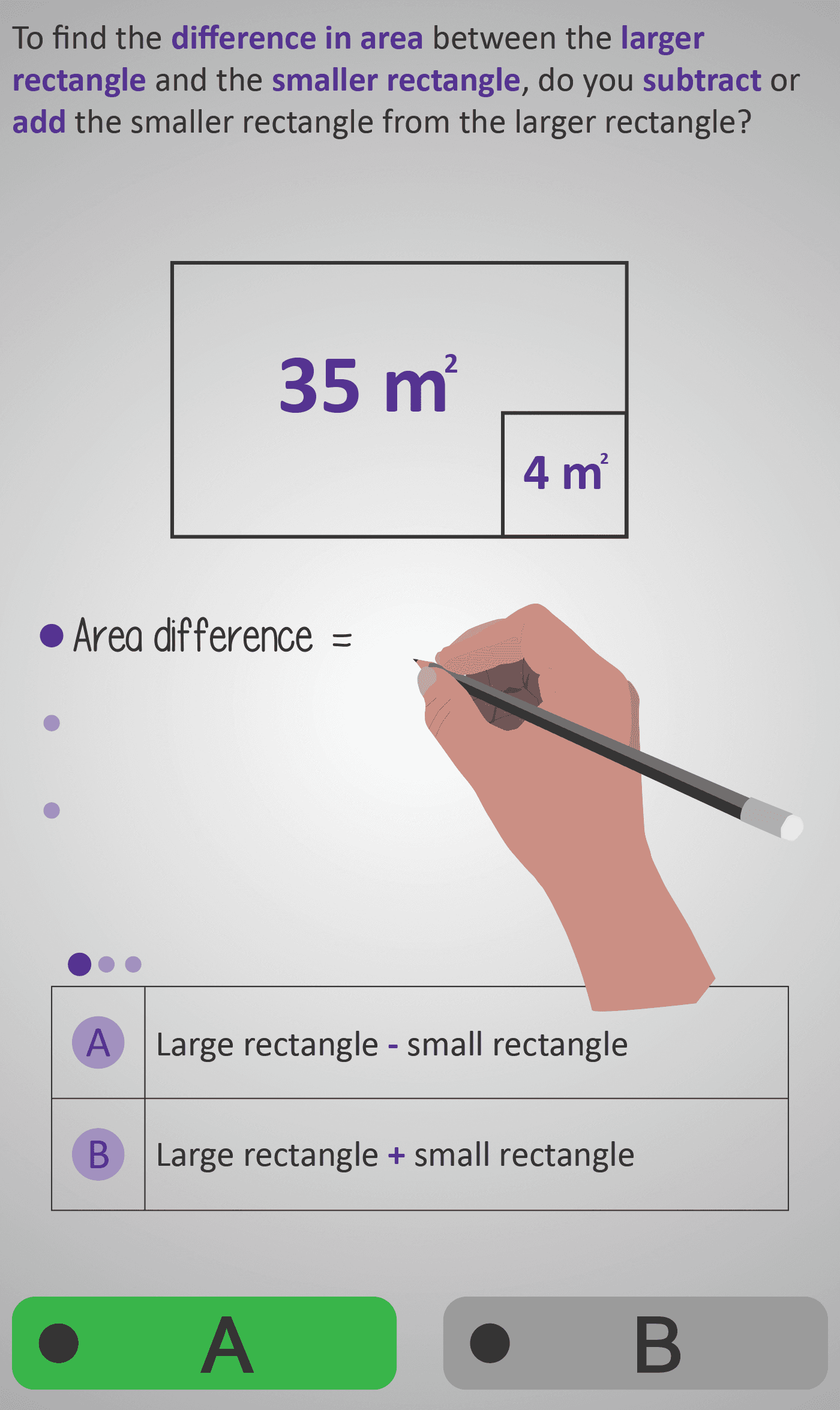
This Phlow develops learners’ understanding of how subtraction applies to area measurement. Students are shown a large rectangle and a smaller one inside it, with their respective areas clearly labelled (e.g., 35 m² and 4 m²). They are asked whether to add or subtract the smaller rectangle’s area from the larger one, then guided step-by-step through the calculation:
Area Difference = 35 − 4 = 31 m²
This visual and numerical process reinforces the concept that difference means finding how much one quantity exceeds another. The sequence moves from conceptual understanding (what “difference in area” means) to procedural fluency (carrying out subtraction correctly).
By connecting arithmetic to geometry, students see how operations model real-world problems such as finding leftover material, paint coverage gaps, or remaining floor space. This strengthens both mathematical reasoning and applied understanding.
Prerequisite Knowledge Required
- Area 3A – Calculating the area of rectangles.
- Number 2C – Understanding subtraction as finding the difference between quantities.
- Measure 2A – Reading and interpreting square units (cm², m²).
- Area 3B – Interpreting area in real-world contexts (e.g., paint coverage).
Main Category
Measurement – Area Comparison
Estimated Completion Time
Approx. 8–10 seconds per question (30 questions total). Total Time: 4–5 minutes.
Cognitive Load / Step Size
Low-to-moderate — each step is isolated (identify operation → apply subtraction → verify units). This scaffolding minimises working memory load while reinforcing the link between geometry and arithmetic.
Language & Literacy Demand
Low — concise, repetitive phrasing (“Do you subtract or add the smaller rectangle from the larger rectangle?”). Key terms (difference, subtract, area) are emphasised in context to support vocabulary acquisition through visual reinforcement.
Clarity & Design
Strong visual clarity — two nested rectangles (one smaller, shaded within the other) make the “large vs small” relationship intuitive. The handwritten progression clearly shows the calculation steps and reinforces equation formation visually.
Curriculum Alignment
Irish Junior Cycle Mathematics:
- Strand 2 – Measures – Learning Outcome 2.6: “Calculate, compare, and interpret area in practical contexts.”
- Supports Strand 1 – Number through the use of arithmetic reasoning.
Engagement & Motivation
The subtraction scenario feels practical and relatable — learners might imagine removing part of a floor plan or calculating leftover wall space. The incremental feedback and animation sustain motivation and understanding.
Error Opportunities & Misconceptions
- Adding instead of subtracting the two areas.
- Reversing the order of subtraction (small − large).
- Forgetting to include the correct unit (m²).
These misconceptions are addressed through visual reinforcement, highlighting of the word “difference,” and consistent directional cues showing subtraction from larger to smaller.
Transferability / Real-World Anchoring
High — the concept of “remaining area” applies directly to real-life scenarios like estimating leftover materials, comparing plot sizes, or finding usable floor space. This fosters meaningful, applied understanding.
Conceptual vs Procedural Balance
Balanced — the Phlow first develops conceptual understanding of “difference” before reinforcing procedural accuracy in subtraction. Students learn both the why and the how of the operation.
Learning Objectives Addressed
- Understand the meaning of “difference” in measurement contexts.
- Apply subtraction to find how much larger one area is than another.
- Accurately substitute values and compute area differences in square units.
- Distinguish between addition (combining areas) and subtraction (comparing areas).
What Your Score Says About You
- Less than 5: You may be adding instead of subtracting — review how “difference” means subtraction.
- 6–7: You understand the idea but sometimes misread which value to subtract.
- 8–9: You accurately find the difference in most cases and include correct units.
- 10 / 10: Excellent — you fully understand how to calculate and interpret the difference in area.