
Area 3D
Overview
This Phlow builds on previous lessons about area and difference to introduce ratio comparison. Students learn to determine how many times bigger one area is compared to another by dividing the larger area by the smaller one.
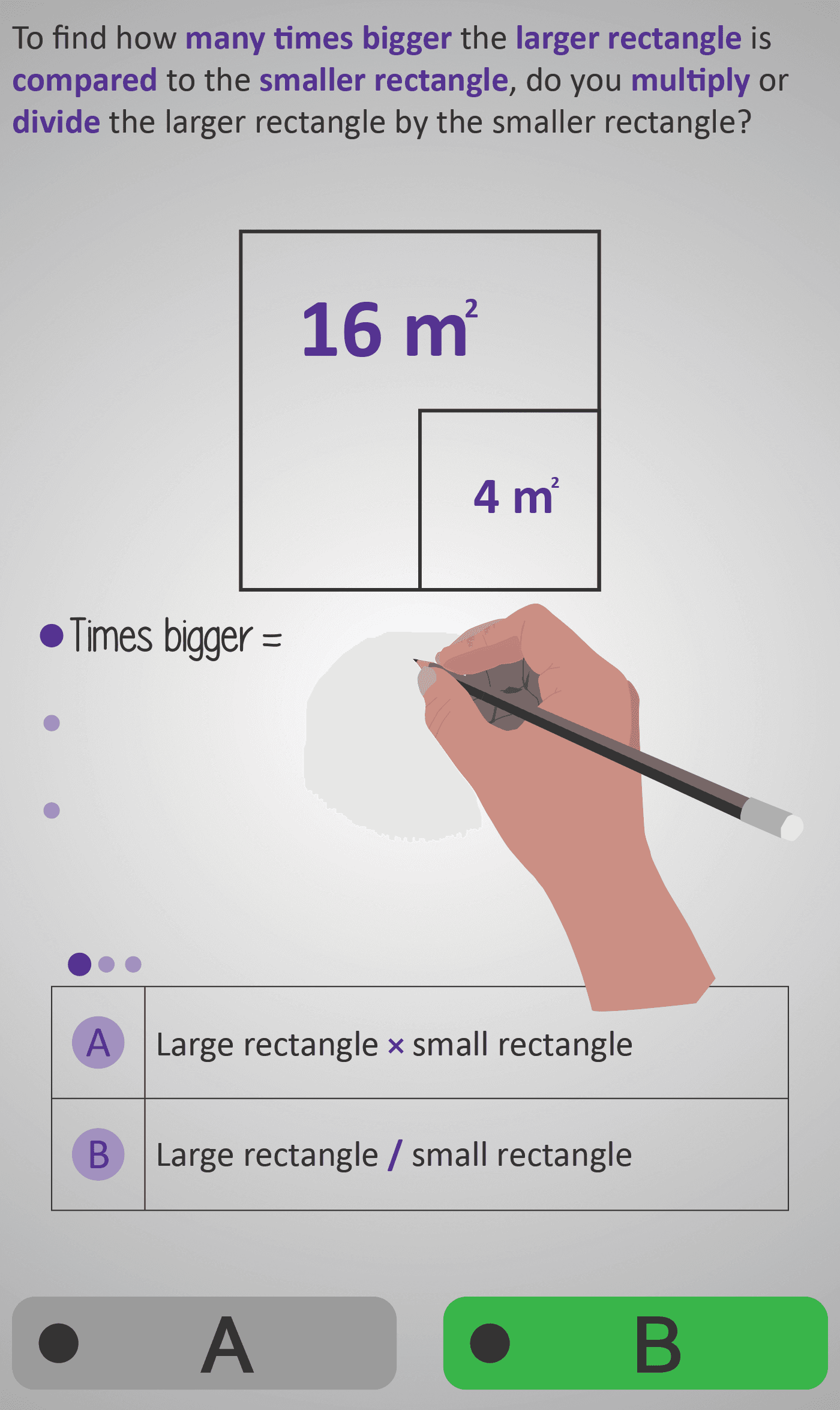
The example shows a large rectangle of 16 m² and a smaller one of 4 m². Learners are guided step-by-step to decide whether to multiply or divide, then whether to divide 16 by 4 or 4 by 16. Through guided reasoning and clear visual cues, they see that:
Times Bigger = Large ÷ Small = 16 ÷ 4 = 4
This reinforces that division expresses “how many of one quantity fit into another,” a key link between area, ratio, and proportional reasoning. The sequence encourages flexible thinking — connecting multiplication (Area = L × H) and division (comparing areas).
By the end, students understand that finding “how many times bigger” uses division, not subtraction or addition — and that the result represents a scale factor of area, not a difference in size.
Prerequisite Knowledge Required
- Area 3A – Calculating the area of rectangles.
- Area 3C – Finding the difference between two areas.
- Number 2C – Understanding division as grouping and comparison.
- Proportion 3A – Understanding “how many times bigger/smaller” in context.
Main Category
Measurement × Ratio – Comparing Areas
Estimated Completion Time
Approx. 8–10 seconds per question (30 questions total). Total Time: 4–5 minutes.
Cognitive Load / Step Size
Moderate — learners must coordinate two ideas (comparison and division), but the visualisation of operation → numbers → result isolates each step clearly. This stepwise guidance maintains flow and prevents overload.
Language & Literacy Demand
Moderate — key comparative words (“many times bigger”, “divide”, “compared to”) are highlighted. The consistent question format supports understanding through visual cues and repetition.
Clarity & Design
The layout is clean and symmetrical for instant comprehension:
- Two rectangles (one large, one small) make the comparison intuitive.
- Clear area labels (16 m² and 4 m²) reinforce scale visually.
- Handwritten animation highlights each mathematical step in sequence.
Consistent purple and grey colour coding links operations, numbers, and outcomes for clarity.
Curriculum Alignment
Irish Junior Cycle Mathematics:
- Strand 2 – Measures: Compare and interpret areas using proportional reasoning.
- Strand 1 – Number: Apply division to scaling and ratio contexts.
- Strand 3 – Algebra: Introduce foundational understanding for scale factors and similarity.
Engagement & Motivation
The question “how many times bigger?” naturally sparks curiosity and encourages pattern recognition. Learners find satisfaction in simple, elegant relationships (e.g., 16 ÷ 4 = 4). The concept connects easily to real-life examples like models, maps, or architecture.
Error Opportunities & Misconceptions
- Dividing the smaller by the larger (4 ÷ 16 = ¼ instead of 4).
- Using multiplication instead of division.
- Misinterpreting “times bigger” as addition (16 + 4 = 20).
The Phlow counters these through deliberate contrast options and immediate corrective feedback.
Transferability / Real-World Anchoring
High — comparing “how many times bigger” applies in real-world contexts such as scaling recipes, reading maps, enlarging images, and comparing data. This builds proportional reasoning in practical terms.
Conceptual vs Procedural Balance
Strong conceptual grounding — students interpret why division expresses comparison before practising how to calculate it. This bridges conceptual understanding and procedural fluency effectively.
Learning Objectives Addressed
- Recognise that comparing sizes involves division, not subtraction.
- Calculate how many times larger one area is than another.
- Understand that “times bigger” represents a multiplicative scale factor.
- Strengthen proportional and spatial reasoning within measurement contexts.
What Your Score Says About You
- Less than 5: You might be dividing the wrong way — remember, larger ÷ smaller gives “how many times bigger.”
- 6–7: You’re developing proportional reasoning but sometimes reverse the order of division.
- 8–9: You can confidently calculate how many times bigger one shape is than another.
- 10 / 10: Excellent — you fully understand how to use division to compare and interpret area relationships.