
Area 3E
Overview
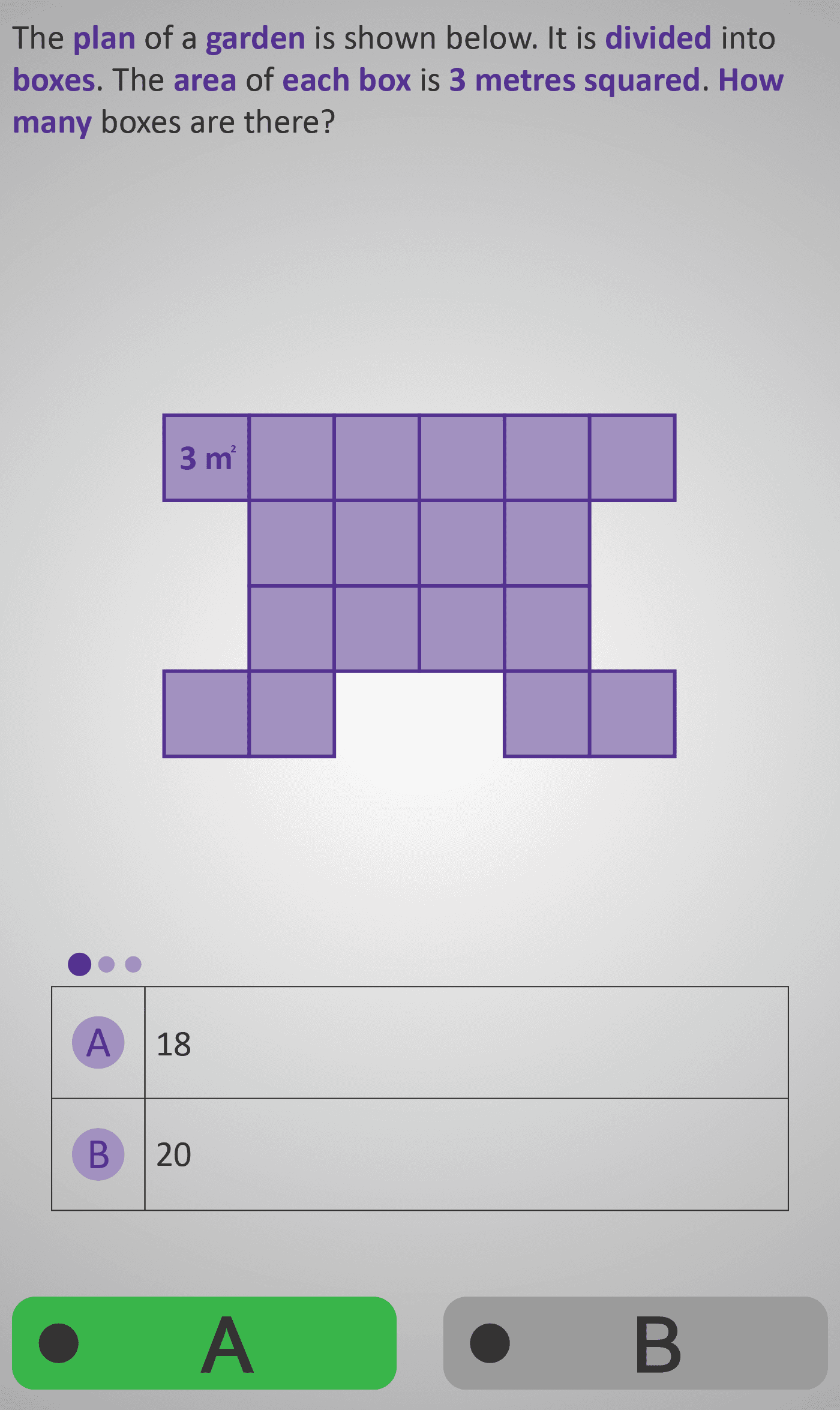
This Phlow introduces learners to composite area — finding the total area of a shape made up of smaller, equal squares. Students examine a garden plan divided into identical boxes, each representing 3 m².
First, they count the total number of boxes in the garden (e.g., 18), reinforcing spatial reasoning and pattern recognition. Next, they are asked whether to multiply or divide the number of boxes by the area of one box to find the total area. Through guided reasoning and visual feedback, they identify multiplication as the correct operation:
Total Area = Number of Boxes × Area of One Box = 18 × 3 = 54 m²
This process consolidates understanding of area as repeated addition of equal parts, connecting counting, multiplication, and geometry. By working with irregular arrangements instead of neat rectangles, students learn that total area can always be found by summing or multiplying consistent units.
Prerequisite Knowledge Required
- Area 3A – Calculating the area of rectangles.
- Area 3B – Understanding area through real-life contexts (e.g., paint coverage).
- Number 2B – Multiplication as repeated addition.
- Area 3C – Subtraction and difference in area (for spatial reasoning).
Main Category
Measurement – Composite and Irregular Area
Estimated Completion Time
Approx. 10 seconds per question (30 questions total). Total Time: 5–6 minutes.
Cognitive Load / Step Size
Moderate — the task combines visual counting with symbolic multiplication, but the clear sequence (count → choose operation → calculate) keeps progression manageable and supports working memory.
Language & Literacy Demand
Moderate — key mathematical terms (area, each box, metres squared, total) are contextualised through visuals. The consistent instruction pattern reinforces comprehension via repetition and examples.
Clarity & Design
Excellent clarity — the grid-based garden layout shows how total area builds from equal units. Each square is uniformly shaded and labelled, and progressive animation links multiplication with area combination. The garden theme anchors the concept in a familiar, real-world setting.
Curriculum Alignment
Irish Junior Cycle Mathematics:
- Strand 2 – Measures: Calculate and interpret area for regular and composite shapes.
- Strand 1 – Number: Apply multiplication to contextual measurement tasks.
- Strand 4 – Statistics and Probability: Interpret spatial representations in context.
Engagement & Motivation
The “garden plan” context links geometry to design and problem-solving. Counting and multiplying visible tiles give instant visual feedback, fostering a sense of achievement and pattern recognition that keeps learners in flow.
Error Opportunities & Misconceptions
- Dividing instead of multiplying (confusing “each box is 3 m²” with “divide by 3”).
- Miscounting the number of boxes in irregular shapes.
- Forgetting to include units (m²).
Each of these is addressed through guided options, colour feedback, and stepwise scaffolding.
Transferability / Real-World Anchoring
Very high — the principle underpins tasks like estimating floor area, garden plots, or tiling surfaces. It fosters an intuitive sense of area as “how much space something covers,” preparing learners for complex composite area problems.
Conceptual vs Procedural Balance
Strongly conceptual — the Phlow reinforces why multiplication represents total area before applying it procedurally. Students see area as a build-up of identical parts, not just a formula.
Learning Objectives Addressed
- Count and calculate the total area of irregular composite shapes.
- Apply multiplication to combine equal-area units.
- Interpret and visualise area in grid-based contexts.
- Strengthen spatial reasoning and unit awareness.
What Your Score Says About You
- Less than 5: You might be miscounting boxes or using the wrong operation — review whether total area means adding or multiplying.
- 6–7: You understand the relationship between boxes and total area but may confuse units or operations.
- 8–9: You’re confident applying multiplication to real-world area problems.
- 10 / 10: Excellent — you can accurately calculate the total area of irregular shapes using multiplication and reasoning.