
Arithmetic 3
Overview
This Phlow introduces students to the order of operations, focusing on how multiplication and addition (or subtraction) are prioritised in mixed expressions. Through guided examples, learners discover which operation comes first and why this matters for accuracy.
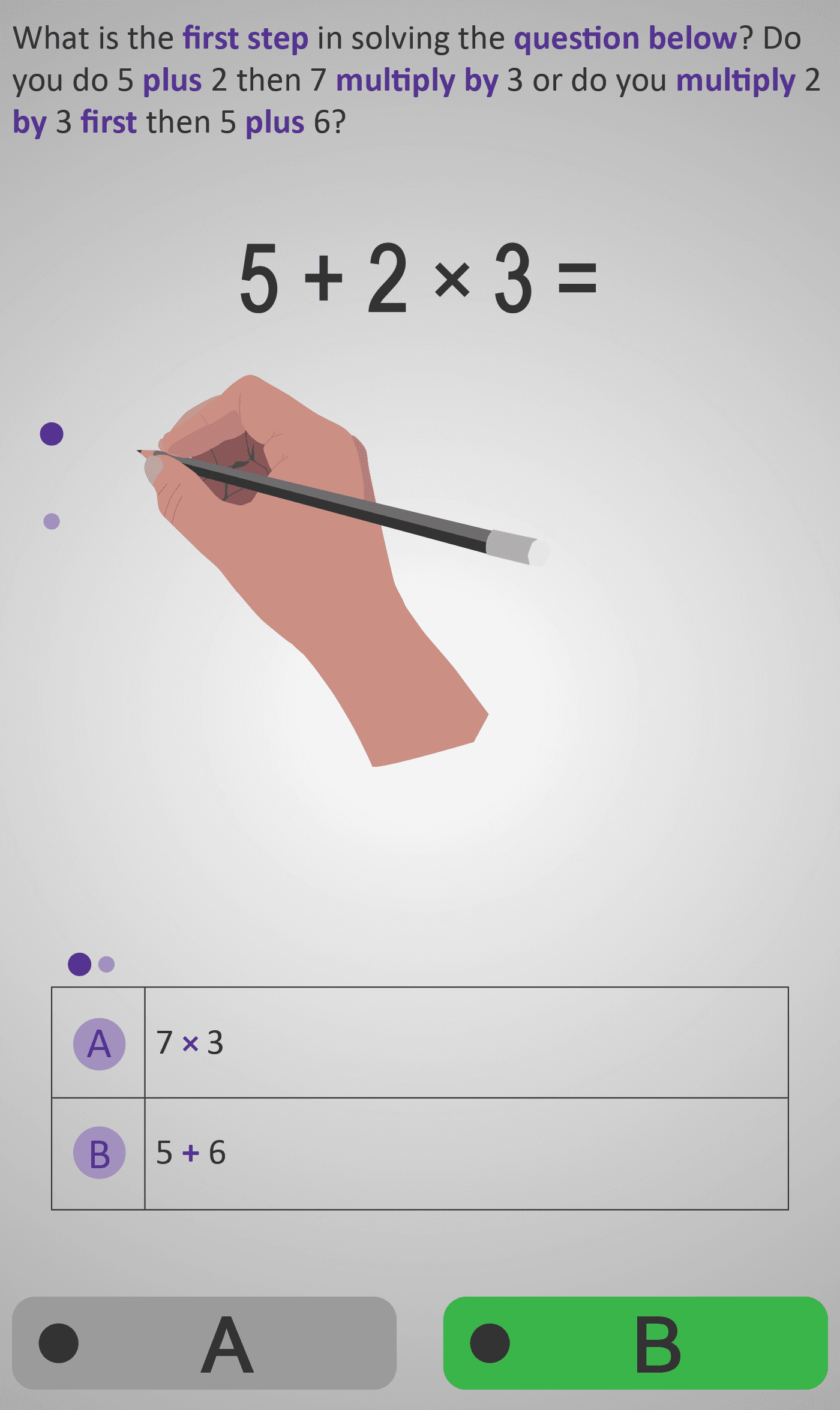
Students are shown examples such as 5 + 2 × 3 and 7 − 2 × 2,
then asked which operation should be performed first.
Step-by-step animations demonstrate that multiplication is carried out before addition or subtraction.
5 + 2 × 3 = 5 + 6 = 11
7 − 2 × 2 = 7 − 4 = 3
Each step is visually reinforced with a pencil writing intermediate stages, helping learners see how expressions unfold logically. This deepens procedural understanding while linking conceptual reasoning (“Which comes first?”) to visible examples.
By the end, learners understand why multiplication takes priority and how to apply this rule consistently — a foundation for algebraic manipulation and calculator use later on.
Prerequisite Knowledge Required
- Arithmetic 2B – Understanding addition and subtraction.
- Arithmetic 2C – Understanding multiplication as repeated addition.
- Number 2D – Interpreting operations in real-world contexts.
- Optional: Arithmetic 4A – BIDMAS and brackets (extension).
Main Category
Number & Operations – Order of Operations
Estimated Completion Time
Approx. 10–12 seconds per question (30 questions total). Total Time: ~5 minutes.
Cognitive Load / Step Size
Moderate — learners juggle two operations but each is isolated sequentially: decide operation order first, then compute. This structured pacing reduces overload while maintaining clarity.
Language & Literacy Demand
Moderate — mathematical vocabulary (plus, minus, multiply by, first step) is reinforced through colour cues and repetition. Sentences are short and procedural, supporting understanding for students with varying literacy levels.
Clarity & Design
The design makes invisible thinking visible:
- Operations are enlarged and colour-coded for clear focus.
- A pencil demonstrates each step in sequence.
- Alternating highlight colours distinguish addition/subtraction from multiplication.
Curriculum Alignment
Irish Junior Cycle Mathematics:
- Strand 1 – Number: Apply order of operations correctly in arithmetic expressions.
- Strand 3 – Algebra: Prepare for evaluating algebraic expressions.
- Learning Outcome 1.2: “Use order of operations to carry out calculations.”
Engagement & Motivation
By turning a rule-based concept into a reasoning-based visual activity, students experience “aha!” moments rather than rote memorisation. Contrasting examples (one with addition, one with subtraction) maintain curiosity and strengthen pattern recognition.
Error Opportunities & Misconceptions
- Performing operations strictly left-to-right without prioritising multiplication/division.
- Misreading multiplication as less important due to position in the equation.
- Failing to recompute the second step after resolving the first operation.
The Phlow anticipates these by pacing steps visually and reinforcing the key prompt: “Which comes first?”
Transferability / Real-World Anchoring
Moderate — understanding order of operations underpins calculator use, coding logic, spreadsheet formulas, and algebraic simplification. It is essential for accurate reasoning across STEM and real-life problem-solving.
Conceptual vs Procedural Balance
Balanced — students practise the procedure (follow operation order) but also grasp the underlying concept of priority, ensuring understanding rather than mechanical rule-following.
Learning Objectives Addressed
- Identify which operation to perform first in mixed arithmetic expressions.
- Apply order of operations correctly in multi-step calculations.
- Strengthen reasoning and accuracy when handling multiple operations.
- Develop readiness for algebraic expression evaluation.
What Your Score Says About You
- Less than 5: You may be working left-to-right — review the rule that multiplication comes before addition or subtraction.
- 6–7: You understand operation order but may occasionally mix the sequence.
- 8–9: You consistently apply order of operations accurately.
- 10 / 10: Excellent — you fully understand and can apply the correct order of operations every time.