
Axis of Symmetry 3A
Overview
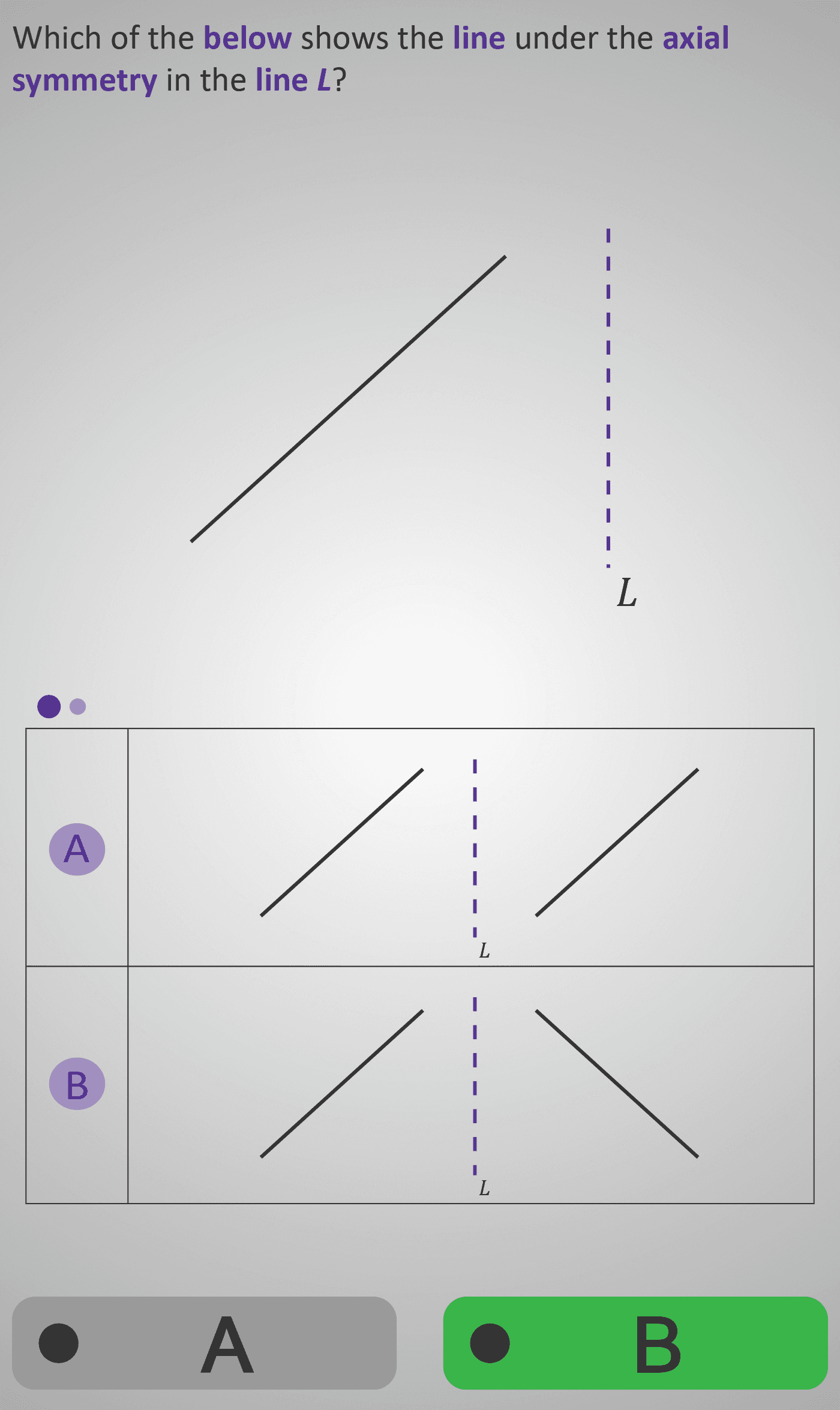
This Phlow introduces students to axial symmetry (reflection symmetry) using simple geometric figures such as single lines and joined lines. Learners are shown a dashed line L, which acts as the axis of symmetry, and asked to choose which diagram shows the correct reflection of the given line or angle.
The task progresses gradually:
- First, students reflect a single line segment across the axis.
- Next, the line is labelled (a, b) so learners can observe how the ends swap positions when mirrored.
- Finally, the line extends to two connected segments (forming an angle), introducing three labelled points (a, b, c) to reinforce one-to-one correspondence under reflection.
By visualising these mirrored pairs, students grasp that symmetry preserves size and shape but reverses orientation. The labelling reinforces point correspondence across the axis, preparing learners for coordinate transformations and geometric reasoning in later levels.
Prerequisite Knowledge Required
- Axis of Symmetry 2 – Recognising symmetry in simple shapes.
- Geometry 2A – Understanding lines, points, and angles.
- Position 2A – Understanding left and right orientation.
Main Category
Geometry & Transformations – Axial / Reflection Symmetry
Estimated Completion Time
Approx. 10–12 seconds per question (30 questions total). Total Time: ~6 minutes.
Cognitive Load / Step Size
Moderate — visualising a reflection can challenge spatial reasoning, but the stepwise increase in complexity (one line → labelled line → joined lines) keeps the cognitive load balanced and supports mastery.
Language & Literacy Demand
Low–Moderate — key terms (axis of symmetry, reflection, labelled points) are presented contextually and reinforced visually. Clear use of labels (a, b, c) reduces text dependency, making the activity accessible to all learners.
Clarity & Design
- Consistent purple colour for the symmetry line L maintains focus.
- Visual options are clean, symmetrical, and well-spaced.
- Labelled points (a, b, c) help track transformations step-by-step.
- Immediate visual feedback reinforces the “flip” concept of reflection.
Curriculum Alignment
Irish Junior Cycle Mathematics:
- Strand 2 – Geometry and Trigonometry: Explore transformations including axial symmetry in the coordinate plane and diagrams.
- Learning Outcome 2.5 – “Recognise and describe axial and central symmetry.”
- Learning Outcome 2.7 – “Apply transformations to shapes and lines.”
Engagement & Motivation
The mirrored images offer a visually satisfying, interactive challenge. Labelled examples invite prediction — learners anticipate how each point will “swap sides” across line L, promoting engagement and curiosity.
Error Opportunities & Misconceptions
- Reflecting along the wrong side of the axis (translating instead of mirroring).
- Not reversing the point order (thinking a stays on the same side).
- Confusing the axis itself with part of the reflected figure.
These misconceptions are addressed with side-by-side diagrams, labelled correspondence, and guided visual feedback.
Transferability / Real-World Anchoring
High — symmetry is foundational in art, design, architecture, and engineering. Understanding reflection supports later learning in coordinate geometry, computer graphics, and spatial reasoning.
Conceptual vs Procedural Balance
Balanced — learners develop conceptual understanding of what reflection means and procedural skill in recognising mirrored orientation. Both reinforce geometric fluency.
Learning Objectives Addressed
- Identify and describe axial (line) symmetry.
- Reflect single and multiple lines across an axis of symmetry.
- Track labelled points under reflection and understand point correspondence.
- Build spatial awareness for later coordinate geometry and transformations.
What Your Score Says About You
- Less than 5: You may be confusing direction or forgetting that reflections reverse order — review how each point flips across line L.
- 6–7: You understand the concept but need more precision with labelled positions.
- 8–9: You can confidently predict and identify correct mirrored images.
- 10 / 10: Excellent — you fully understand reflection symmetry and how labels swap correctly across the axis.