
Axis of Symmetry 3B
Overview
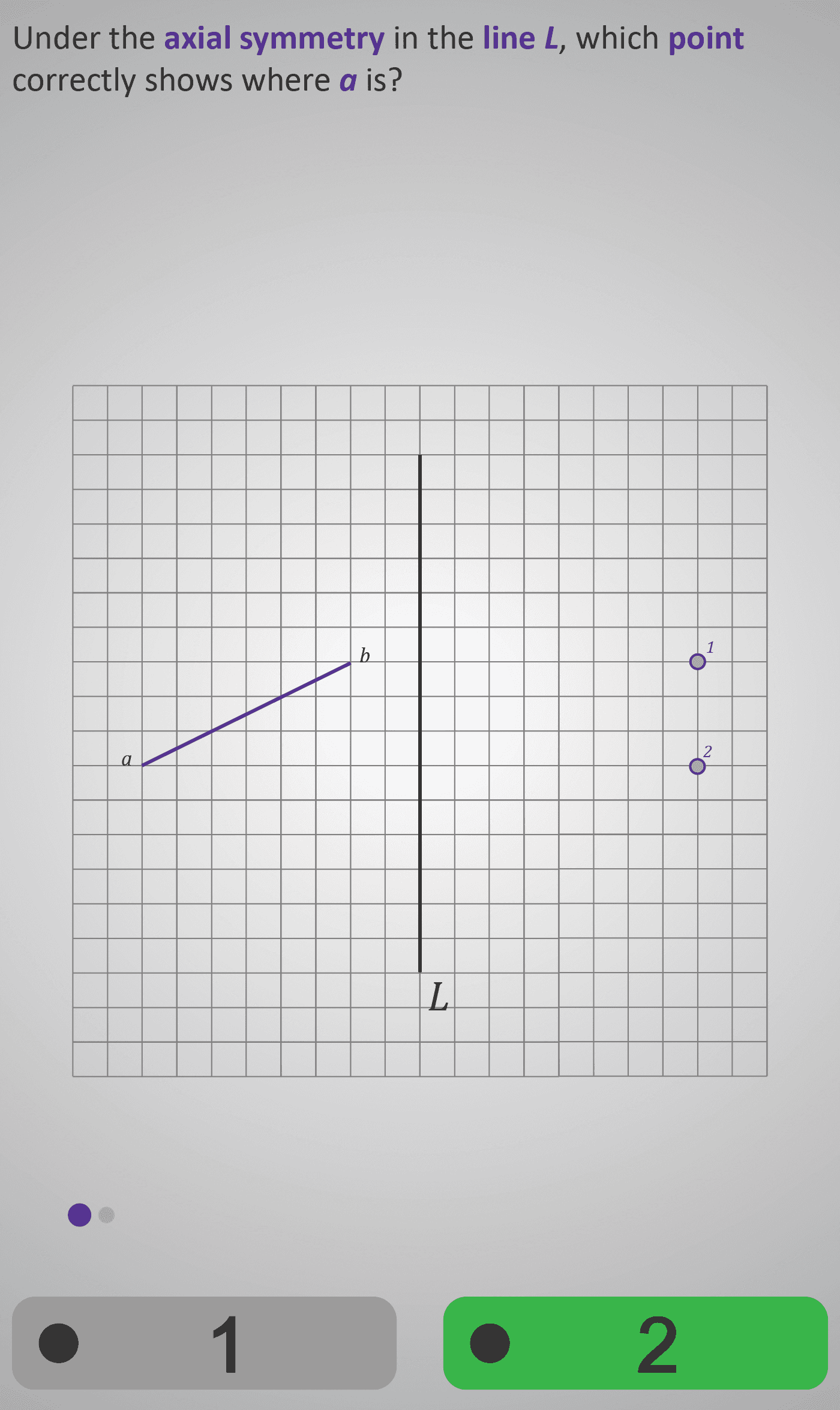
This Phlow builds on earlier symmetry concepts by applying axial symmetry to coordinates on a grid. Learners are shown a vertical line L (the axis of symmetry) and must determine where each point or vertex appears after reflection.
At first, students identify the reflection of single points labelled a and b. Later, the concept extends to line segments and angles, requiring them to track multiple labelled points (a, b, c) simultaneously. The mirrored positions are represented with numbered options, guiding students to reason about equal distance from the axis and mirror orientation.
By comparing left and right positions across the grid, learners gain an intuitive understanding that:
- Reflected points are directly opposite each other,
- Distances from the line of symmetry are equal, and
- The reflected figure is congruent but reversed.
This activity strengthens visual reasoning and spatial accuracy, preparing students for coordinate geometry reflections and geometric transformations.
Prerequisite Knowledge Required
- Axis of Symmetry 3A – Reflecting lines and angles without a grid.
- Geometry 2B – Measuring distance and position on a grid.
- Position 2A – Reading coordinates and understanding axes.
Main Category
Geometry & Transformations – Axial / Reflection Symmetry
Estimated Completion Time
Approx. 12–15 seconds per question (30 questions total). Total Time: ~7–8 minutes.
Cognitive Load / Step Size
Moderate — students must retain the rule of symmetry while comparing grid positions and visualising distances. The gradual progression (one point → two points → three points) builds fluency while keeping effort manageable.
Language & Literacy Demand
Low — essential terms (point, line, axis of symmetry, distance, mirror image) are repeated and visually reinforced. Instructions are concise, promoting focus on spatial reasoning over text comprehension.
Clarity & Design
- Grid backgrounds support precise counting of distances from line L.
- Purple highlighting maintains visual continuity with earlier symmetry Phlows.
- Numbered points (1, 2, 3) simplify choice-making while reinforcing conceptual accuracy.
- Smooth visual transitions simulate the real reflection process for intuitive learning.
Curriculum Alignment
Irish Junior Cycle Mathematics:
- Strand 2 – Geometry and Trigonometry: Apply transformations including axial symmetry on the coordinate plane.
- Learning Outcome 2.5 – “Recognise and describe axial and central symmetry.”
- Learning Outcome 2.7 – “Apply transformations using coordinates and diagrams.”
Engagement & Motivation
The grid adds a puzzle-solving element — students “test” their understanding by counting equal spaces. This blend of visual and logical reasoning keeps engagement high and reinforces geometric intuition.
Error Opportunities & Misconceptions
- Counting grid squares incorrectly (unequal spacing from the axis).
- Reflecting in the wrong direction (left instead of right).
- Swapping point order (e.g., mixing a and b).
These are corrected through consistent feedback, colour cues, and side-by-side visual comparison.
Transferability / Real-World Anchoring
High — symmetry on a grid connects directly to coordinate geometry, map reading, architecture, and design. Understanding these reflections supports future applications in CAD, art, and computer graphics.
Conceptual vs Procedural Balance
Balanced — learners internalise the concept (equal distances from the axis) while applying procedural accuracy (plotting reflected points precisely).
Learning Objectives Addressed
- Identify the mirror image of a point or line across a vertical axis.
- Apply the rule of equal distance from the axis of symmetry.
- Reflect multiple labelled points accurately using grid reasoning.
- Develop spatial awareness and symmetry recognition on coordinate planes.
What Your Score Says About You
- Less than 5: You may be missing the equal-distance rule — check how far each point is from line L.
- 6–7: You understand reflection but might occasionally count grid spaces incorrectly.
- 8–9: You show strong spatial accuracy and understanding of mirrored positions.
- 10 / 10: Excellent — you’ve mastered symmetry on a grid and are ready for coordinate geometry reflections.