
Buy & Sell 3A
Overview
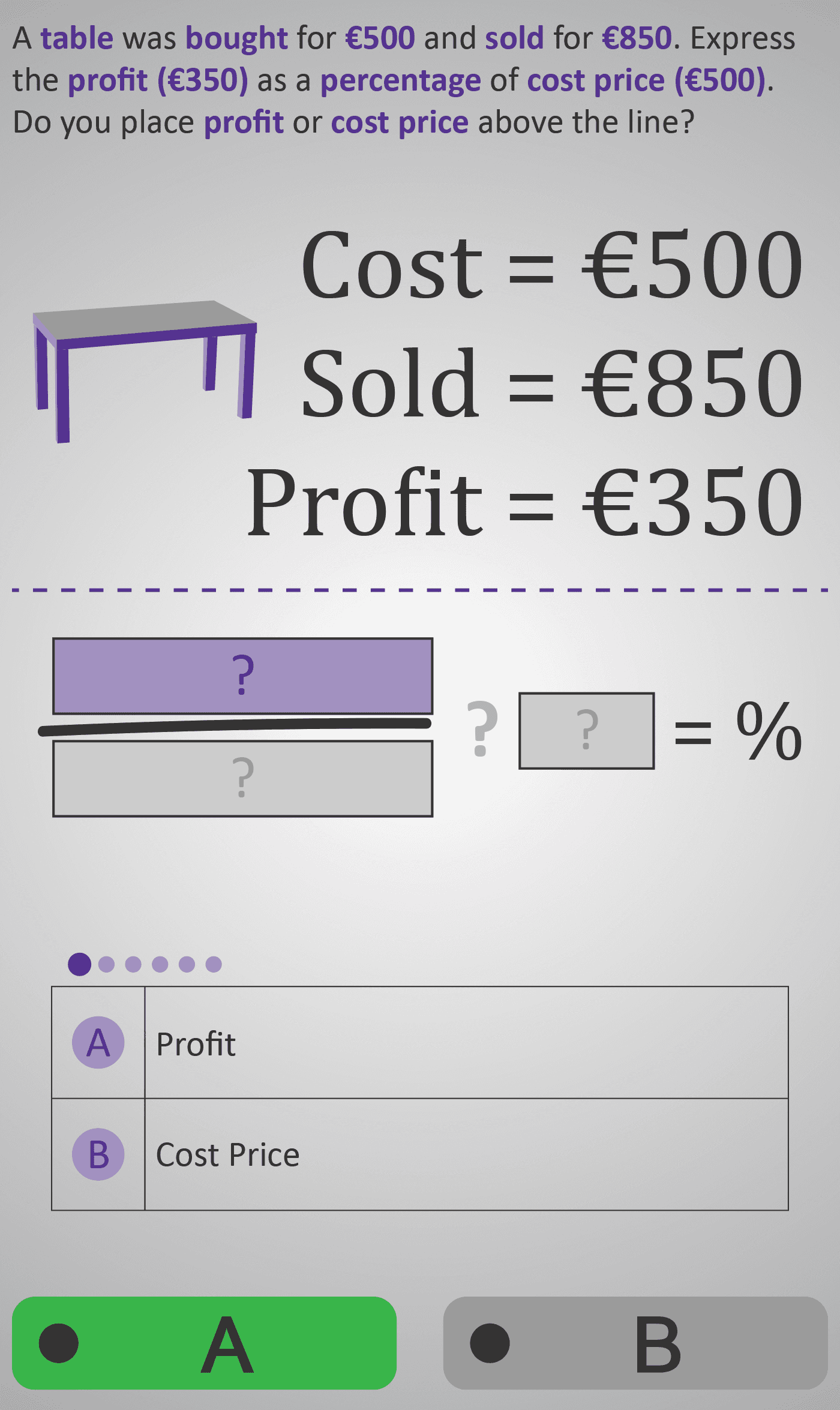
Introduces students to expressing profit as a percentage of cost price, a key concept in financial mathematics. The scenario involves a table bought for €500 and sold for €850, giving a profit of €350. Students are guided to construct the correct formula step-by-step:
- Decide whether profit or cost price goes above the line.
- Identify whether cost price or sale price belongs below the line.
- Recall that to find a percentage, we divide profit by cost price and then multiply by 100.
- Apply the rule: Profit % = Profit ÷ Cost Price × 100
- Finally, calculate (350 ÷ 500) × 100 = 70 %
Each step isolates a single decision, reinforcing conceptual understanding before procedural calculation. The visuals (table image, handwritten working, and boxed expressions) help learners see profit as a relationship rather than memorise a formula. By the end, students compute profit percentages accurately and understand why profit is compared to cost price — the original value invested.
Prerequisite Knowledge Required
- Money 2A – Understanding cost, selling price, and profit/loss basics.
- Fractions 2B – Dividing one number by another.
- Percentage 2B – Converting fractions or decimals to percentages.
Main Category
Financial Maths – Profit and Loss / Percentages
Estimated Completion Time
Approx. 10–12 seconds per question (30 questions total). Total Time: ~7 minutes.
Cognitive Load / Step Size
Moderate — each concept (order of terms, operation choice, multiplying by 100) is introduced separately. This sequencing reduces cognitive strain and strengthens proportional reasoning in financial contexts.
Language & Literacy Demand
Moderate — key terms (cost price, sale price, profit, percentage) are reinforced visually and numerically, with consistent use of symbols (€ ÷ × %). Sentences are short, clear, and instructional.
Clarity & Design
- Purple–grey palette distinguishes numerator (profit) and denominator (cost price).
- Real-world table image anchors abstraction in context.
- Progressive highlighting clarifies each fraction component and operation.
- Handwriting animation shows reasoning as a process, not rote formula use.
Curriculum Alignment
Irish Junior Cycle Mathematics:
- Strand 1 – Number: Apply percentages to solve problems in context, including profit and loss.
- Learning Outcome 1.5 – “Solve problems involving percentage increase and decrease.”
- Learning Outcome 1.9 – “Apply proportional reasoning in financial contexts.”
Engagement & Motivation
The relatable buy-and-sell scenario connects directly to real life — students immediately understand the usefulness of finding profit percentage. The final 70 % result provides a satisfying sense of purpose and achievement.
Error Opportunities & Misconceptions
- Reversing numerator and denominator (putting cost above profit).
- Using sale price instead of cost price as the base.
- Dividing by 100 instead of multiplying.
- Treating € signs as part of calculation rather than value labels.
Each is corrected visually and conceptually through scaffolded feedback.
Transferability / Real-World Anchoring
High — applies directly to business, shopping, and everyday money decisions. Builds foundational understanding for VAT, discounts, percentage loss, and simple interest.
Conceptual vs Procedural Balance
Strongly balanced — learners first reason conceptually about “part vs whole” before computing procedurally. The Phlow emphasises meaning before method.
Learning Objectives Addressed
- Recognise the relationship between profit, cost price, and selling price.
- Express profit as a fraction of cost price.
- Convert this fraction into a percentage.
- Apply the profit % formula correctly and interpret the result.
What Your Score Says About You
- Less than 5: You might be mixing up which value to use as the base — review how percentages always compare part to whole (profit to cost price).
- 6–7: You understand the steps but should double-check your operations (divide first, multiply after).
- 8–9: You can explain the logic behind the formula and apply it accurately.
- 10 / 10: Excellent — you’ve mastered profit percentages and are ready for loss and percentage change Phlows next.