
Buy & Sell 3B
Overview
This Phlow develops students’ understanding of total cost and profit through connected, story-based examples. Using Sarah’s truck sales, learners progress from single-step to multi-step reasoning:
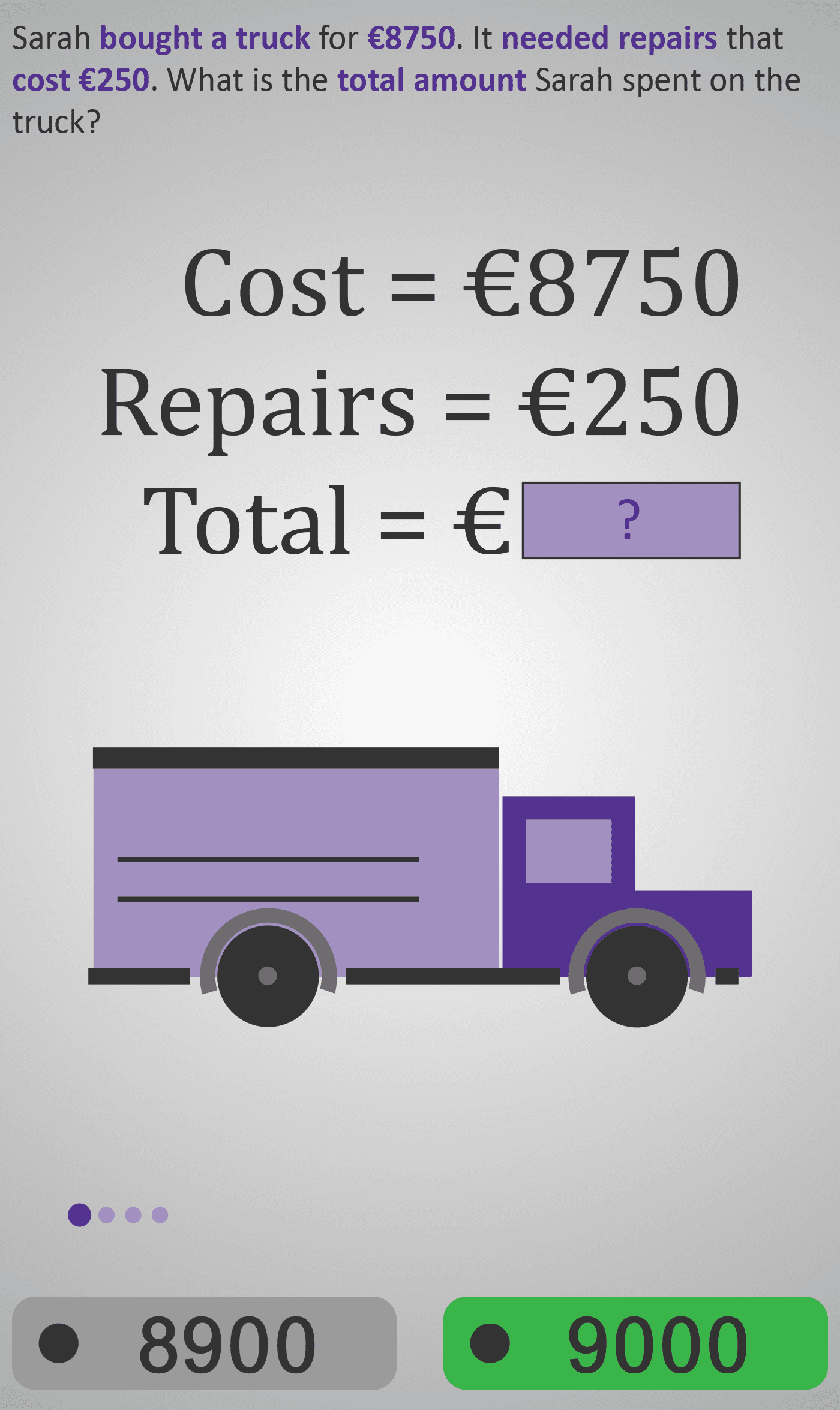
- Adding Costs: Sarah buys a truck for €8,750 and pays €250 for repairs. Students find the total amount spent (€9,000).
- Finding Profit: She sells the truck for €10,000. Students subtract to find the profit (€1,000).
- Scaling Up: Sarah repeats this process with four trucks, requiring multiplication to find the total sales (€40,000).
- Combined Scenario: Ciara buys the four trucks and sells them for €50,000, leading to a total profit of €10,000.
Through these incremental steps, learners build fluency with money calculations, reinforce arithmetic operations, and interpret profit as the difference between selling and total cost. The visual narrative (trucks, cost/sell/profit breakdowns) makes abstract arithmetic tangible, while introducing compound reasoning — combining operations logically across transactions, a foundation for more advanced financial and business contexts.
Prerequisite Knowledge Required
- Buy & Sell 3A – Expressing profit as a percentage of cost price.
- Money 2A – Adding and subtracting monetary values.
- Multiplication 2B – Scaling by whole numbers.
- Subtraction 2A – Finding differences between quantities.
Main Category
Financial Maths – Cost, Selling Price & Profit
Estimated Completion Time
Approx. 10–12 seconds per question (30 questions total). Total Time: ~7 minutes.
Cognitive Load / Step Size
Moderate — each screen introduces one small extension: addition → subtraction → scaling → multi-step reasoning. The repeated structure (Cost → Sold → Profit) builds automaticity and confidence while keeping working memory load low.
Language & Literacy Demand
Low–Moderate — terms like cost, repairs, sold, profit, and total are reinforced visually and contextually. Each question uses short, action-oriented language linked directly to clear visual outcomes.
Clarity & Design
- Purple visual theme matches Buy & Sell 3A for continuity.
- Truck images anchor abstract numbers in a familiar business context.
- Large, bold € symbols reinforce monetary focus.
- Sequential layout mirrors real financial processes — spending → selling → profit.
Curriculum Alignment
Irish Junior Cycle Mathematics:
- Strand 1 – Number: Apply operations (addition, subtraction, multiplication) to financial problems.
- Learning Outcome 1.5 – “Solve problems involving profit, loss, and total cost.”
- Learning Outcome 1.9 – “Apply arithmetic to real-life contexts including business and transactions.”
Engagement & Motivation
Students enjoy tracing Sarah’s and Ciara’s business profits — a small-scale entrepreneurial story that rewards logical thinking and precision. Each question reveals a clear purpose and visible reward, making financial maths meaningful and engaging.
Error Opportunities & Misconceptions
- Forgetting to include repairs in total cost.
- Subtracting in the wrong order (cost from sale vs. sale from cost).
- Forgetting to multiply by quantity when scaling up.
- Confusing total profit with per-item profit.
Each misconception is surfaced and corrected through progressive scaffolding, repetition, and visual feedback.
Transferability / Real-World Anchoring
Very High — links directly to budgeting, small business, pricing goods, and return-on-investment thinking. Strengthens practical financial literacy and entrepreneurship skills.
Conceptual vs Procedural Balance
Strong conceptual grounding — learners first understand what total cost and profit mean, then practise combining arithmetic operations procedurally for accuracy.
Learning Objectives Addressed
- Calculate total spending when multiple costs are combined.
- Find profit by comparing selling price and total cost.
- Scale up profit and cost for multiple identical items.
- Connect arithmetic operations to realistic financial contexts.
What Your Score Says About You
- Less than 5: You may be missing one operation — review whether to add or subtract in each step.
- 6–7: You can handle single transactions; practise combining multiple steps.
- 8–9: You calculate linked costs and sales confidently and can explain your reasoning.
- 10 / 10: Excellent — you’ve mastered multi-step profit problems and are ready for percentage and compound applications.