
Circle 3A
Overview
In this Phlow, learners explore how to find the circumference (perimeter) of a circle by linking concrete understanding with symbolic representation.
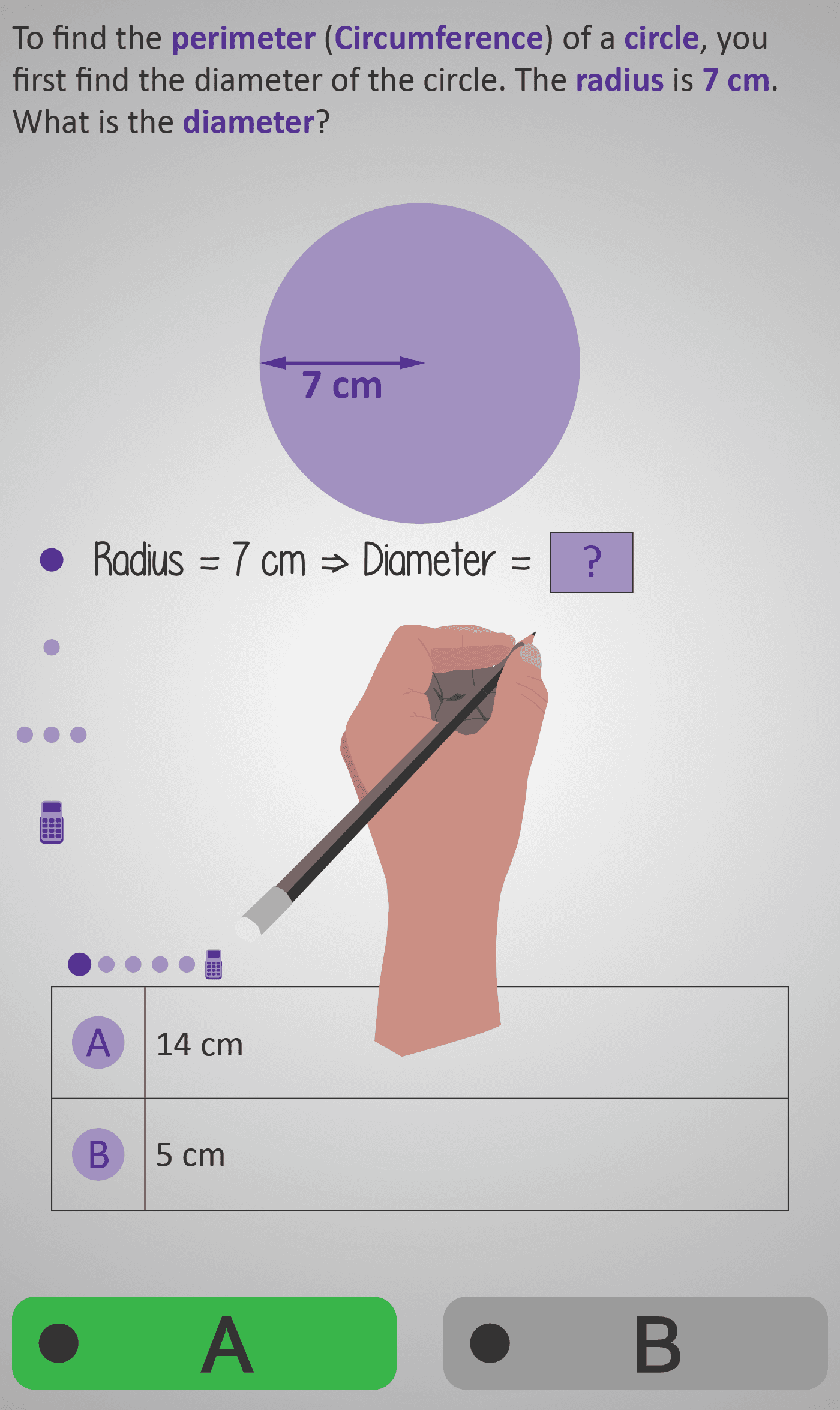
The sequence begins by reminding students that the radius is half the diameter. With the radius given as 7 cm, learners deduce the diameter as 14 cm. They then discover the formula for the perimeter of a circle — C = πd.
Next, they identify the correct value for π (3.142) and decide whether it should be multiplied or added within the formula, reinforcing conceptual understanding through guided choices. The final step has them multiply 3.142 × 14 to calculate the circumference (≈ 43.988 cm), with encouragement to check their answer using a calculator.
This gradual, scaffolded design reinforces both the concept (how radius, diameter, and circumference are related) and the procedure (using π correctly in a formula), developing fluency through interactive visual reasoning.
Prerequisite Knowledge Required
- Circle 2A – Identifying parts of a circle (radius, diameter, centre).
- Circle 2B – Understanding the relationship between radius and diameter.
- Arithmetic 2C – Multiplying decimals and interpreting formulas.
Main Category
Measurement – Geometry (Circles & Perimeter)
Estimated Completion Time
Approx. 8–12 seconds per question (30 questions total). Total Time: 4–6 minutes.
Cognitive Load / Step Size
Low to moderate — each step introduces one clear mathematical action: finding the diameter, recognising π, choosing the correct operation, and applying the formula. The consistent visual layout and sequential logic ensure smooth cognitive transitions.
Language & Literacy Demand
Low — the text is short and visual. Diagrams and colour-coded cues highlight radius, diameter, and perimeter. Simple phrasing keeps focus on reasoning and relationships rather than lengthy reading.
Clarity & Design
- Large central circle diagram with labelled radius and diameter.
- Hand and pencil animation visually demonstrates substitution and calculation.
- Calculator and formula icons guide learners through each step.
- Clean design supports comprehension without distractions.
Curriculum Alignment
Irish Junior Cycle Mathematics:
- Strand 3 – Geometry and Trigonometry / Strand Unit: 2D Shapes and Measure.
- Learning Outcome 3.7 – “Use appropriate formulae to calculate the perimeter and area of 2D shapes, including circles.”
- Learning Outcome 3.8 – “Understand and use the relationship between the radius, diameter, and circumference of a circle.”
Engagement & Motivation
The step-by-step format turns formula learning into a guided discovery. Students feel autonomy by checking their work with a calculator, reinforcing confidence and accuracy. The active visuals (writing hand, glowing formula) create an engaging, interactive experience.
Error Opportunities & Misconceptions
- Mixing up radius and diameter.
- Treating π as a number to multiply by itself or by 3.
- Adding instead of multiplying by π.
- Using the radius in place of diameter in C = πd.
Each misconception is directly addressed with contrasting examples and immediate visual correction.
Transferability / Real-World Anchoring
High — this skill connects directly to real-world design, measurement, and engineering contexts (wheels, lids, pipes, circular tracks). It also lays the groundwork for area and trigonometric concepts in later levels.
Conceptual vs Procedural Balance
Balanced — learners first understand the relationship between circle parts, then apply the procedure of using the formula. “Why” always precedes “how,” ensuring deep comprehension.
Learning Objectives Addressed
- Understand the relationship between radius and diameter.
- Recall and apply the formula C = πd.
- Use π ≈ 3.142 accurately in calculations.
- Calculate circumference to the nearest hundredth.
What Your Score Says About You
- Less than 5: You may be mixing up radius and diameter — revisit their relationship.
- 6–7: You understand the concept but need more confidence using π.
- 8–9: You can apply the formula correctly — check calculator precision.
- 10 / 10: Excellent — you can link radius, diameter, and π fluently to calculate circumference.