
Circle 3B
Overview
This Phlow helps students internalise the relationship between a circle’s radius and diameter — a foundational concept that underpins all later work on circumference and area.
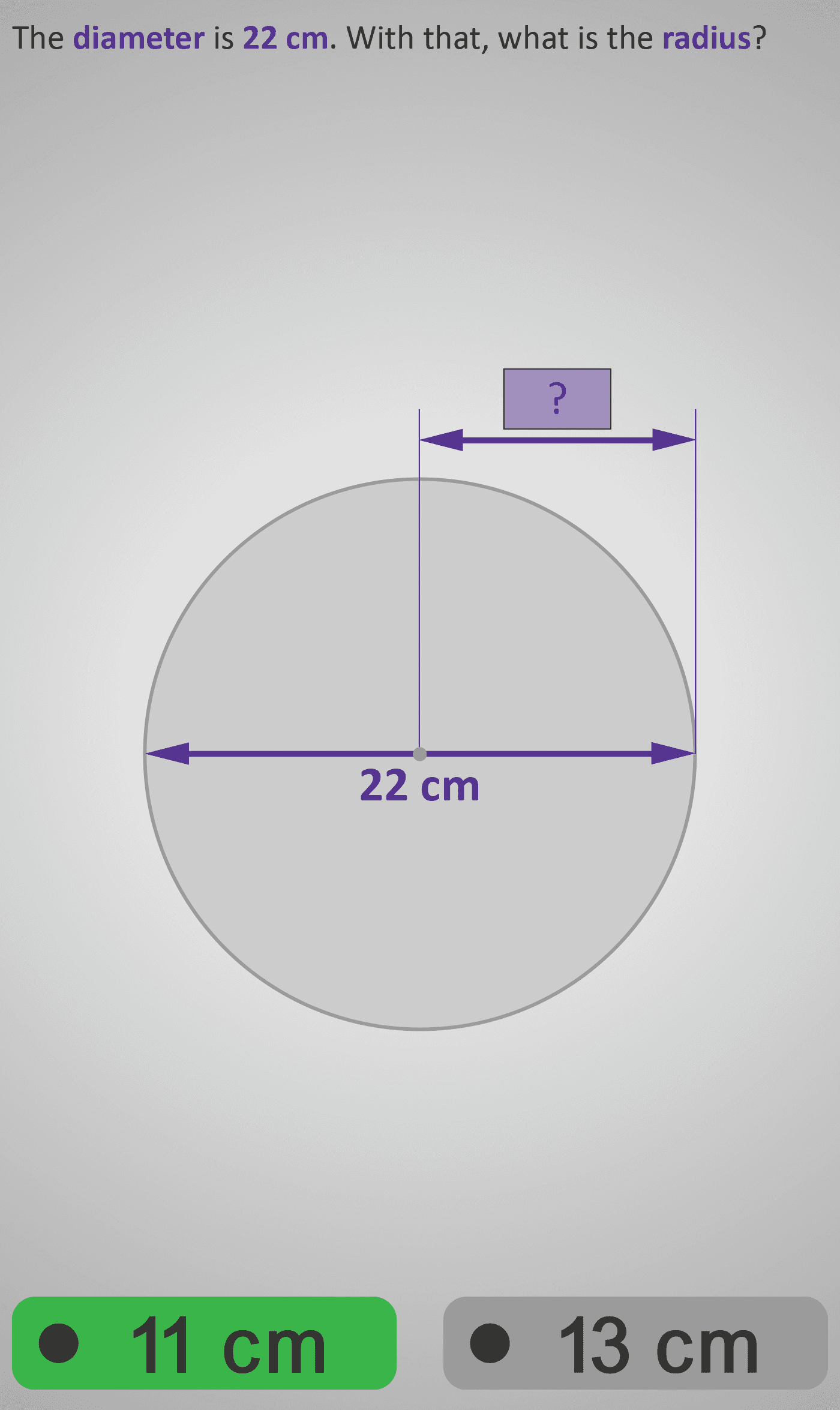
Each screen presents a simple, clearly drawn circle with one measurement (either the radius or diameter) labelled. Learners must determine the missing value, reinforcing the key relationships: Diameter = 2 × Radius and Radius = Diameter ÷ 2.
The sequence alternates between both directions — halving the diameter to find the radius, and doubling the radius to find the diameter. Visual cues (central point, arrows, and consistent use of purple measurement lines) anchor the relationship in a clear geometric representation.
By the end, students develop fluency in converting between radius and diameter, preparing them to use these values accurately in circumference and area formulas in later Phlows.
Prerequisite Knowledge Required
- Circle 2A – Recognising circles and key parts (centre, radius, diameter).
- Arithmetic 2B – Doubling and halving numbers accurately.
- Measurement 2C – Understanding lengths and units (cm, m).
Main Category
Measurement – Geometry (Circles & Relationships)
Estimated Completion Time
Approx. 8–12 seconds per question (30 questions total). Total Time: 4–6 minutes.
Cognitive Load / Step Size
Low — each question isolates one transformation: halving or doubling. The alternation between both directions introduces variation without overload, strengthening memory through bidirectional reasoning.
Language & Literacy Demand
Very low — questions use simple and repetitive sentence patterns (e.g., “The diameter is 22 cm. What is the radius?”). Key terms are colour-highlighted and supported visually, making this Phlow accessible to all learners.
Clarity & Design
- Large shaded circle with clearly marked radius or diameter.
- Arrows and purple lines emphasise direction and measurement.
- Labels use consistent font and colour for quick visual recognition.
- Clean, uncluttered layout reinforces visual learning and memory retention.
Curriculum Alignment
Irish Junior Cycle Mathematics:
- Strand 3 – Geometry and Trigonometry / Strand Unit: 2D Shapes and Measure.
- Learning Outcome 3.8 – “Recognise and use the relationship between the radius and diameter of a circle.”
- Learning Outcome 3.7 – “Apply knowledge of circle properties to solve practical problems in measurement.”
Engagement & Motivation
The short, visually consistent tasks feel quick and achievable, encouraging confidence through instant success. Alternating between doubling and halving maintains interest and strengthens numerical fluency. The use of familiar real-world units (cm, m) adds practical relevance to everyday contexts like wheels, plates, and lids.
Error Opportunities & Misconceptions
- Forgetting that the diameter is twice the radius.
- Confusing which measure is given vs. which to find.
- Mixing up units (e.g., cm vs. m).
Alternating question direction (radius → diameter and diameter → radius) helps correct overgeneralisation and reinforces two-way understanding.
Transferability / Real-World Anchoring
High — learners apply this reasoning when interpreting measurements in design, construction, sports, and engineering. The visual–numerical connection supports mental estimation and practical problem-solving.
Conceptual vs Procedural Balance
Conceptually strong — the Phlow focuses on understanding the relationship rather than memorising formulas. Repetition naturally builds procedural fluency through conceptual reasoning and pattern recognition.
Learning Objectives Addressed
- Recognise that the diameter is twice the radius.
- Recognise that the radius is half the diameter.
- Convert between radius and diameter accurately.
- Understand how these two measurements relate geometrically.
What Your Score Says About You
- Less than 5: You may still be mixing up radius and diameter — review their definitions.
- 6–7: You’re recalling the relationship but need to check doubling or halving accuracy.
- 8–9: You understand the relationship well with minor numerical slips.
- 10 / 10: Excellent — you can move between radius and diameter effortlessly and accurately.