
Circle 3C
Overview
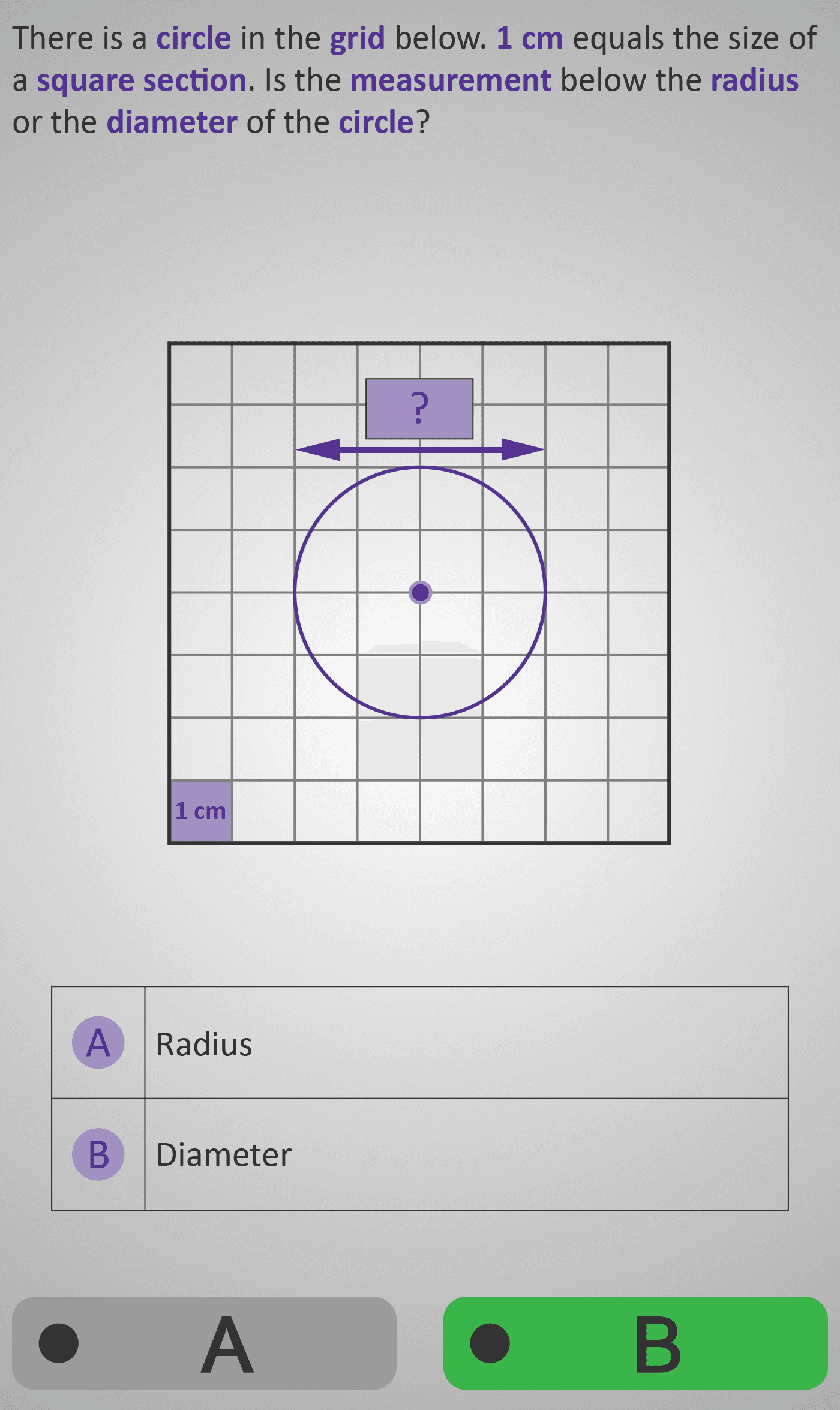
In this Phlow, learners use a square grid to visualise the relationship between a circle’s radius and diameter. Each grid square represents 1 cm, helping students translate visual lengths into numerical values.
Through a series of guided questions, students decide whether a measurement shown represents the radius or the diameter, then calculate its numerical value by counting the grid squares. This activity reinforces that Diameter = 2 × Radius while developing fluency in interpreting visual geometry.
By engaging with grid-based reasoning, learners strengthen their understanding of proportional relationships and spatial measurement — essential skills for later Phlows on circumference and area.
Prerequisite Knowledge Required
- Circle 3A – Perimeter (Circumference) of a Circle.
- Circle 3B – Relationship between Radius and Diameter.
- Understanding that radius = ½ × diameter and diameter = 2 × radius.
- Familiarity with geometric terms: circle, centre, radius, diameter.
- Ability to count uniform grid squares accurately.
Main Category
Geometry (Measurement & Spatial Reasoning)
Estimated Completion Time
Approx. 8–12 seconds per question (30 questions total). Total Time: 4–6 minutes.
Cognitive Load / Step Size
Moderate — each question adds a small conceptual step: identifying a circle part, then applying counting or doubling/halving. The grid visuals anchor abstraction in clear geometry, keeping cognitive demand balanced and flow consistent.
Language & Literacy Demand
Low — the Phlow relies primarily on visual understanding. Minimal text is used, and terms like “radius” and “diameter” are reinforced through clear labelling rather than extended explanation, ensuring accessibility for all learners.
Clarity & Design
- Simple, functional graphics with purple-grey palette.
- Grid overlay enables students to count units directly.
- Measurement arrows and labels clarify whether the distance is one-radius or two-radius.
- Visual hierarchy keeps the focus on relationships, not decoration.
Curriculum Alignment
Irish Junior Cycle Mathematics:
- Strand 3 – Geometry and Trigonometry.
- Learning Outcome: “Explore, identify, and use the radius, diameter, and circumference of a circle, and investigate their relationships.”
- Learning Outcome 3.8 – “Recognise and use relationships between the radius, diameter, and circumference of a circle.”
Engagement & Motivation
The grid-based design turns geometry into a visual puzzle. Quick decisions and immediate feedback maintain engagement and make the learning feel intuitive rather than abstract. The hands-on feel of “counting to measure” sustains flow and motivation.
Error Opportunities & Misconceptions
- Confusing radius with diameter (not realising the diameter crosses the full circle).
- Miscounting squares or misidentifying the circle’s centre.
- Assuming radius and diameter vary independently.
Each misconception is addressed visually through repetition, contrasting examples, and direct feedback.
Transferability / Real-World Anchoring
High — skills here apply to map reading, design, construction, and scaled drawings. The task reinforces proportional reasoning used in real-world geometry, engineering, and trigonometry.
Conceptual vs Procedural Balance
Balanced, leaning conceptual — learners practise procedures like counting and identifying, but the emphasis remains on why the radius and diameter relate proportionally and how to recognise them visually in context.
Learning Objectives Addressed
- Identify and differentiate between the radius and diameter of a circle.
- Measure circle dimensions using a scaled grid.
- Recognise and apply the relationship between radius and diameter.
- Interpret diagrams to infer geometric properties accurately.
What Your Score Says About You
- Less than 5: You may be confusing radius with diameter — revisit how each is drawn from the centre.
- 6–7: You can identify circle parts but occasionally mix them up — practise visualising their link.
- 8–9: You understand the concept well; check counting accuracy for small slips.
- 10 / 10: Excellent — you can read and measure radius and diameter from a grid confidently, ready for circumference and area work next.