
Coins 3
Overview
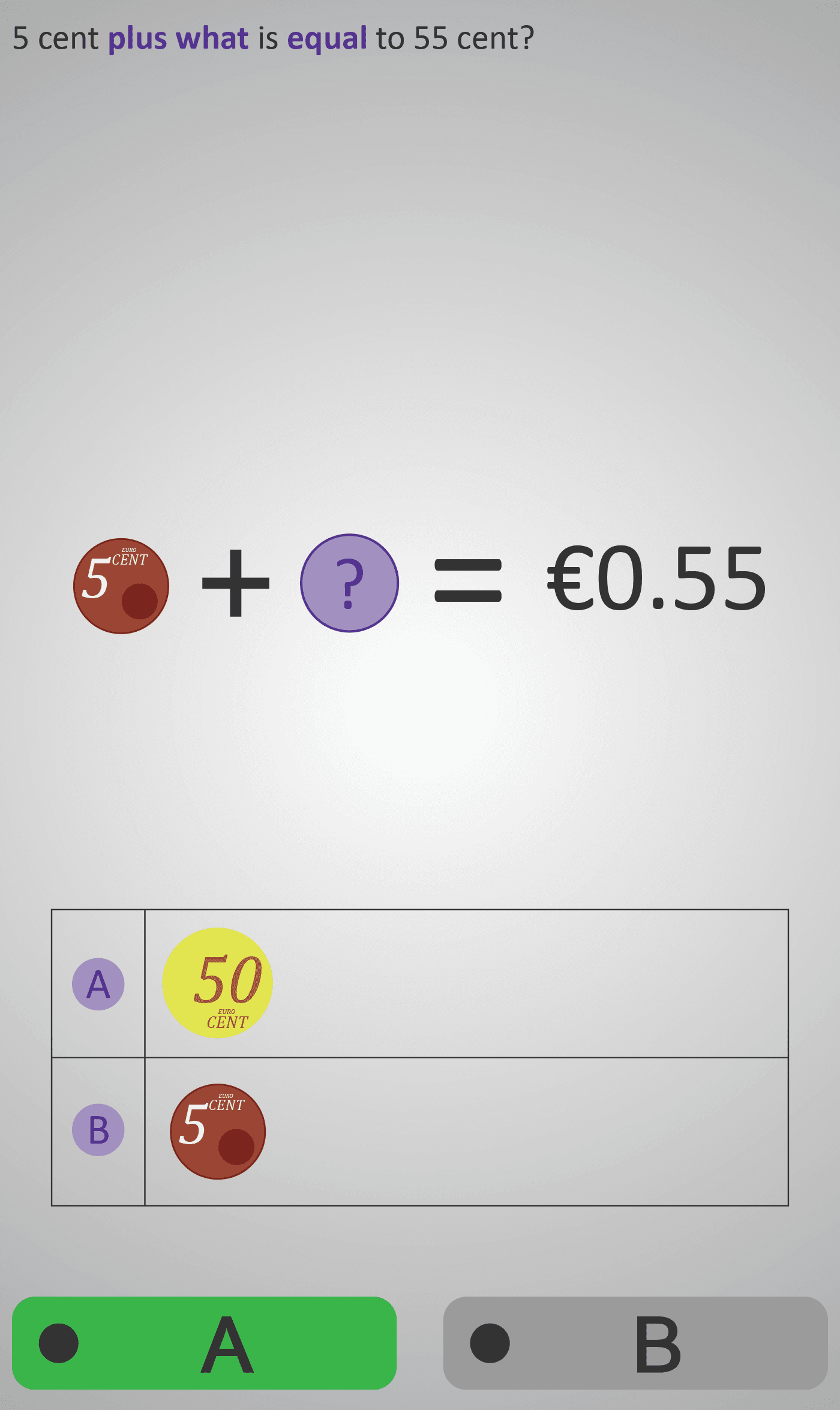
This Phlow builds mathematical fluency through everyday money problems. Each screen presents a familiar coin equation — for example, “5 cent plus what equals 55 cent?” or “2 euro minus what equals €1.50?” Students must identify the missing coin or amount to complete the equation.
By alternating between addition and subtraction, the Phlow strengthens understanding of inverse operations, bridging arithmetic facts with real-world money values. The use of coins, colours, and realistic visuals makes abstract number relationships concrete and relatable.
Learners practise reasoning about “what’s missing” rather than only computing totals, encouraging flexible mathematical thinking and reinforcing the equivalence between coins and euro–cent notation (€1 = 100c).
Prerequisite Knowledge Required
- Coins 2 – Recognising and combining euro values.
- Add 2A – Simple addition facts.
- Subtract 2A – Simple subtraction facts.
- Understanding that €1 = 100 cent.
- Ability to recognise common euro coins (5c, 10c, 20c, 50c, €1, €2).
- Familiarity with basic addition and subtraction within 100.
Main Category
Arithmetic – Money
Estimated Completion Time
Approx. 8–12 seconds per question (30 questions total). Total Time: 4–6 minutes.
Cognitive Load / Step Size
Moderate — each question isolates one arithmetic operation while introducing small variations in coin value and phrasing. Alternating between “plus what” and “minus what” keeps engagement active and strengthens understanding of inverse operations.
Language & Literacy Demand
Low — text is concise and repetitive. Key mathematical words (“plus,” “minus,” “equals”) are highlighted in purple to guide focus. Euro and cent symbols provide immediate meaning without requiring extended reading.
Clarity & Design
- Realistic coin imagery supports intuitive understanding.
- Equations are laid out cleanly with strong contrast and alignment.
- Colour-coded coins and text highlight which values are known or missing.
- Simple, uncluttered design reduces distraction and enhances visual reasoning.
Curriculum Alignment
Irish Primary & Junior Cycle Mathematics:
- Strand 1 – Number
- Strand 2 – Measures
- Learning Outcomes:
- Solve money problems involving addition and subtraction of euro and cent values.
- Recognise and use the relationship between euro and cent.
- Apply understanding of equivalence and the inverse relationship between addition and subtraction.
Engagement & Motivation
The familiar use of euro coins makes learning personally relevant and confidence-building. Quick, puzzle-like questions maintain attention and provide a satisfying sense of progress with each correct answer.
Error Opportunities & Misconceptions
- Confusing “plus what” with “minus what.”
- Forgetting to convert between euro and cent (e.g., €1.50 = 150c).
- Judging coin value by size rather than number label.
The Phlow anticipates these through contrasting examples and visual correction — ensuring learners focus on numerical value, not appearance.
Transferability / Real-World Anchoring
High — students can directly apply these skills to shopping, giving change, and budgeting. The connection between arithmetic and money enhances practical numeracy and strengthens everyday reasoning.
Conceptual vs Procedural Balance
Balanced — students gain procedural fluency with addition and subtraction while deepening conceptual understanding of equivalence and inverse relationships, setting the stage for early algebraic thinking.
Learning Objectives Addressed
- Add and subtract euro and cent values within 100 accurately.
- Recognise and apply the inverse relationship between addition and subtraction.
- Identify equivalent money representations using coins and symbols.
- Develop flexible mental arithmetic through real-world contexts.
What Your Score Says About You
- Less than 5: You may be mixing up addition and subtraction or coin values — revisit basic euro coin values.
- 6–7: You understand the concept but may misread the operation — pay attention to “plus” or “minus.”
- 8–9: You’re confident and nearly fluent; small subtraction or conversion errors may remain.
- 10 / 10: Excellent! You have strong number sense and can apply it effortlessly in real-world money situations.