
Compound Interest 3
Overview
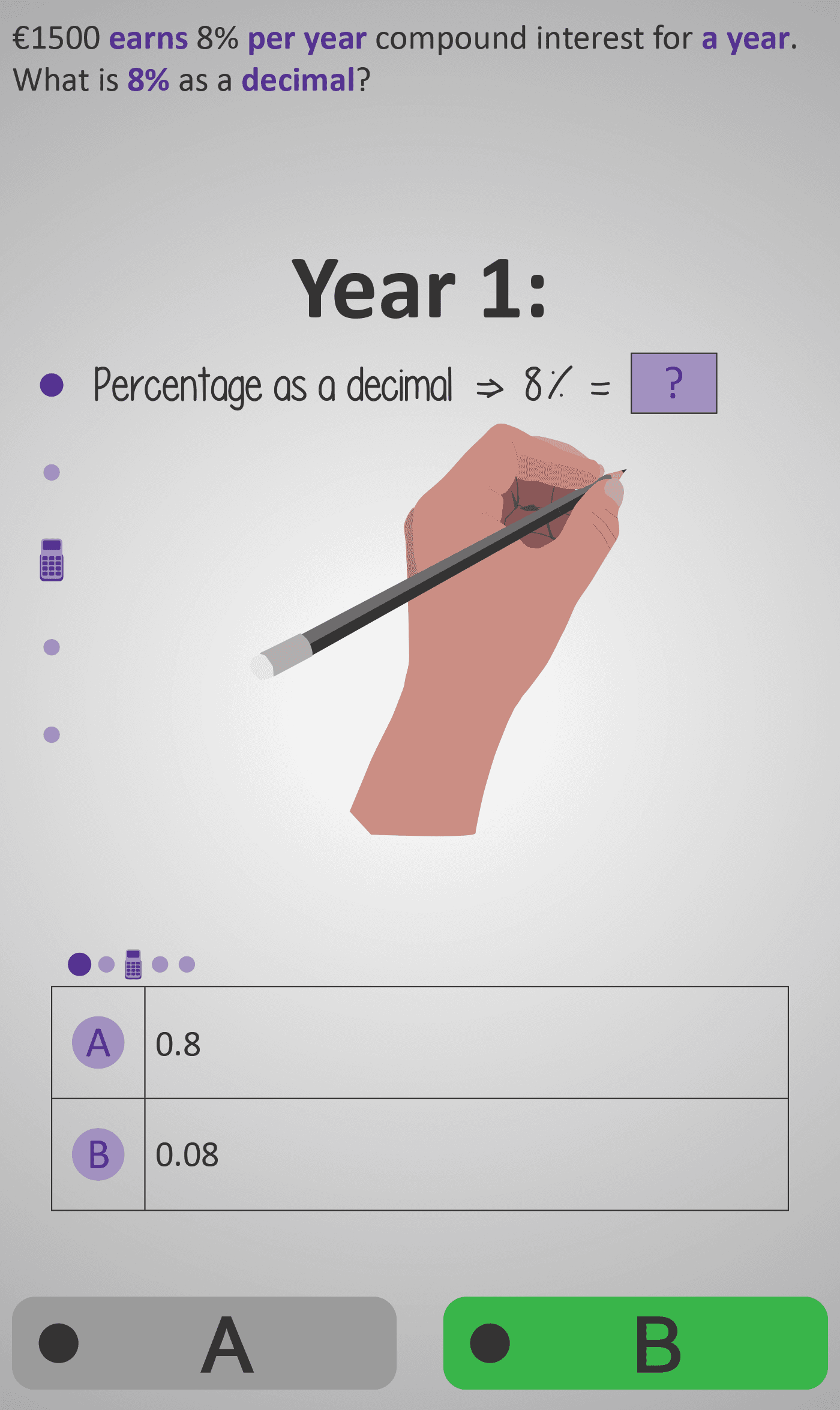
In this Phlow, learners break down the process of calculating compound interest for the first year into clear, manageable steps. Beginning with a principal of €1500 and an interest rate of 8%, students convert the percentage into its decimal form (0.08), then find the yearly interest by multiplying it by the principal.
Next, they add the interest earned to the original amount to determine the final balance after one year (€1620). This guided, sequential design ensures that each mathematical action is fully understood in context — not just memorised.
The Phlow builds fluency in percentage–decimal conversion, reinforces order of operations, and connects abstract numerical steps to meaningful financial scenarios, showing learners how money grows over time.
Prerequisite Knowledge Required
- Percent 2A – Converting percentages to decimals.
- Money 3 – Addition and subtraction with euro values.
- Multiply 3A – Multiplying by whole numbers.
- Understanding how percentages represent parts of 100.
- Ability to multiply decimals and add two monetary amounts.
- Familiarity with the concept of interest as “extra money earned or paid.”
Main Category
Algebra & Financial Mathematics
Estimated Completion Time
Approx. 8–12 seconds per question (30 questions total). Total Time: 4–6 minutes.
Cognitive Load / Step Size
Low to moderate — each step isolates one key sub-skill: conversion → multiplication → addition. This steady sequencing maintains clarity and prevents overload. Repetition across examples builds procedural fluency before introducing multi-year growth in later levels.
Language & Literacy Demand
Moderate — mathematical terms such as percentage, decimal, multiply, and final balance are highlighted and reinforced visually. Short, instructional sentences paired with icons (€, calculator, arrow) support comprehension for all reading levels.
Clarity & Design
- Sequential screen design mirrors the calculation flow (convert → multiply → add).
- “Year 1” label anchors each problem in a real-world financial context.
- Clear icons and handwritten visuals guide attention to each sub-step.
- Consistent purple–grey palette enhances visual clarity and reduces distraction.
Curriculum Alignment
Irish Junior Cycle Mathematics:
- Strand 1 – Number: Solve problems involving percentage increase and decrease in context.
- Strand 3 – Algebra & Functions: Apply formulae and calculations for simple and compound interest.
- Learning Outcome 1.5 – “Solve problems involving percentage change in everyday situations.”
- Learning Outcome 3.6 – “Use algebraic representations to model relationships in finance and growth.”
Engagement & Motivation
Relatable examples — “money growing in a bank account” — make abstract ideas personally meaningful. The step-by-step flow ensures small wins, helping learners experience success early and stay motivated to progress.
Error Opportunities & Misconceptions
- Confusing 8% with 0.8 instead of 0.08.
- Adding instead of multiplying the rate by the principal.
- Subtracting interest instead of adding to find the final balance.
- Mixing up compound and simple interest (forgetting growth compounds yearly).
Each misconception is targeted directly in visual feedback and guided correction.
Transferability / Real-World Anchoring
High — learners can apply these skills directly to banking, savings, loans, and investments. Understanding compound growth also prepares them for topics like exponential functions, population growth, and depreciation.
Conceptual vs Procedural Balance
Strongly procedural with conceptual scaffolding — students master the how (step-by-step calculation) while reinforcing the why (money increases proportionally each year). This prepares them for formal use of the compound interest formula in later levels.
Learning Objectives Addressed
- Convert percentages to decimals accurately.
- Calculate compound interest for one year.
- Add interest to principal to find the final balance.
- Understand how rate, time, and growth interact in financial contexts.
What Your Score Says About You
- Less than 5: You may be mixing up conversion or operation order — review the “multiply then add” rule.
- 6–7: You understand the process but may need more fluency with decimals or addition.
- 8–9: Excellent logic — refine consistency and calculation accuracy.
- 10 / 10: Outstanding! You can calculate yearly compound interest confidently and are ready for multi-year growth problems.