
Co-ordinate 3E
Overview
In this Phlow, students practise finding the area of a rectangle plotted on a coordinate grid by applying the formula:
Area = Height × Width
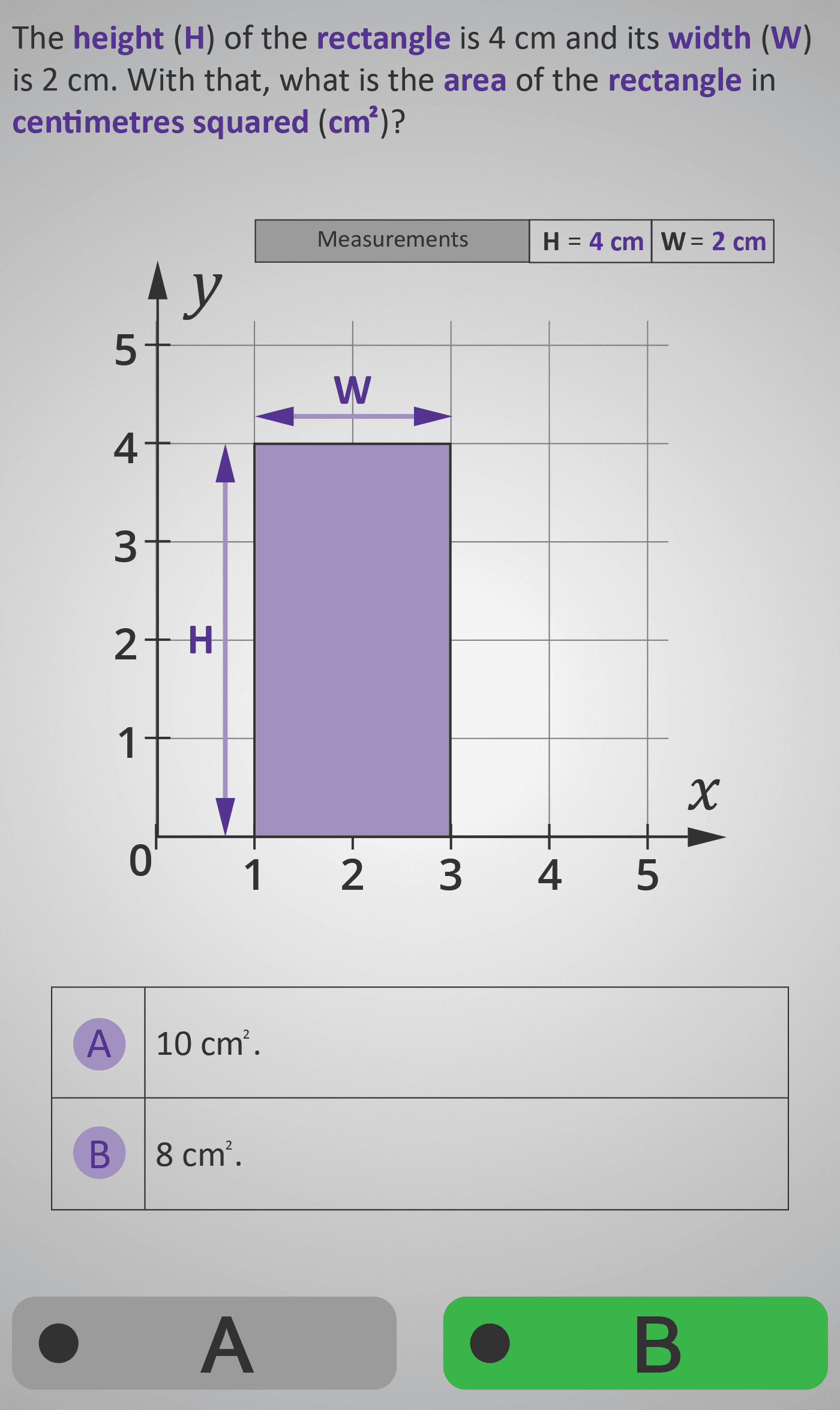
Each screen presents a rectangle with labelled dimensions and asks learners to determine its area, reinforcing how the grid represents real measurements. For example, with H = 4 cm and W = 2 cm, students calculate A = 8 cm²; with H = 3 cm and W = 5 cm, A = 15 cm². These clear examples connect visual geometry to numerical calculation.
The progression helps learners understand why area is measured in square units, how to interpret these from grid diagrams, and how multiplication models repeated addition of unit squares. Clear colour coding and unit labelling make abstract formulas concrete and intuitive.
By the end, students can confidently read dimensions from a coordinate grid, apply the area formula, and express answers in cm² — preparing for compound and irregular shape calculations in later Phlows.
Prerequisite Knowledge Required
- Co-ordinate 3A – Reading distances on a grid.
- Co-ordinate 3B – Using Pythagoras’ theorem on grids.
- Area 2A – Counting squares to find area.
- Understanding what “area” represents compared to “perimeter.”
- Ability to multiply lengths and interpret units (cm, cm²).
- Recognising height and width on a coordinate diagram.
Main Category
Measurement & Geometry
Estimated Completion Time
Approx. 8–12 seconds per question (30 questions total). Total Time: 4–6 minutes.
Cognitive Load / Step Size
Low to moderate — each question isolates one relationship (Height × Width) before introducing new orientations or scales. The repetition supports conceptual reinforcement and smooth skill automation without cognitive overload.
Language & Literacy Demand
Low — key terms like height, width, rectangle, centimetres squared are colour-coded and visually linked to the diagram. Clear, concise phrasing supports learners with varying literacy levels.
Clarity & Design
- Consistent coordinate grid background anchors spatial reasoning.
- Purple measurement arrows clearly mark height and width.
- Clean, minimal layout prioritises visibility of relationships and units.
- Visual labels (cm, cm²) reinforce the shift from linear to area measurement.
Curriculum Alignment
Irish Junior Cycle Mathematics:
- Strand 4 – Measures
- Learning Outcomes:
- Calculate the area of rectangles and interpret area in square units.
- Connect geometric shapes to real-world measurement contexts.
- Apply multiplication to find area from coordinate grid representations.
Engagement & Motivation
The visual and interactive layout transforms geometry into an engaging puzzle. Students immediately see how side lengths affect total area, reinforcing both accuracy and intuition. Realistic units and quick confirmation sustain focus and motivation.
Error Opportunities & Misconceptions
- Mixing up height and width.
- Adding instead of multiplying dimensions (e.g., 4 + 2 instead of 4 × 2).
- Omitting or mislabelling units (writing “8 cm” instead of “8 cm²”).
- Assuming grid squares are always 1 cm regardless of given scale.
Each error is surfaced through contrastive questioning and visual correction (e.g., highlighting correct unit usage or swapped dimensions).
Transferability / Real-World Anchoring
High — skills directly apply to construction, design, packaging, and planning. Learners connect grid-based geometry to real-world contexts like floor plans, blueprints, and spatial estimation.
Conceptual vs Procedural Balance
Balanced — learners achieve procedural fluency in applying A = H × W while developing conceptual understanding of area as repeated unit coverage. The Phlow visually shows how square centimetres represent two-dimensional measure.
Learning Objectives Addressed
- Identify and label the height and width of rectangles on a grid.
- Apply the formula A = H × W to find area.
- Express results correctly using square units (cm²).
- Interpret area as the number of unit squares covering a shape.
What Your Score Says About You
- Less than 5: You may be confusing the operation or forgetting units — review what “square centimetres” mean.
- 6–7: You understand the process but may need to double-check multiplication or reading of dimensions.
- 8–9: Strong comprehension — you calculate areas accurately and express units correctly.
- 10 / 10: Excellent! You can now calculate rectangular areas with ease — ready for compound and irregular shapes next.