
Co-ordinate 3F
Overview
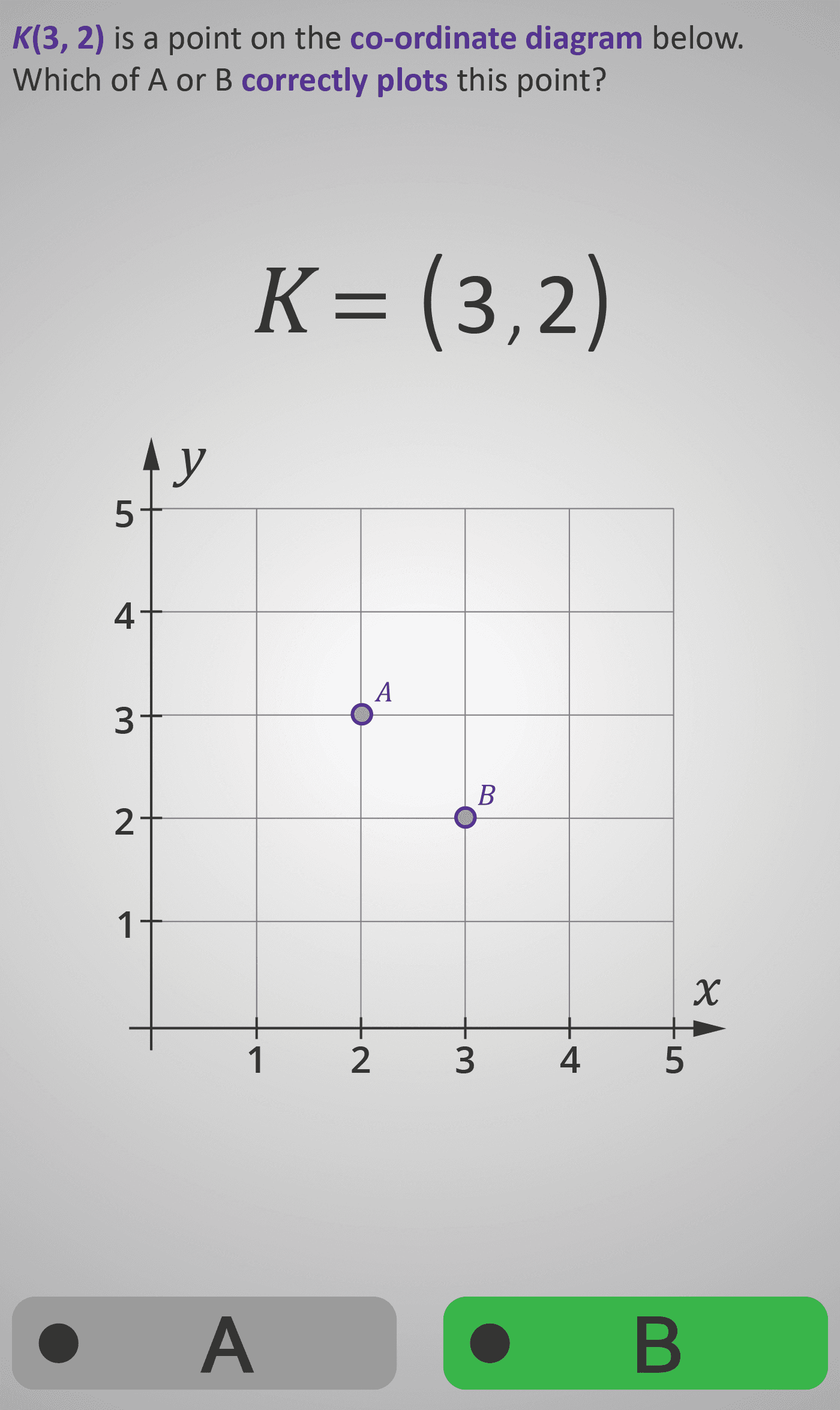
In this Phlow, learners practise identifying and plotting points accurately on a coordinate grid. Each question presents a coordinate pair such as K(3, 2), D(5, 5), or L(4, 6), along with two possible plotted points labelled A and B. Students must choose which point correctly matches the given coordinates.
The activity reinforces the fundamental rule that the first number represents the x-value (horizontal movement) and the second number represents the y-value (vertical movement). Through repetition and visual feedback, students internalise the key pattern: across first, then up.
The step-by-step sequence builds confidence in reading and plotting coordinates, preparing learners for later Phlows involving lines, midpoints, gradients, and shapes on the coordinate plane. Variation in grid scale and direction ensures true comprehension, not memorisation.
By the end, students can reliably translate between numerical coordinate pairs and plotted points — a foundational skill for geometry, algebra, and data representation.
Prerequisite Knowledge Required
- Co-ordinate 3A – Identifying the x- and y-axes.
- Co-ordinate 3B – Reading and interpreting coordinates.
- Understanding the origin and intersection of axes (0, 0).
- Recognising ordered pairs written as (x, y).
- Ability to count accurately along horizontal and vertical grid lines.
- Basic visual identification and pattern recognition skills.
Main Category
Geometry & Coordinate Algebra
Estimated Completion Time
Approx. 6–10 seconds per question (30 questions total). Total Time: 3–5 minutes.
Cognitive Load / Step Size
Low — each question isolates a single task: identifying which plotted point corresponds to a coordinate pair. The repetitive structure and immediate feedback support mastery through gradual pattern reinforcement.
Language & Literacy Demand
Low — clear and consistent phrasing (“Which of A or B correctly plots this point?”) allows all focus to remain on visual–numerical reasoning rather than reading. Minimal text ensures accessibility for all learners.
Clarity & Design
- Clean, uncluttered grids with well-spaced axes and labelled points.
- Purple highlighting of coordinates and plotted points for visual consistency.
- Simple typography and clear numeric display reinforce coordinate order.
- Visual cues link “across first, then up” with horizontal and vertical arrows.
Curriculum Alignment
Irish Junior Cycle Mathematics:
- Strand 3 – Geometry and Trigonometry
- Learning Outcomes:
- Plot and identify points on the coordinate plane using ordered pairs.
- Understand and apply the convention that coordinates are written as (x, y).
- Relate algebraic representations to geometric positions on the plane.
Engagement & Motivation
The visual “spot the correct point” design makes each question feel like a quick puzzle. The instant feedback loop builds confidence and satisfaction as students master accuracy through consistent application of the coordinate rule.
Error Opportunities & Misconceptions
- Reversing x and y coordinates (plotting vertically first).
- Miscounting grid squares from the origin.
- Assuming symmetrical points are equivalent.
- Ignoring axis scaling or orientation when grids vary.
Each misconception is addressed visually by showing correct vs. incorrect placement with clear contrastive cues.
Transferability / Real-World Anchoring
High — coordinate plotting underpins mapping, navigation, computer graphics, data visualisation, and engineering design. The skill transfers directly to higher-level geometry, algebra, and applied STEM tasks.
Conceptual vs Procedural Balance
Primarily procedural with conceptual reinforcement. Students apply the plotting rule repeatedly but also understand why order matters and how coordinates locate precise positions on a plane.
Learning Objectives Addressed
- Recognise that each ordered pair (x, y) identifies one unique point.
- Apply the correct sequence: move across (x) first, then up (y).
- Identify correct plotted points from multiple visual options.
- Strengthen two-dimensional spatial awareness and grid reasoning.
What Your Score Says About You
- Less than 5: You may be reversing coordinate order — remember, x comes first, then y.
- 6–7: You’re improving — slow down when counting along each axis.
- 8–9: You understand coordinate order well and can identify points quickly.
- 10 / 10: Excellent! You can now plot coordinates accurately — ready for lines, midpoints, and gradients next.