
Co-ordinate 3G
Overview
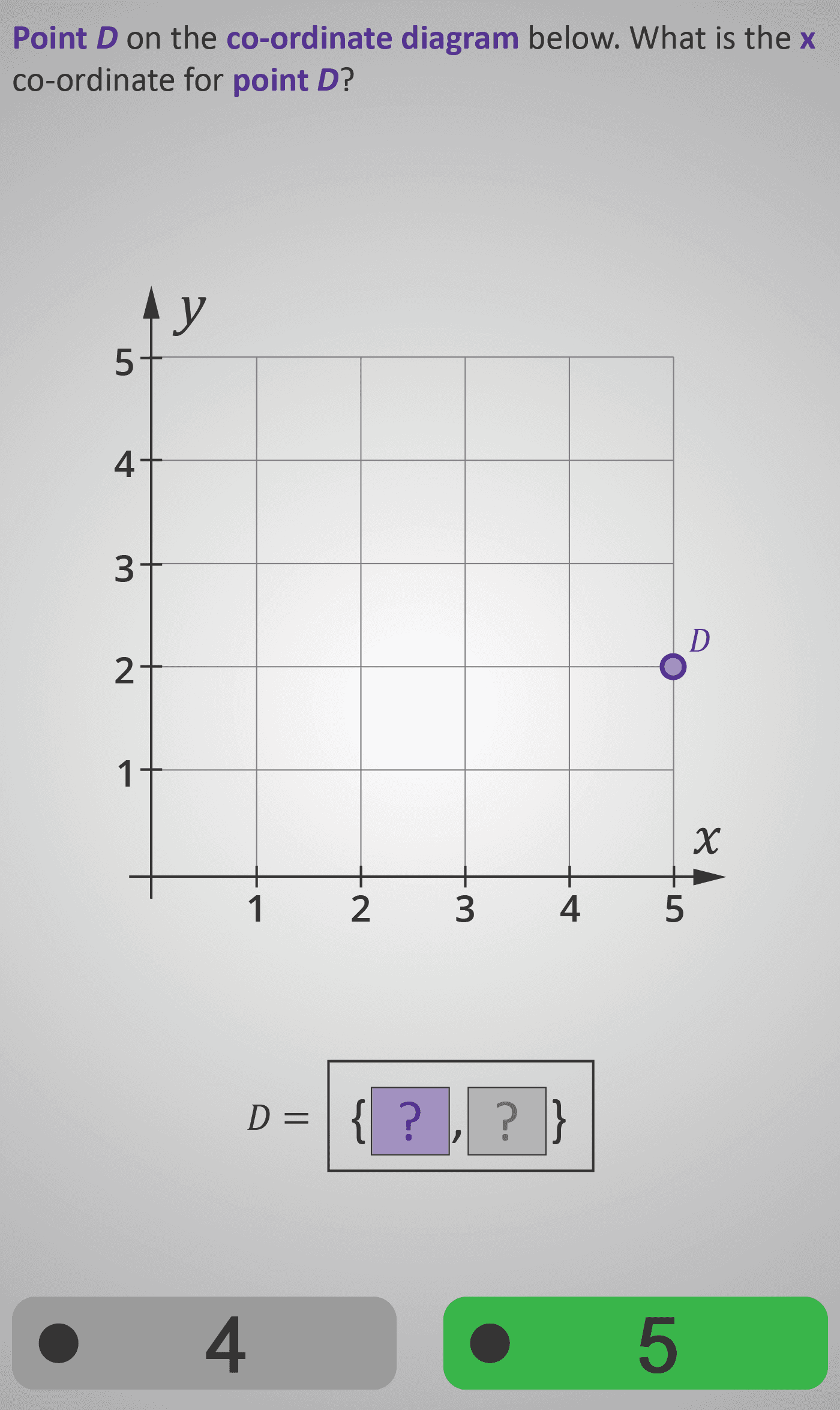
In this Phlow, students practise extracting the x- and y-values of points plotted on a coordinate grid. Each question isolates one component of a coordinate, for example:
- “What is the x-coordinate for point D?”
- “What is the y-coordinate for point F?”
Through examples like D(5, 2), F(2, 6), and G(0, 5), learners strengthen their understanding of how to move horizontally first (x) and vertically second (y). The activity reinforces the rule that coordinates are always written as ordered pairs (x, y), where the x-axis runs left–right and the y-axis runs up–down.
Learners progress from observing coordinates to confidently identifying them from any plotted point — including those on the axes. This visual, interactive approach ensures they internalise the coordinate convention through pattern, repetition, and feedback.
By completing this Phlow, students master how to read and write coordinates correctly — a vital skill before advancing to plotting, gradients, and midpoints in higher-level Phlows.
Prerequisite Knowledge Required
- Co-ordinate 3A – Understanding the x- and y-axes.
- Co-ordinate 3B – Reading points on a grid.
- Knowing that coordinates are written as ordered pairs (x, y).
- Ability to count along grid lines horizontally and vertically.
- Familiarity with uniform grid spacing and numeric labelling.
Main Category
Geometry & Coordinate Algebra
Estimated Completion Time
Approx. 6–10 seconds per question (30 questions total). Total Time: 3–5 minutes.
Cognitive Load / Step Size
Low — each screen isolates one small cognitive action (identifying either the x- or y-coordinate). The single-variable focus minimises distraction and supports accurate pattern recognition.
Language & Literacy Demand
Low — short, repetitive phrasing and highlighted key terms (x-coordinate, y-coordinate) ensure clarity. Colour-coded axis labels visually reinforce meaning, removing reliance on extended text.
Clarity & Design
- Single-point diagrams prevent visual overload.
- Purple highlighting of points (e.g., D, F, G) and boxed coordinate values maintain focus.
- Axis arrows and clear grid numbering reinforce spatial orientation.
- Simple layout allows learners to connect diagram → question → answer directly.
Curriculum Alignment
Irish Junior Cycle Mathematics:
- Strand 3 – Geometry and Trigonometry
- Learning Outcomes:
- Identify and record coordinates of given points on the coordinate plane.
- Understand and apply the convention that x- and y-values represent horizontal and vertical distances from the origin.
Engagement & Motivation
The task design offers immediate feedback and clear success markers. The repetitive yet fast-paced structure builds mastery through instant validation, encouraging confidence in reading and recognising coordinates accurately.
Error Opportunities & Misconceptions
- Reversing x and y values when reading or writing coordinates.
- Counting incorrectly along one axis or misreading scale intervals.
- Assuming both coordinates must be non-zero for a plotted point.
Each misconception is corrected through clear colour-coded cues and comparative feedback between the correct and incorrect coordinate positions.
Transferability / Real-World Anchoring
High — accurate reading of coordinates supports real-world applications such as map reading, computer graphics, engineering design, and data plotting. It provides the foundation for all future coordinate geometry and algebraic graphing.
Conceptual vs Procedural Balance
Procedural fluency reinforced by conceptual understanding — learners repeatedly identify and label coordinates but also understand why x and y positions define unique points in two-dimensional space.
Learning Objectives Addressed
- Identify x- and y-coordinates of plotted points.
- Recognise that x represents horizontal distance and y represents vertical distance from the origin.
- Write coordinates in correct ordered-pair form (x, y).
- Read grid diagrams accurately, including points on axes.
What Your Score Says About You
- Less than 5: You may be mixing up axes — review which direction represents x and y.
- 6–7: You’re improving — focus on carefully checking coordinate order.
- 8–9: You read coordinates accurately and understand how positions relate to the axes.
- 10 / 10: Excellent! You can now read coordinates with precision — ready to move on to plotting lines and interpreting graphs.