
Cylinder 3A
Overview
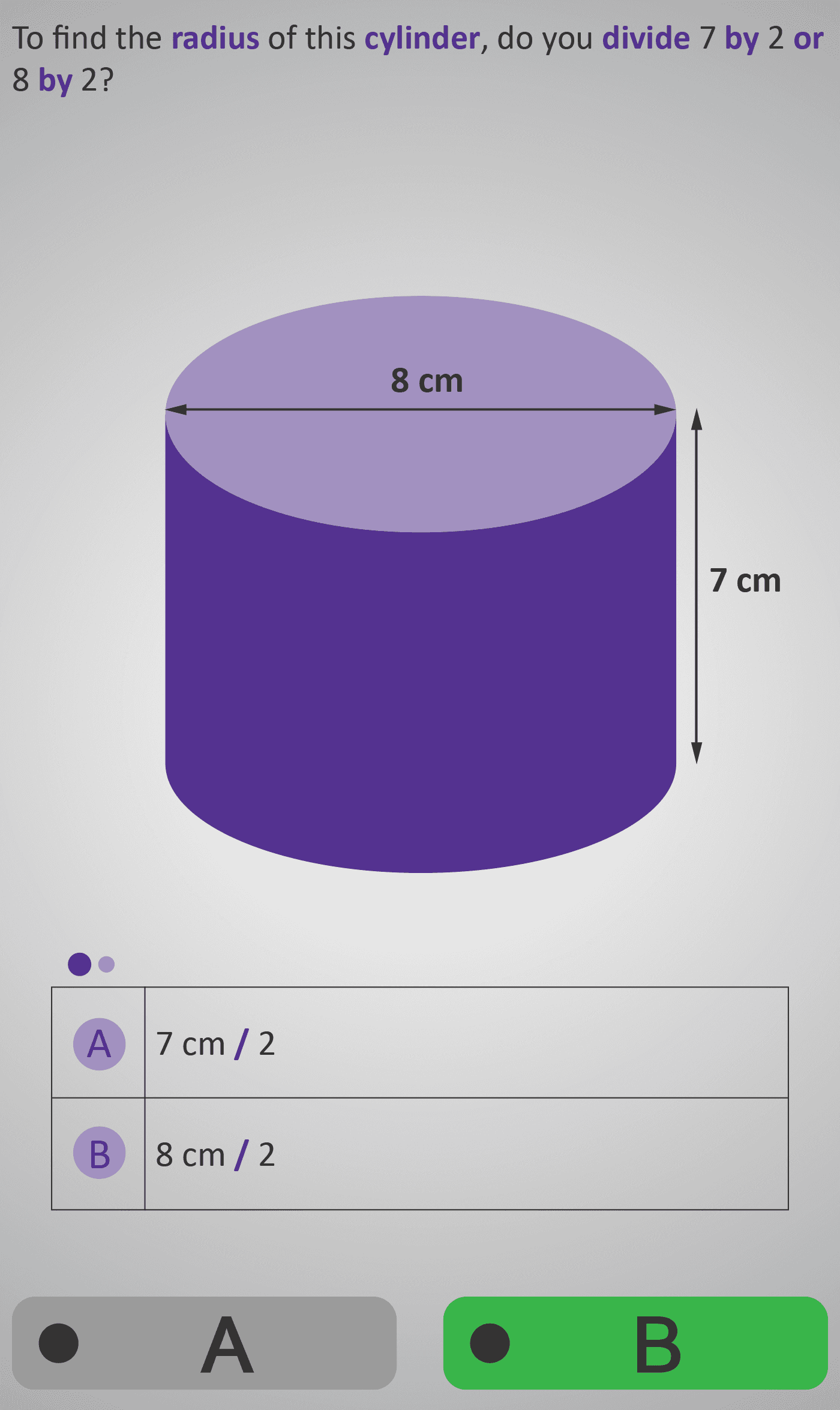
In this Phlow, learners explore the relationship between a cylinder’s radius, diameter, and height. They begin with questions such as whether to divide the height or the diameter by 2 to find the radius — reinforcing that the radius always comes from the diameter, not the height.
Through visual prompts, students practise halving the diameter (e.g. 8 cm ÷ 2 = 4 cm) to find the radius, and doubling the radius (e.g. 15 cm × 2 = 30 cm) to find the diameter. The clear, step-by-step format links 3D visuals of cylinders to 2D circle diagrams, showing that a cylinder’s circular base behaves like a circle.
This understanding prepares learners for later topics, such as calculating circumference, surface area, and volume. By the end, students can confidently identify which measurement is which, explain the relationship between radius and diameter, and convert between them using simple multiplication or division.
Prerequisite Knowledge Required
- Circle 2A – Identifying Parts of a Circle.
- Circle 2B – Radius and Diameter Relationship.
- Understanding that the radius extends from the centre to the edge of a circle.
- Knowing that the diameter passes through the centre and connects two edges of a circle.
- Familiarity with dividing and multiplying by 2.
- Recognising standard measurement units (cm, m).
Main Category
Measurement & Geometry
Estimated Completion Time
Approx. 5–8 seconds per question (30 questions total). Total Time: 3–4 minutes.
Cognitive Load / Step Size
Low to Moderate — each question requires one clear step (either multiplying or dividing by 2). The repeated visual structure reinforces understanding without overloading working memory.
Language & Literacy Demand
Low — consistent, simple vocabulary (“radius,” “diameter,” “divide,” “multiply”) is reinforced visually. Key terms are colour-coded to aid comprehension and recall.
Clarity & Design
- Clean combination of 3D and 2D visuals reinforces conceptual understanding.
- Purple highlights draw focus to the circular dimensions, not the cylinder’s height.
- Consistent labelling and unit notation prevent confusion.
- Balanced use of visuals and text supports both procedural and visual learners.
Curriculum Alignment
Irish Junior Cycle Mathematics:
- Strand 3 – Geometry and Trigonometry
- Learning Outcomes:
- Identify radius and diameter in circles and cylinders.
- Understand and apply the relationship diameter = 2 × radius.
- Use this relationship to find missing measurements.
Engagement & Motivation
Visually engaging and intuitive — the 3D cylinder models paired with quick-response questions promote curiosity and confidence. Immediate visual feedback reinforces understanding through repetition and correction.
Error Opportunities & Misconceptions
- Confusing diameter with height.
- Forgetting that radius = diameter ÷ 2.
- Reversing operations (dividing instead of multiplying, or vice versa).
- Misinterpreting measurement lines in 3D diagrams.
Each misconception is addressed through targeted feedback and clear diagrammatic cues.
Transferability / Real-World Anchoring
High — learners connect mathematical reasoning to everyday cylindrical objects such as cans, bottles, pipes, and wheels. This concept supports later understanding of surface area, volume, and circular motion.
Conceptual vs Procedural Balance
Strong conceptual grounding with procedural fluency — learners both see and apply the rule linking radius and diameter, building confidence in both visual reasoning and calculation.
Learning Objectives Addressed
- Distinguish between radius, diameter, and height in a cylinder.
- Apply the relationships r = d ÷ 2 and d = 2r.
- Interpret visual representations of circular dimensions in 3D contexts.
- Prepare for surface area and volume calculations in later Phlows.
What Your Score Says About You
- Less than 5: You may be mixing up the cylinder’s height and diameter — review which line measures across the circle.
- 6–7: You understand the idea but may need to review when to multiply or divide by 2.
- 8–9: Excellent! You can confidently find missing measurements using the correct operation.
- 10 / 10: Perfect understanding — you’re ready to use radius and diameter in formulas for area, circumference, and volume.