
Cylinder 3B
Overview
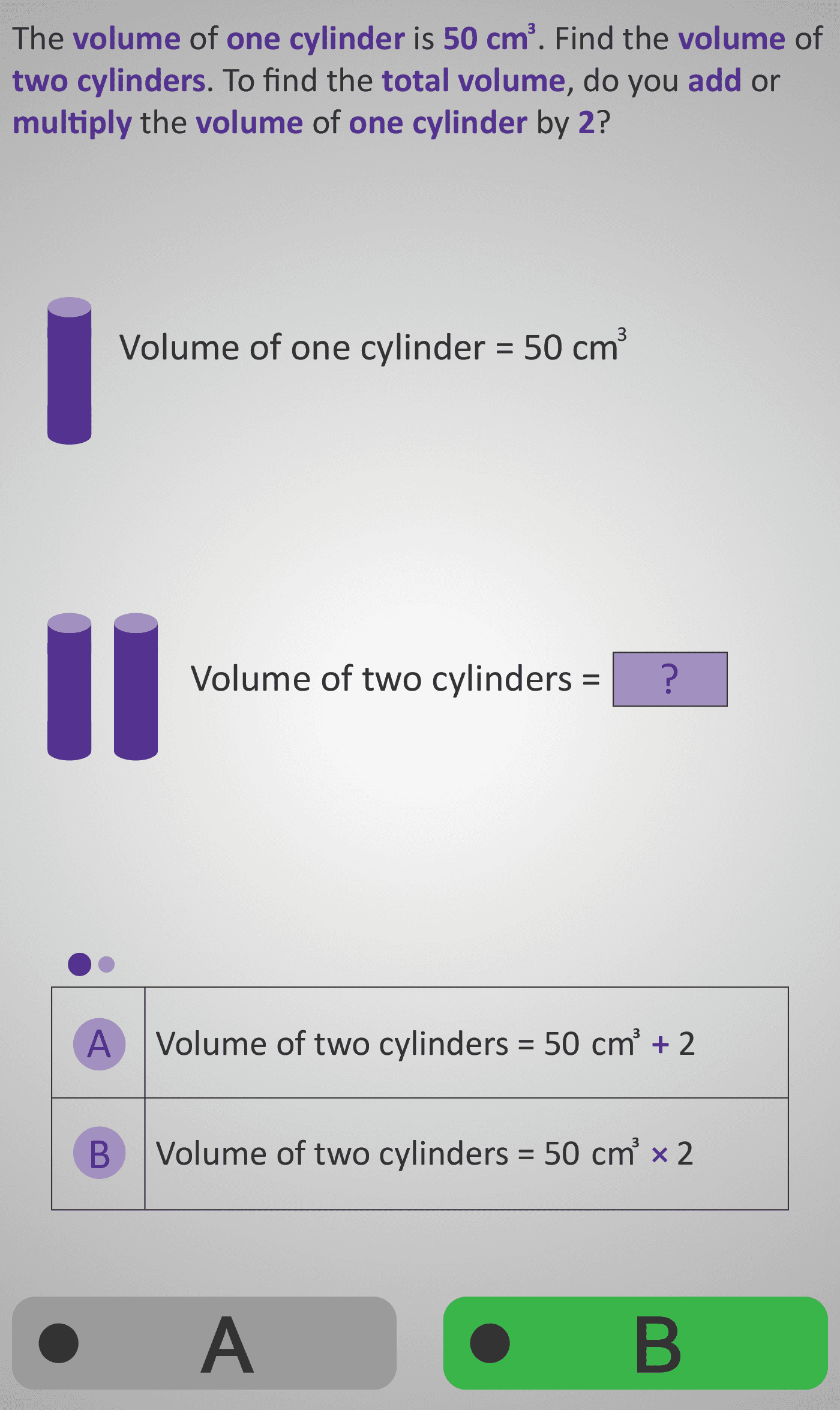
In this Phlow, learners progress from understanding the volume of a single cylinder to calculating the combined volume of multiple identical cylinders. They begin with simple prompts such as:
“The volume of one cylinder is 50 cm³. What is the volume of two cylinders?”
By comparing single and multiple shapes visually, learners see that to find total volume, they multiply the volume of one cylinder by the number of cylinders — for example:
50 × 2 = 100 cm³
This pattern extends naturally to larger quantities, such as four cylinders: 200 × 4 = 800 cm³. The consistent use of identical shapes reinforces proportional reasoning — when the number of cylinders doubles or quadruples, the total volume increases by the same factor.
By the end, learners can confidently apply multiplicative reasoning to volume and distinguish when to use multiplication rather than addition in volume-based contexts.
Prerequisite Knowledge Required
- Cylinder 3A – Understanding Radius and Diameter of a Cylinder.
- Understanding that volume measures 3D space in cubic units (cm³).
- Ability to multiply by small whole numbers (2, 3, 4).
- Knowing what “total” and “per one” mean in practical maths contexts.
Main Category
Measurement & Geometry
Estimated Completion Time
Approx. 8–12 seconds per question (30 questions total). Total Time: 4–6 minutes.
Cognitive Load / Step Size
Low to Moderate — each step introduces a small, manageable scaling increase (e.g. one cylinder → two → four). The operation (multiplication) is familiar, so cognitive demand focuses on understanding its geometric meaning.
Language & Literacy Demand
Low — clear, repetitive phrasing (“one cylinder,” “two cylinders,” “total volume”) reduces reading load. Visual emphasis on numbers and units (cm³) supports comprehension without heavy text.
Clarity & Design
- Graphics clearly display groups of identical cylinders.
- Purple highlighting links multiplication visually to scaling.
- Consistent use of units (cm³) reinforces measurement awareness.
- Simple, uncluttered visuals promote focus on multiplicative relationships.
Curriculum Alignment
Irish Junior Cycle Mathematics:
- Strand 4 – Measures
- Learning Outcomes:
- Recognise and calculate total volume for repeated 3D shapes.
- Apply multiplicative reasoning to solve practical measurement problems.
- Use and interpret correct volume units (cm³, m³).
Engagement & Motivation
The real-world connection — such as stacking cans, filling containers, or packing cylinders — makes the task instantly relevant. Quick, visually guided questions sustain engagement and confidence through pattern recognition and repetition.
Error Opportunities & Misconceptions
- Adding instead of multiplying the given volume.
- Omitting or misusing units (cm³).
- Miscounting the number of cylinders shown.
- Confusing “volume per one” with “total volume.”
The Phlow’s clear numeric and visual comparisons address these misconceptions immediately through feedback and examples.
Transferability / Real-World Anchoring
High — learners can apply this concept to real-life scenarios like storage, packaging, shipping, and construction. The reasoning supports spatial thinking and estimation skills essential in applied measurement.
Conceptual vs Procedural Balance
Strong procedural fluency built on clear conceptual grounding — learners see why multiplication represents repeated volume, then practise it repeatedly until fluent.
Learning Objectives Addressed
- Understand that total volume = volume of one object × number of objects.
- Recognise volume as a multiplicative quantity, not additive.
- Apply unit reasoning (cm³) consistently in calculations.
- Connect symbolic operations (×) to real-world 3D measurements.
What Your Score Says About You
- Less than 5: You may be adding instead of multiplying — check when “total” means repeated equal quantities.
- 6–7: You’re close — review examples of repeated multiplication in real contexts (e.g. stacking, storage).
- 8–9: Great understanding — you can calculate total volumes accurately and efficiently.
- 10 / 10: Excellent! You fully understand that total volume scales proportionally with the number of identical cylinders.