
Decimals 3A
Overview
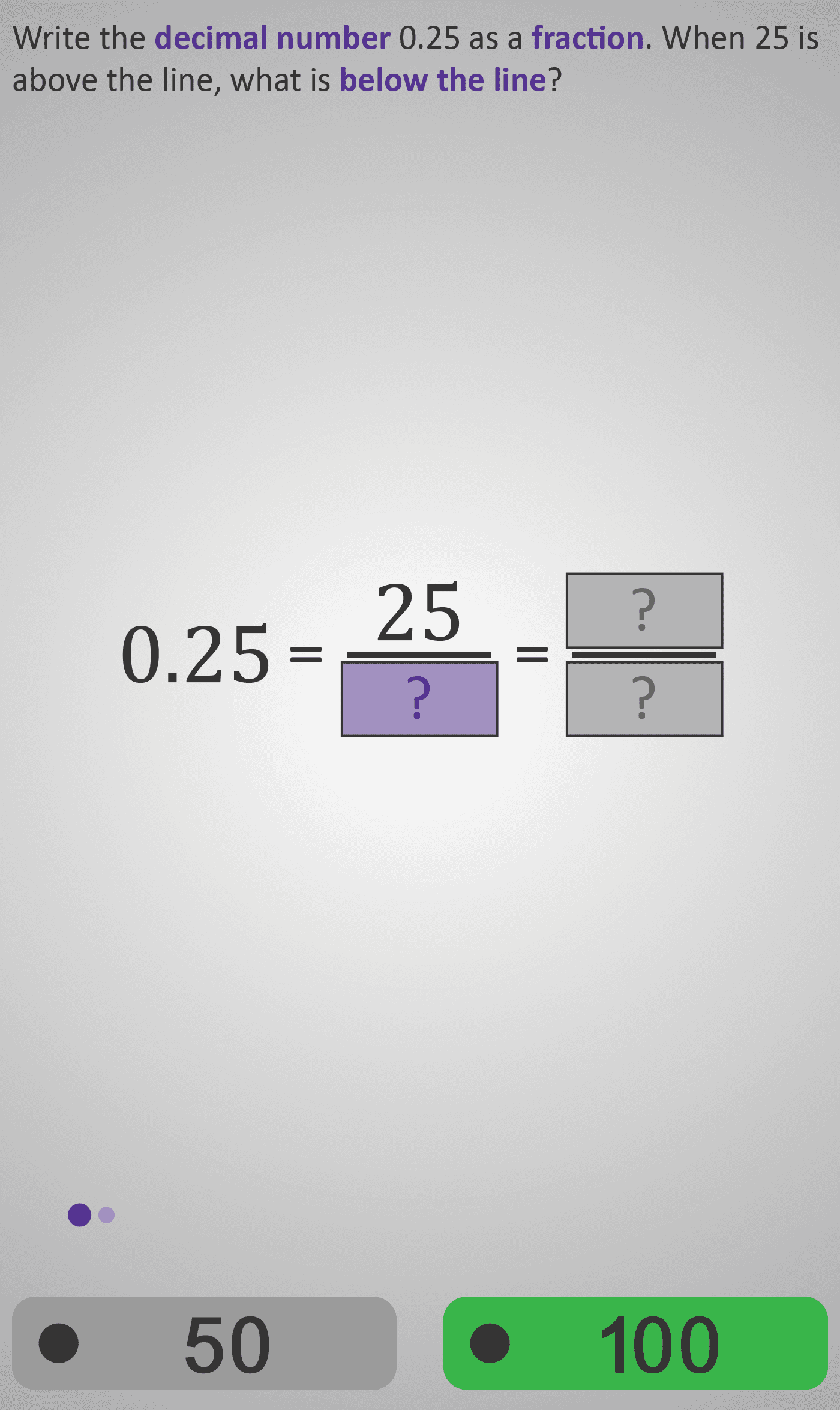
In this Phlow, learners explore the connection between decimal and fraction representations of the same number. They begin with simple decimals like 0.25 and 0.70, identifying what goes below the line (the denominator) based on place value — for two decimal places, the denominator is 100.
0.25 = 25⁄100, 0.70 = 70⁄100
Next, they simplify each fraction by dividing both numerator and denominator by their greatest common factor:
25⁄100 = 1⁄4, 70⁄100 = 7⁄10
Through visual cues such as “above the line” and “below the line,” students build a strong conceptual understanding of how decimals correspond to fractions. Each question isolates one step — identifying the denominator, writing the fraction, or simplifying — helping learners master the conversion process systematically.
By the end, learners can confidently switch between decimals and fractions, understand the meaning of tenths and hundredths, and simplify to lowest terms with ease.
Prerequisite Knowledge Required
- Decimals 2B – Understanding Tenths and Hundredths.
- Fractions 2A – Understanding Numerators and Denominators.
- Recognising that 0.1 = one tenth and 0.01 = one hundredth.
- Understanding that digits after the decimal point represent parts of a whole.
- Ability to divide and multiply small numbers by 10 and 100.
Main Category
Number & Fractions
Estimated Completion Time
Approx. 8–12 seconds per question (30 questions total). Total Time: 4–6 minutes.
Cognitive Load / Step Size
Moderate — the concept is introduced in small, visual steps (decimal → fraction → simplified fraction). “Above/below the line” visual guidance keeps attention focused and prevents overload.
Language & Literacy Demand
Low to Moderate — short, consistent phrasing such as “What is below the line?” or “Simplify the fraction” allows learners to focus on symbols rather than reading. Colour-coded numerators and denominators guide attention to position.
Clarity & Design
- High visual clarity using purple shading to highlight active parts of the calculation.
- Equal-sized numerator and denominator boxes reinforce proportional structure.
- Decimals and fractions displayed side-by-side for direct visual linkage.
- Minimal text supports a clean, focused learning experience.
Curriculum Alignment
Irish Junior Cycle Mathematics:
- Strand 1 – Number
- Learning Outcomes:
- Convert between decimals and fractions.
- Simplify fractions to their lowest terms.
- Recognise the link between tenths, hundredths, and place value.
Engagement & Motivation
The transformation of decimals into fractions provides instant visual feedback and satisfaction. The clear progression from easy to slightly harder examples (e.g., 0.25 → 0.7 → 0.125) keeps engagement high while reinforcing success at each step.
Error Opportunities & Misconceptions
- Writing 0.25 as 25⁄10 instead of 25⁄100.
- Forgetting to simplify the fraction fully.
- Reversing numerator and denominator placement.
- Treating decimals as whole numbers (e.g., 0.25 = 25⁄1).
Each misconception is addressed through contrasting examples and guided corrections.
Transferability / Real-World Anchoring
High — understanding decimal–fraction equivalence is essential for interpreting money, measurements, percentages, and data. It provides a foundation for ratio and proportion reasoning in later topics.
Conceptual vs Procedural Balance
Balanced — learners gain procedural fluency in conversion and simplification while strengthening their conceptual grasp of place value and fractional meaning.
Learning Objectives Addressed
- Identify the denominator from decimal place value (10, 100, etc.).
- Write decimals as equivalent fractions.
- Simplify fractions to their simplest form.
- Explain the relationship between decimals, fractions, and percentages.
What Your Score Says About You
- Less than 5: Review place value — remember that two decimal places represent hundredths.
- 6–7: You understand conversion steps but may need to practise simplifying fractions.
- 8–9: You can confidently convert and simplify decimals and fractions.
- 10 / 10: Excellent! You fully understand decimal–fraction equivalence — ready for percentage conversions next.