
Decimals 3B
Overview
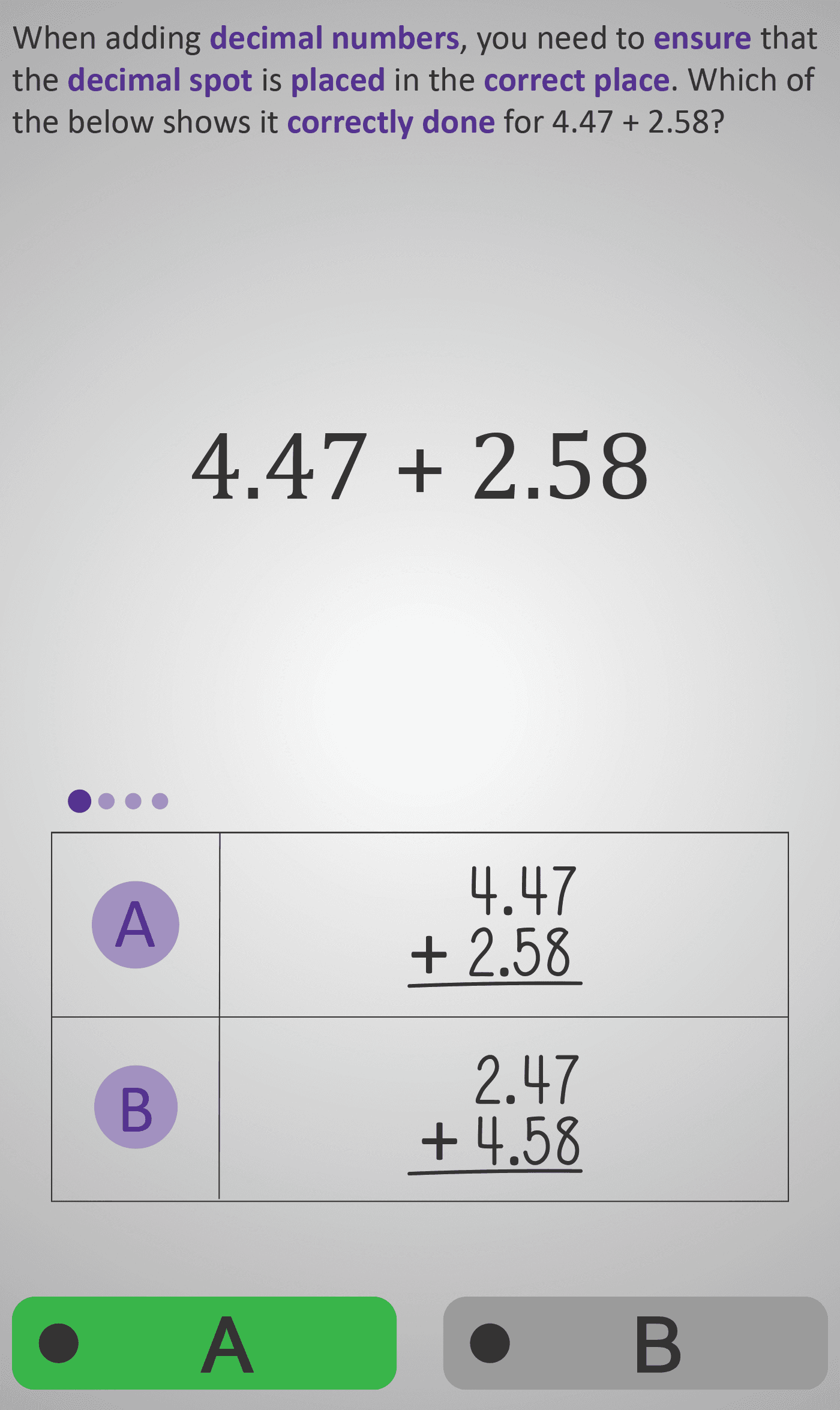
In this Phlow, learners are guided step-by-step through the process of adding two decimal numbers accurately. The activity begins by reinforcing the crucial rule of lining up the decimal points before adding — for example, when calculating 4.47 + 2.58.
Students first identify the correct alignment of digits (Option A), and then move into the addition process column by column. Each screen isolates one small decision:
- Adding the hundredths (7 + 8 = 15 → place the 5, carry the 1)
- Adding the tenths (4 + 5 + 1 = 10 → place the 0, carry the 1)
- Adding the whole numbers (4 + 2 + 1 = 7)
Visual prompts such as “What number do you place here?” reinforce proper column alignment and placement. The final answer (7.05) shows that the decimal point must remain vertically aligned throughout.
This clear, visual sequence ensures that learners not only perform each step correctly but also understand why place value alignment is essential for accuracy in all decimal operations.
Prerequisite Knowledge Required
- Decimals 2C – Understanding Decimal Place Value.
- Addition 2B – Carrying in Whole Number Addition.
- Understanding tenths and hundredths in place value.
- Ability to add two-digit numbers with regrouping (carrying).
- Recognising that the decimal point separates whole and fractional parts.
Main Category
Number & Operations
Estimated Completion Time
Approx. 8–12 seconds per question (30 questions total). Total Time: 4–6 minutes.
Cognitive Load / Step Size
Moderate — each micro-step (alignment, addition, carrying, placement) is isolated and reinforced visually. The progression ensures comprehension without cognitive overload while gradually building toward full-column addition mastery.
Language & Literacy Demand
Low to Moderate — instructions are brief and repetitive (“What digit do you place here?”), while animation and colour cues communicate key concepts like carrying and alignment. Learners focus on numerical reasoning rather than heavy text.
Clarity & Design
- Decimals align vertically to emphasise correct placement of the decimal point.
- A pencil animation guides learners through each step of the calculation.
- Purple highlighting reinforces active digits and carried values.
- Consistent, uncluttered layout ensures focus on essential arithmetic relationships.
Curriculum Alignment
Irish Junior Cycle Mathematics:
- Strand 1 – Number
- Learning Outcomes:
- Add and subtract decimal numbers accurately.
- Apply place value knowledge to align decimals correctly.
- Understand and apply carrying within decimal addition.
Engagement & Motivation
The interactive and visual nature of this Phlow encourages engagement by simulating the experience of working through each column. The dynamic feedback loop (correct/incorrect prompts) and visible progression build both accuracy and confidence.
Error Opportunities & Misconceptions
- Misaligning decimal points (treating decimals like whole numbers).
- Forgetting to carry a digit to the next column.
- Omitting placeholder zeros (writing 7.5 instead of 7.05).
- Adding across mismatched decimal places (tenths with hundredths).
These misconceptions are corrected through immediate visual feedback and structured scaffolding.
Transferability / Real-World Anchoring
High — decimal addition directly supports real-life tasks such as adding prices, measurements, and data values. It reinforces money-based reasoning (€4.47 + €2.58) and metric understanding (e.g., lengths, weights, distances).
Conceptual vs Procedural Balance
Balanced — while learners gain procedural fluency through repetition, the concept of decimal place alignment is continually reinforced visually to promote deep understanding of why the method works.
Learning Objectives Addressed
- Line up decimal points correctly before adding.
- Add decimal numbers to two decimal places with regrouping.
- Maintain the decimal point’s position in the final answer.
- Use estimation or mental checks to verify addition accuracy.
What Your Score Says About You
- Less than 5: You may be misaligning decimals — review how the decimal separates whole and fractional parts.
- 6–7: You understand alignment but may need more practice with carrying between columns.
- 8–9: You’re accurate and consistent — just double-check your placement of zeros and decimal points.
- 10 / 10: Excellent! You can add decimals with precision — ready to move on to subtracting decimals next.