
Decimals 3C
Overview
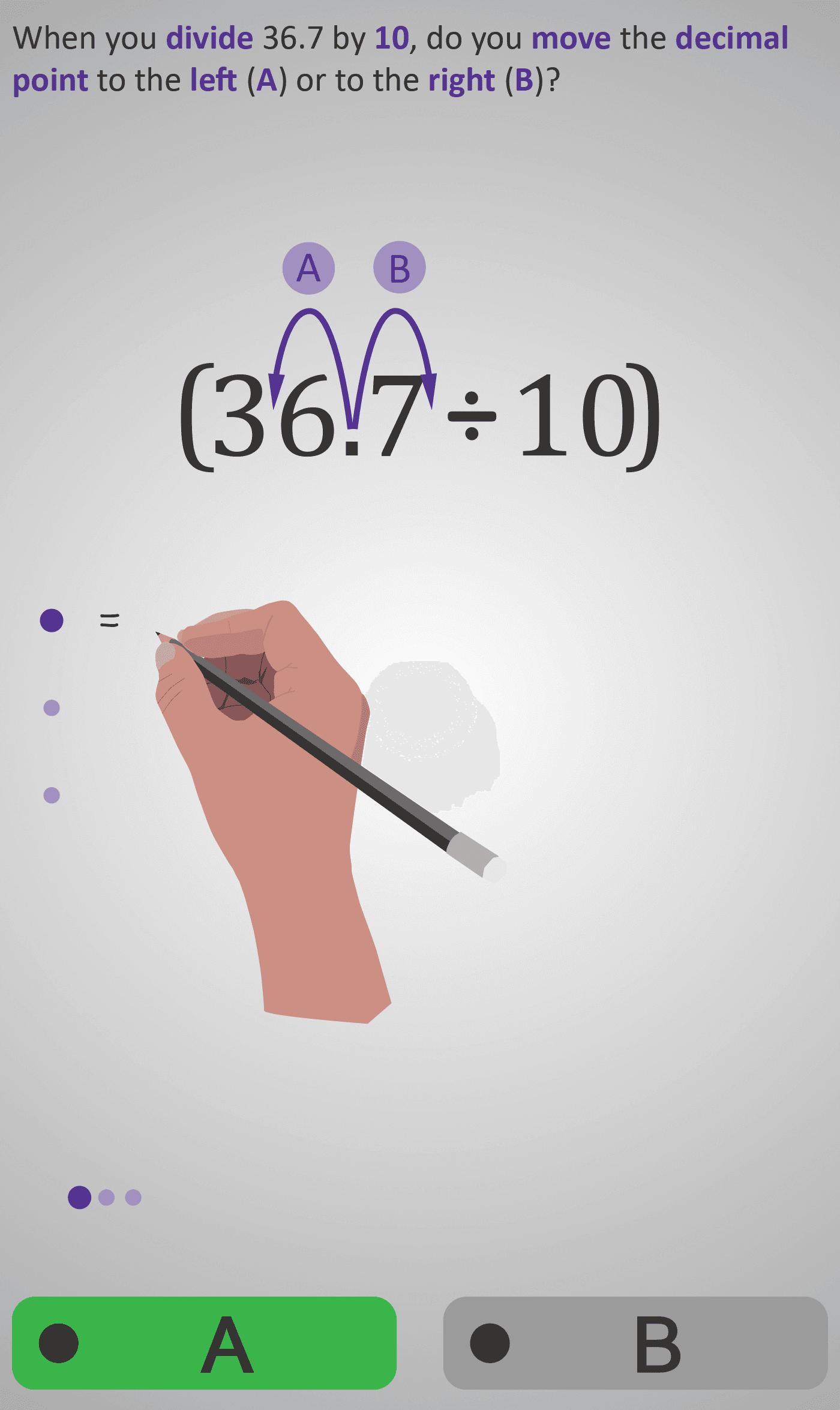
In this Phlow, learners are introduced to how dividing by powers of 10 affects a decimal number. They begin with an example such as 36.7 ÷ 10 and are asked whether the decimal point moves left or right. Through visual arrows and animation, they observe that dividing shifts the decimal one place to the left, turning 36.7 into 3.67.
The sequence then reinforces understanding by breaking the reasoning into small, clear steps:
- Identifying the direction of the decimal shift — left for division.
- Crossing out one zero in 10 after the shift, linking the divisor to the number of moves.
- Recognising that dividing by 1 leaves the number unchanged.
Each stage blends visual reasoning with symbolic understanding, showing how one operation (÷10) can be understood through movement rather than memorised rules. By the end, students see that dividing by 10 reduces the number’s value by a factor of 10, and that the decimal’s movement reflects a structured place value shift.
Prerequisite Knowledge Required
- Decimals 3B – Adding Decimal Numbers.
- Place Value 2C – Understanding Tens and Units.
- Understanding place value: tens, ones, tenths, hundredths.
- Recognising that division means splitting or grouping.
- Knowing that multiplying by 10 increases a number’s value (this Phlow builds the inverse concept).
Main Category
Number & Place Value
Estimated Completion Time
Approx. 8–12 seconds per question (30 questions total). Total Time: 4–6 minutes.
Cognitive Load / Step Size
Low to Moderate — each step isolates one transformation: moving the decimal once, crossing out a zero, or reading the new value. This clear progression helps learners visualise how the operation connects to place value.
Language & Literacy Demand
Low — minimal text with strong visual reinforcement. Key words such as “divide,” “move left,” and “decimal point” are consistently repeated and highlighted. Symbolic representation (36.7 ÷ 10 → 3.67) communicates the logic visually.
Clarity & Design
- Purple arrows and motion visuals clearly indicate the direction of the decimal shift.
- The cross-out of a zero reinforces the logic of division by 10.
- Animations and handwriting visuals maintain attention and comprehension.
- Clean, minimalist layout keeps focus on the transformation itself.
Curriculum Alignment
Irish Junior Cycle Mathematics:
- Strand 1 – Number
- Learning Outcomes:
- Divide decimal numbers by 10 and explain the place value shift.
- Describe the meaning of dividing by powers of 10.
- Represent division by 10 visually and symbolically.
Engagement & Motivation
The short, discovery-based structure keeps students engaged as each question reveals a predictable, satisfying pattern. The visible decimal movement reinforces understanding through action and promotes a sense of achievement with each small success.
Error Opportunities & Misconceptions
- Moving the decimal point in the wrong direction (right instead of left).
- Adding instead of removing a zero after division.
- Thinking dividing by 10 increases rather than decreases a number.
- Confusing decimal shift with digit value changes.
Each misconception is addressed visually with before-and-after comparisons and guided correction prompts.
Transferability / Real-World Anchoring
High — the concept applies directly to unit conversions (cm → m, g → kg), financial scaling, and data adjustments. Understanding decimal shifts supports real-world numeracy and metric reasoning.
Conceptual vs Procedural Balance
Balanced — learners gain procedural fluency in dividing by 10, but more importantly, develop conceptual understanding of why the decimal point moves left and how this connects to place value.
Learning Objectives Addressed
- Recognise that dividing by 10 shifts digits one place to the left.
- Perform simple decimal division by 10 accurately.
- Explain the connection between place value, division, and scaling.
- Describe why dividing by 10 reduces a number’s size by a factor of 10.
What Your Score Says About You
- Less than 5: You may be unsure about the decimal’s direction — review how division makes numbers smaller.
- 6–7: You’re starting to grasp the pattern — focus on the place value logic behind the shift.
- 8–9: Strong understanding — you can explain and apply the decimal shift accurately.
- 10 / 10: Excellent! You confidently divide decimals by 10 and understand exactly why the decimal moves left.