
Decimals 3D
Overview
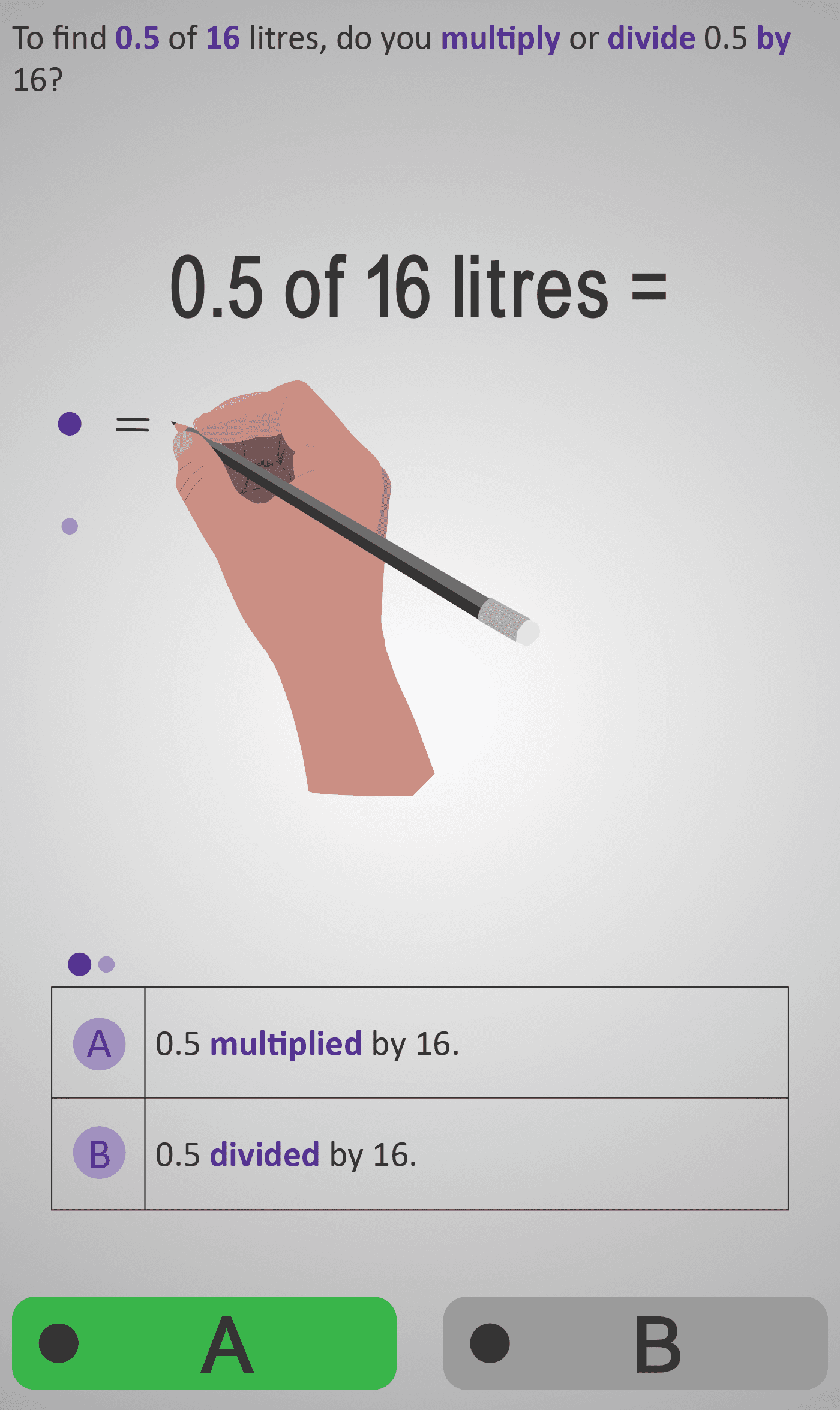
In this Phlow, learners connect decimals to real-world measures by calculating a fraction of a quantity using decimals. The concept of “0.5 of 16 litres” is introduced visually, prompting learners to decide whether to multiply or divide. They quickly learn that to find “of,” you multiply — so 0.5 × 16 = 8.
The following examples deepen understanding with decimals less than one, such as 0.25 × 20, showing that the result (5) represents a quarter of the whole. Each step visually reinforces:
- The relationship between decimals and fractions (e.g. 0.5 = ½, 0.25 = ¼).
- Multiplication as scaling down when the decimal is less than 1.
- How to apply this understanding to real-world contexts (litres, kilograms, etc.).
This Phlow builds proportional reasoning and bridges the gap between fractional understanding and decimal multiplication. Learners develop the crucial insight that multiplying by a decimal smaller than 1 reduces a number — a key conceptual milestone in understanding scaling.
Prerequisite Knowledge Required
- Decimals 3C – Dividing by 10.
- Fractions 2C – Understanding Halves and Quarters.
- Multiplication 2B – Multiplying by Whole Numbers.
- Understanding what a decimal represents (tenths, hundredths).
- Recognising simple equivalences such as 0.5 = ½ and 0.25 = ¼.
- Confidence with basic multiplication facts.
- Familiarity with everyday quantities (litres, kilograms, etc.).
Main Category
Number & Proportion
Estimated Completion Time
Approx. 10 seconds per question (30 questions total). Total Time: 5 minutes.
Cognitive Load / Step Size
Moderate — this Phlow integrates decimals, fractions, and multiplication concepts but introduces them in small, guided steps. Each screen follows the pattern “identify → multiply → interpret result,” allowing understanding to build gradually without overload.
Language & Literacy Demand
Moderate — the mathematical meaning of “of” is emphasised repeatedly as shorthand for “multiply.” Contextual examples involving litres and kilograms add meaning while maintaining simple phrasing. Repeated prompts (“Find 0.25 of 20”) encourage verbal fluency and automatic recognition.
Clarity & Design
- Sequential, clean layout presenting one decision at a time.
- Clear visual steps: choose the operation → perform multiplication → interpret result.
- Purple highlighting of multiply and equals reinforces key logic.
- Animated examples and the moving pencil guide attention to each stage of reasoning.
Curriculum Alignment
Irish Junior Cycle Mathematics:
- Strand 1 – Number
- Learning Outcomes:
- Multiply decimals by whole numbers accurately.
- Interpret “of” as multiplication in proportional reasoning.
- Connect fractions, decimals, and percentages as equivalent forms.
Engagement & Motivation
The use of real-life examples (ingredients, weights, and measures) creates an intuitive connection between abstract decimals and tangible contexts. Instant green/red feedback reinforces correct reasoning and promotes a satisfying sense of mastery with each correct response.
Error Opportunities & Misconceptions
- Confusing “of” with division instead of multiplication.
- Expecting the result to be larger when multiplying by decimals less than one.
- Misinterpreting 0.25 as “add 0.25” instead of multiply.
- Neglecting to include units (litres, kilograms) in interpretation.
Each misconception is corrected visually through contrast examples and explicit feedback.
Transferability / Real-World Anchoring
Very high — learners apply these skills directly to recipes, measurement scaling, budgeting, and discount calculations. This Phlow provides the conceptual foundation for percentages, ratios, and proportional reasoning in higher levels.
Conceptual vs Procedural Balance
Balanced — the Phlow moves fluidly from conceptual (“‘of’ means multiply”) to procedural (decimal × whole number) understanding. Repetition across multiple real-world examples reinforces both meaning and method.
Learning Objectives Addressed
- Recognise that “of” represents multiplication.
- Multiply whole numbers by decimals smaller than one.
- Understand that multiplying by decimals reduces a quantity proportionally.
- Apply this reasoning to practical contexts involving measurement.
What Your Score Says About You
- Less than 5: You may still be mixing up “multiply” and “divide” — review what “of” means in maths.
- 6–7: You’re recognising the rule — focus on observing how multiplying by decimals changes size.
- 8–9: You understand decimals as fractions — you’re applying proportional reasoning confidently.
- 10 / 10: Excellent! You can fluently find decimal parts of real-world quantities — ready for percentages and ratio problems next.