
Electricity Bill 3B
Overview
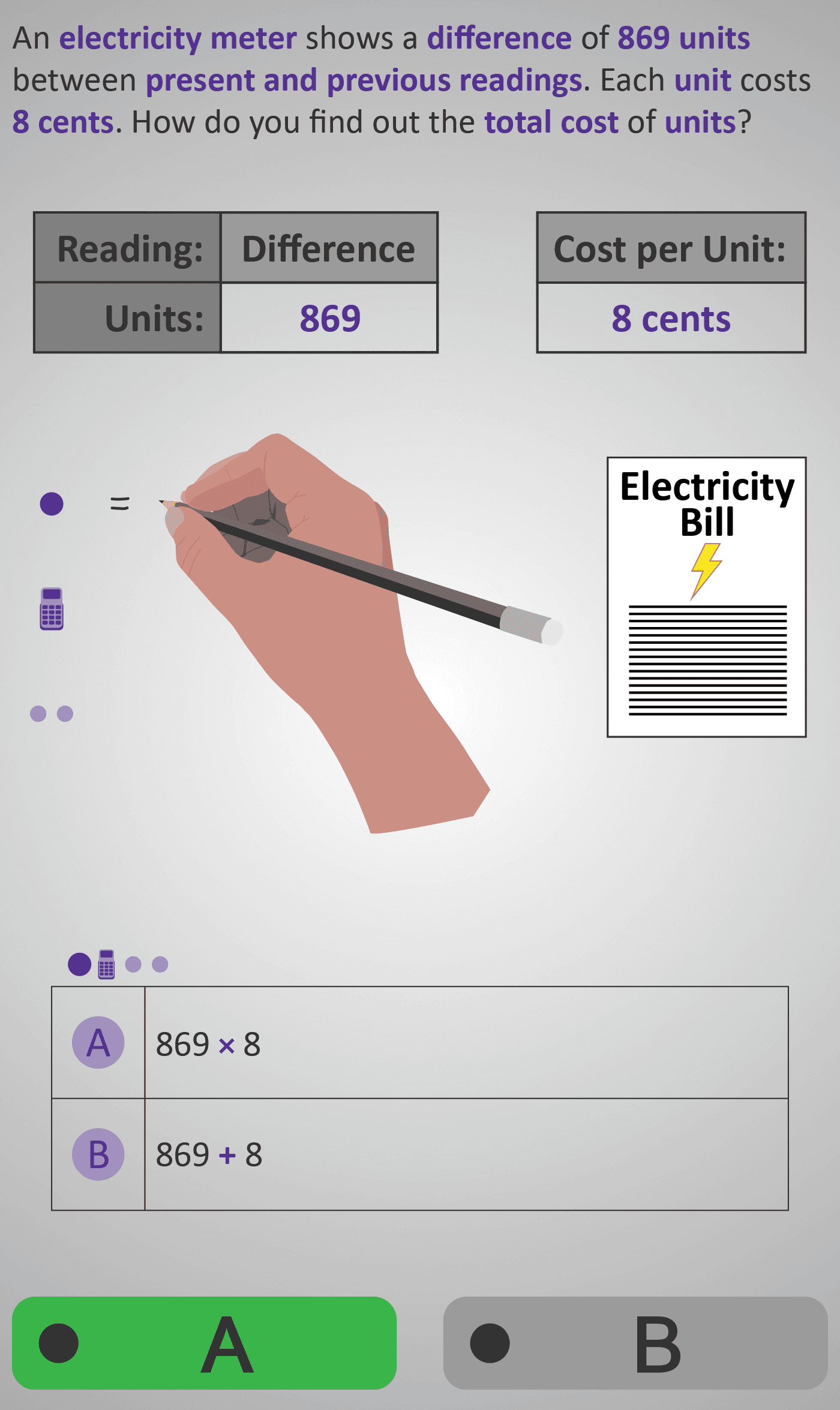
In this Phlow, learners build on their understanding of electricity meter readings and money calculations. They work within a realistic scenario where the difference in meter readings (e.g. 869 units) must be multiplied by the cost per unit (e.g. 8 cents) to find the total cost in cents.
Next, students convert this total from cents to euro by dividing by 100, reinforcing their understanding of place value and the relationship between the two currency units. Each screen walks through the key steps clearly — first multiplying to find the total, then dividing to convert.
Through this process, learners practise choosing the correct operations (× then ÷), interpreting data from real-world contexts, and applying arithmetic to everyday problem-solving, such as calculating an electricity bill.
Prerequisite Knowledge Required
- Electricity Bill 3A – Finding Units Used.
- Multiply 3A – Multiplying by Single-Digit Numbers.
- Decimals 2C – Understanding Place Value with Money.
- Understanding that multiplication can be used to find totals (repeated addition).
- Understanding division as an inverse operation used for conversion.
- Familiarity with the relationship between cents and euro (100 cents = €1).
- Ability to use a calculator for multi-step operations.
Main Category
Applied Arithmetic / Real-World Maths
Estimated Completion Time
Approx. 12–15 seconds per screen (6 screens total). Total Time: 3–4 minutes.
Cognitive Load / Step Size
Moderate — this Phlow introduces a two-step problem combining multiplication and division. Each part is clearly segmented and visually supported, maintaining focus while strengthening understanding of operation order in practical contexts.
Language & Literacy Demand
Moderate — terms such as meter, units, cost per unit, and total cost are introduced in meaningful contexts. Strong visual cues — data tables, calculator displays, and euro symbols — make the material accessible and concrete.
Clarity & Design
- Tables clearly separate “Units Used” and “Cost per Unit.”
- Each step (multiply → divide) is visually represented with matching calculator animations.
- Consistent purple highlights focus attention on the active part of the equation.
- The euro symbol (€) appears alongside answers to reinforce currency understanding.
Curriculum Alignment
Irish Junior Cycle Mathematics:
- Strand 1 – Number
- Strand 3 – Statistics and Probability (Real-World Contexts)
- Learning Outcomes:
- Perform multiplication and division to solve multi-step problems.
- Interpret contextual data from real-life scenarios such as utility bills.
- Convert between currency units using knowledge of place value.
Engagement & Motivation
High — students see immediate real-world relevance. They connect maths to everyday responsibilities like managing household bills or budgeting. The practical context encourages ownership and curiosity about real costs.
Error Opportunities & Misconceptions
- Adding instead of multiplying cost per unit.
- Forgetting to divide by 100 when converting to euro.
- Reversing the order of operations (dividing first, then multiplying).
- Misinterpreting 8 cents as €8.00.
The Phlow’s step-by-step visual sequence directly addresses each potential error with guided examples and immediate corrective feedback.
Transferability / Real-World Anchoring
Very High — this Phlow builds essential financial literacy and numeracy confidence. The same reasoning applies to water, gas, or mobile phone bills, as well as shopping or budgeting scenarios.
Conceptual vs Procedural Balance
Balanced — procedural fluency (using × and ÷ correctly) is underpinned by conceptual reasoning. Students understand why they multiply to find totals and why they divide to convert, reinforcing comprehension and retention.
Learning Objectives Addressed
- Multiply to calculate total electricity cost.
- Divide by 100 to convert cents to euro.
- Interpret and use real-world data from a table or bill.
- Apply calculator skills accurately in multi-step calculations.
- Understand the order of operations in practical contexts.
What Your Score Says About You
- Less than 5: You may be mixing up multiplication and division — review which comes first in the process.
- 6–7: You understand the process but may need to practise converting cents to euro.
- 8–9: Strong grasp of both steps and good financial reasoning.
- 10 / 10: Excellent! You can confidently calculate real-world electricity costs and handle conversions — a vital everyday skill.