
Estimate 3A
Overview
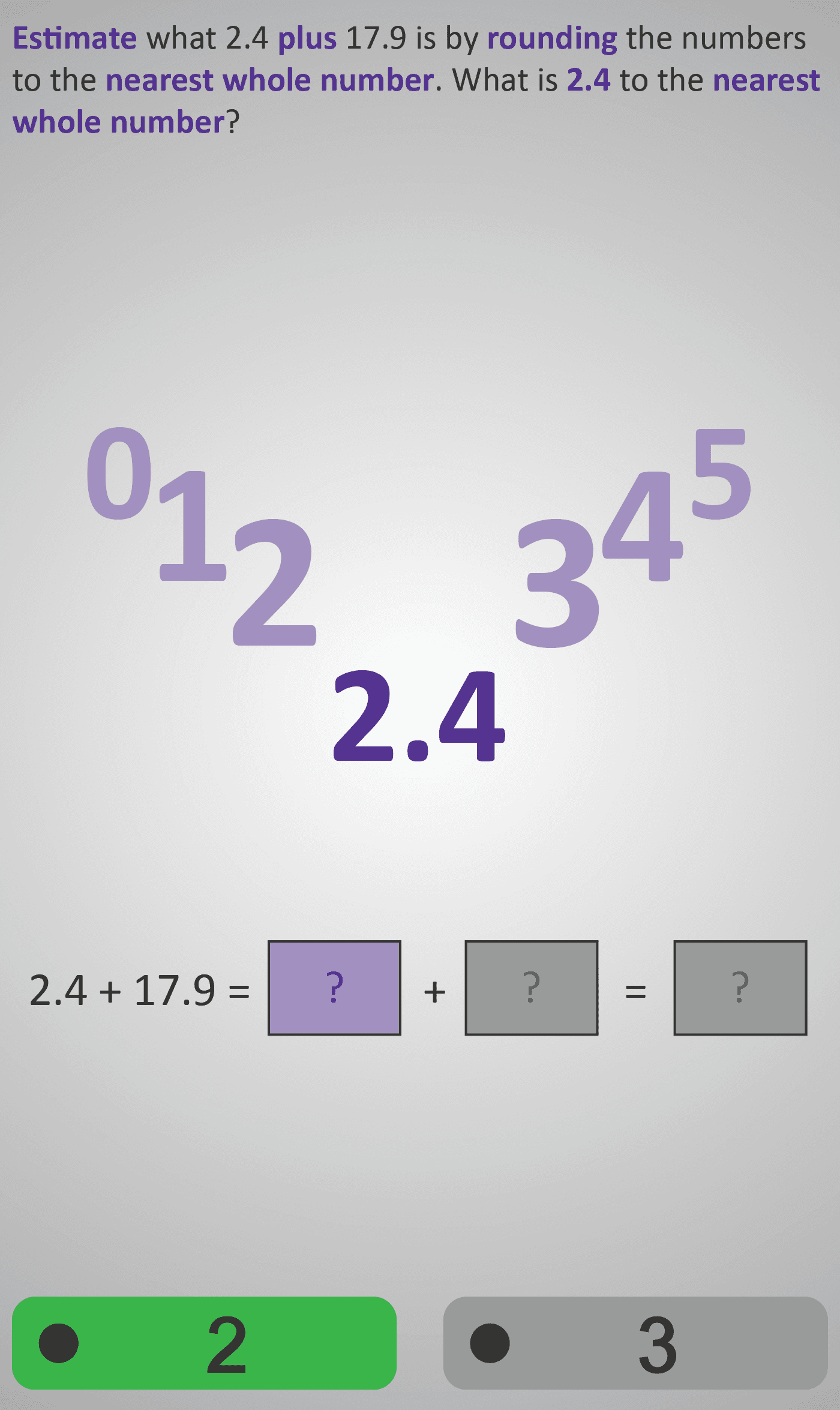
In this Phlow, learners develop their ability to estimate addition problems by rounding decimals to the nearest whole number. They begin with simple examples, such as 2.4 + 17.9, and learn to round each number first:
2.4 ≈ 2, 17.9 ≈ 18
2 + 18 = 20
This sequence helps students understand that estimation provides an approximate answer to check whether a result is reasonable. The visuals — including enlarged numbers and colour-coded rounding cues — reinforce the rounding process, making abstract concepts feel concrete and intuitive.
By the end, learners can confidently round to the nearest whole number and use estimation to make quick mental checks in real-world contexts such as shopping, measurement, and interpreting data.
Prerequisite Knowledge Required
- Rounding 2A – Understanding Place Value.
- Addition 2B – Adding Two Numbers.
- Decimals 2B – Understanding Tenths and Units.
- Knowledge of place value and identifying tenths.
- Understanding what “nearest whole number” means.
- Ability to add small whole numbers mentally.
- Awareness that estimation gives an approximate, not exact, answer.
Main Category
Number Sense / Estimation
Estimated Completion Time
Approx. 8–10 seconds per question (3 screens total). Total Time: 2–3 minutes.
Cognitive Load / Step Size
Low to Moderate — the Phlow builds directly on known rounding and addition skills. Each step isolates one small decision: round the first number, round the second, then add. This pacing promotes fluency without cognitive overload.
Language & Literacy Demand
Moderate — keywords like estimate, round, nearest, and whole number are colour-coded and used consistently. Visual supports such as number lines and proximity cues reduce the need for lengthy reading.
Clarity & Design
- Sequential focus — learners round one number, then the other, then sum both.
- Colour-coded rounding helps visualise movement to the nearest whole number.
- Clean design with large fonts and clear alignment promotes accuracy.
- Animations show how each number shifts up or down when rounding.
Curriculum Alignment
Irish Junior Cycle Mathematics:
- Strand 1 – Number
- Strand 2 – Measures (Estimation and Accuracy)
- Learning Outcomes:
- Round decimals to the nearest whole number.
- Estimate sums to check reasonableness of answers.
- Apply rounding in mental arithmetic and problem-solving.
Engagement & Motivation
High — the immediate success of estimation tasks builds confidence and flow. The quick, visual progression creates a game-like rhythm that rewards intuition over precision, appealing especially to learners developing numeracy confidence.
Error Opportunities & Misconceptions
- Rounding 0.5 in the wrong direction (e.g. 2.5 → 2 instead of 3).
- Forgetting to round before adding.
- Treating estimated results as exact answers.
- Confusing “nearest whole number” with “nearest tenth.”
Each error is pre-empted by visual demonstrations and short reminders (e.g. “5 rounds up!”) before learners proceed.
Transferability / Real-World Anchoring
High — estimation skills apply across everyday contexts: budgeting, cooking, travel planning, or quick mental checks. It develops flexible thinking and confidence with approximate reasoning, vital in decision-making and practical numeracy.
Conceptual vs Procedural Balance
Conceptual emphasis — learners grasp why we round before practising how. Once the idea of estimation as “checking reasonableness” is established, students can apply it procedurally and independently.
Learning Objectives Addressed
- Round decimals to the nearest whole number accurately.
- Estimate addition results by rounding first.
- Use estimation to check the reasonableness of answers.
- Develop approximate reasoning and numerical intuition.
What Your Score Says About You
- Less than 5: You may need to review the difference between exact and estimated answers.
- 6–7: You understand rounding but may rush your final estimate — take time to check!
- 8–9: Strong understanding of rounding and estimation — your number sense is developing well.
- 10 / 10: Excellent! You can estimate confidently to check results — a key skill in everyday maths and exams.