
Estimate 3B
Overview
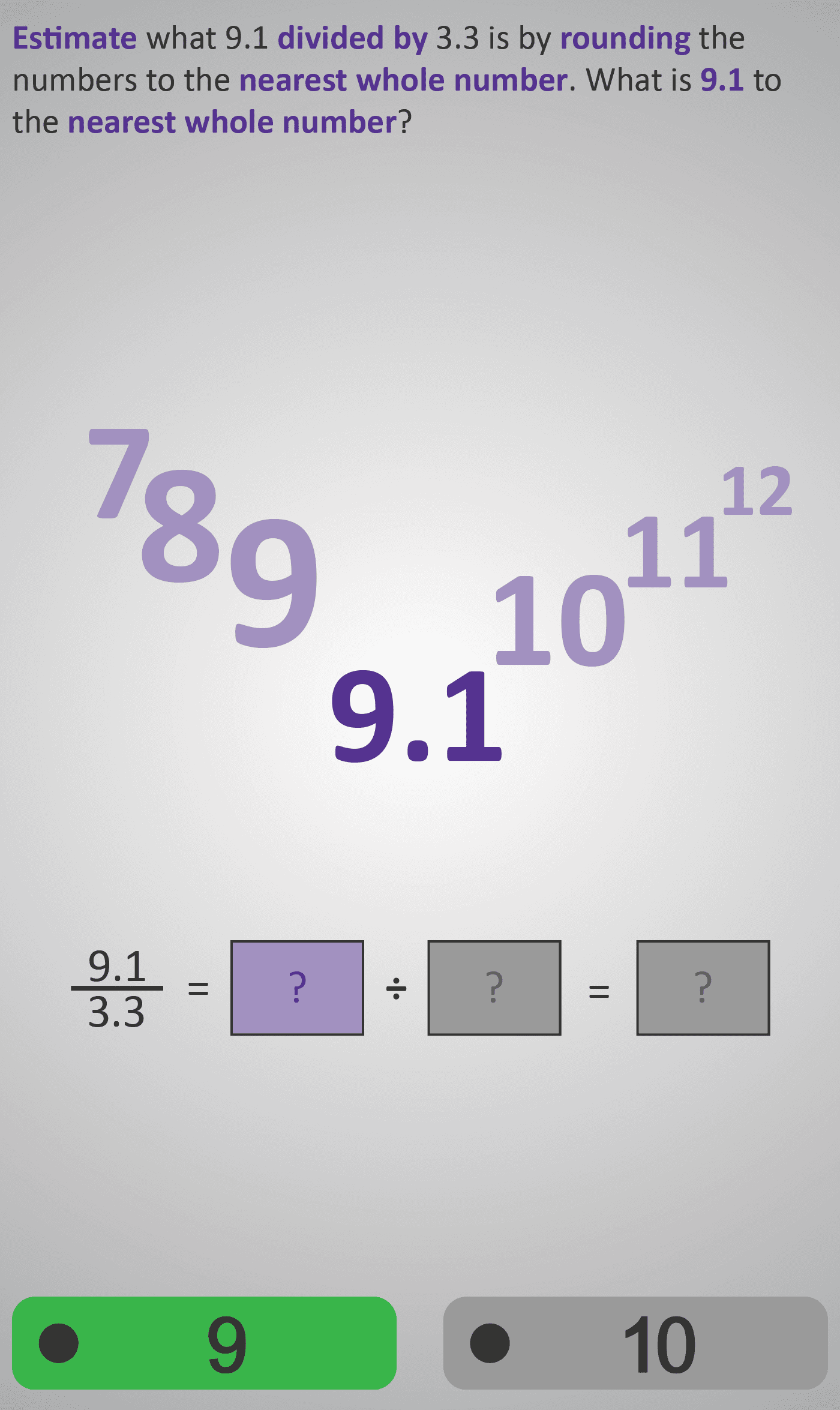
In this Phlow, learners practise estimating division problems by rounding both numbers to the nearest whole number before dividing. They begin with an example such as 9.1 ÷ 3.3, and are guided through rounding each number:
9.1 ≈ 9, 3.3 ≈ 3
9 ÷ 3 = 3
This simple but powerful method shows how estimation can make division easier and faster to perform mentally. Learners see that rounding helps simplify complex decimal problems while still providing a result that is close to the exact value.
Visual number lines and step-by-step animations help students decide whether to round up or down. Boxed calculation stages clearly separate rounding and dividing, ensuring both conceptual clarity and procedural fluency. By the end, students can confidently estimate division results and use their estimates to check calculator or written answers for reasonableness.
Prerequisite Knowledge Required
- Estimate 3A – Rounding to Estimate Sums.
- Division 3A – Understanding Division as Sharing.
- Decimals 2B – Place Value of Tenths and Units.
- Ability to round decimals to the nearest whole number.
- Understanding of division and its meaning (sharing or grouping).
- Confidence dividing small whole numbers mentally.
- Awareness that estimation produces an approximate, not exact, answer.
Main Category
Number Sense / Estimation
Estimated Completion Time
Approx. 8–12 seconds per question (3 screens total). Total Time: 2–3 minutes.
Cognitive Load / Step Size
Low to Moderate — the Phlow isolates one decision at a time: first rounding the dividend, then the divisor, then performing the division. Familiar visual patterns from previous estimation Phlows make it easy to transfer understanding without cognitive overload.
Language & Literacy Demand
Moderate — essential mathematical terms (estimate, divide, round, nearest whole number) are colour-coded and introduced through short, repeatable sentence structures. Visual supports (number lines, calculator cues) reduce text dependence while keeping conceptual meaning clear.
Clarity & Design
- Number lines show proximity to the nearest whole number to guide rounding decisions.
- Each equation is presented clearly with separate steps for rounding and division.
- Animations reveal one action per step — round, then divide — to reinforce sequence and logic.
- Consistent purple highlighting connects rounded values with final results.
Curriculum Alignment
Irish Junior Cycle Mathematics:
- Strand 1 – Number
- Strand 2 – Measures (Estimation and Accuracy)
- Learning Outcomes:
- Round decimals to the nearest whole number.
- Estimate the result of a division using rounded values.
- Use estimation to evaluate the reasonableness of exact answers.
Engagement & Motivation
High — learners see how estimation makes division more manageable in daily life. Real-world relevance (e.g., splitting costs or quantities) enhances engagement, while instant feedback keeps the activity fast and rewarding.
Error Opportunities & Misconceptions
- Forgetting to round both numbers before dividing.
- Rounding incorrectly (e.g. 9.1 → 10 instead of 9).
- Expecting the estimate to match the exact answer.
- Reversing the order of division (e.g. 3 ÷ 9 instead of 9 ÷ 3).
Each misconception is explicitly modelled and corrected through guided questions and side-by-side comparisons.
Transferability / Real-World Anchoring
High — estimation in division is a practical skill for budgeting, sharing amounts, or interpreting data. Learners build numerical confidence by seeing that a rough, reasoned answer can often be just as useful as an exact one.
Conceptual vs Procedural Balance
Conceptual emphasis — the Phlow focuses on understanding why rounding helps simplify calculations. Learners see estimation as a mental reasoning tool rather than just a shortcut, developing flexible number sense and intuition.
Learning Objectives Addressed
- Round decimal numbers to the nearest whole number.
- Use rounded values to estimate quotients.
- Apply estimation to check calculator and written results.
- Interpret estimation as part of real-world reasoning and checking.
What Your Score Says About You
- Less than 5: You may need more practice rounding up or down before dividing — slow down and check number lines.
- 6–7: You understand rounding but might rush during division — take time to align the steps carefully.
- 8–9: Excellent intuition for estimation — your number sense is developing very well.
- 10 / 10: Superb! You can estimate division results confidently and use them to verify real calculations — a key numeracy skill mastered.