
Estimate 3C
Overview
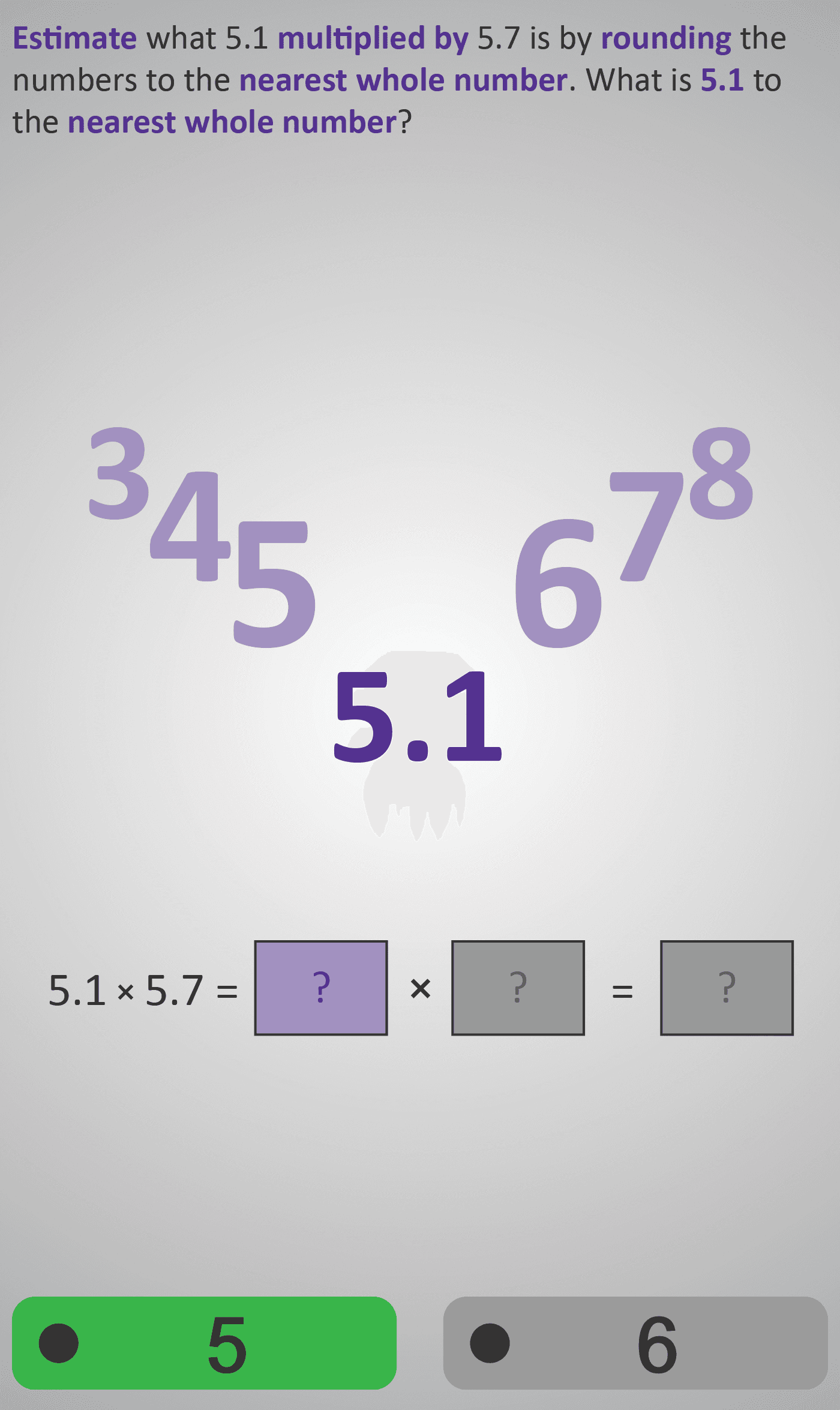
In this Phlow, learners practise estimating multiplication results by rounding each number to the nearest whole number before multiplying. They start with an example such as 5.1 × 5.7 and are guided through each step:
5.1 ≈ 5, 5.7 ≈ 6
5 × 6 = 30
This simple method allows learners to estimate quickly and check whether their answers are reasonable. They discover that rounding both numbers first makes mental multiplication easier while keeping results close to the true value. The visuals — including number lines and boxed equations — reinforce each step in the process.
By the end, learners understand that estimation is not about precision — it’s about confidence, checking, and reasoning. This builds a strong foundation for flexible, independent thinking in both mathematical and real-world contexts.
Prerequisite Knowledge Required
- Estimate 3A – Rounding to Estimate Sums.
- Estimate 3B – Estimating Division by Rounding.
- Multiplication 2B – Multiplying Whole Numbers.
- Decimals 2B – Understanding Tenths and Place Value.
- Understanding of place value and rounding rules.
- Familiarity with single-digit multiplication facts.
- Awareness that estimation provides an approximate result.
- Ability to mentally round up or down based on tenths.
Main Category
Number Sense / Estimation
Estimated Completion Time
Approx. 10–12 seconds per question (3 screens total). Total Time: 3–4 minutes.
Cognitive Load / Step Size
Moderate — each screen focuses on a single action: rounding the first number, rounding the second, then multiplying. This gradual build-up reinforces understanding while maintaining a clear flow. The familiar estimation sequence ensures transfer of learning from previous Phlows.
Language & Literacy Demand
Moderate — terms such as estimate, multiplied by, and nearest whole number are colour-coded and repeated for fluency. Instructions are concise and supported by consistent visual cues that highlight rounding and multiplying steps.
Clarity & Design
- Ascending number lines illustrate rounding thresholds visually.
- The multiplication equation remains on-screen to connect each step to the full process.
- High-contrast visuals direct attention to active steps (rounding or multiplying).
- Progressive transitions ensure clarity and reduce cognitive load.
Curriculum Alignment
Irish Junior Cycle Mathematics:
- Strand 1 – Number
- Strand 2 – Measures (Estimation and Accuracy)
- Learning Outcomes:
- Round decimals to the nearest whole number.
- Estimate multiplication results by rounding both factors.
- Use estimation to check the reasonableness of results.
Engagement & Motivation
High — learners quickly see the usefulness of estimation in everyday life. The activity feels intuitive and confidence-building, encouraging students to test their intuition and self-check their answers without pressure to be exact.
Error Opportunities & Misconceptions
- Forgetting to round both numbers before multiplying.
- Rounding in the wrong direction (e.g. 5.1 → 6).
- Assuming estimates must be exact.
- Viewing estimation as an “easy mode” rather than a checking tool.
The Phlow addresses each misconception visually, showing how rounding affects the result and why estimation supports verification of accuracy.
Transferability / Real-World Anchoring
Very High — estimation is useful for budgeting, shopping, measurement, and scaling. Learners see that quick, approximate reasoning is a powerful everyday skill, building practical numeracy confidence.
Conceptual vs Procedural Balance
Balanced — learners develop both conceptual understanding (why estimation works) and procedural fluency (round, multiply, check). Each question reinforces estimation as a mental reasoning strategy, not just a shortcut.
Learning Objectives Addressed
- Round decimal numbers to the nearest whole number.
- Estimate multiplication results by rounding factors.
- Apply estimation in real-world and problem-solving contexts.
- Judge the reasonableness of exact multiplication results.
What Your Score Says About You
- Less than 5: You may need to review how rounding affects multiplication — focus on rounding first, then multiplying.
- 6–7: You can round accurately but might rush the multiplication — slow down to confirm your estimate.
- 8–9: Great estimation instincts — you’re developing solid number sense and fluency.
- 10 / 10: Excellent! You can round, estimate, and reason confidently — a vital real-world and exam-ready skill.