
Estimate 3D
Overview
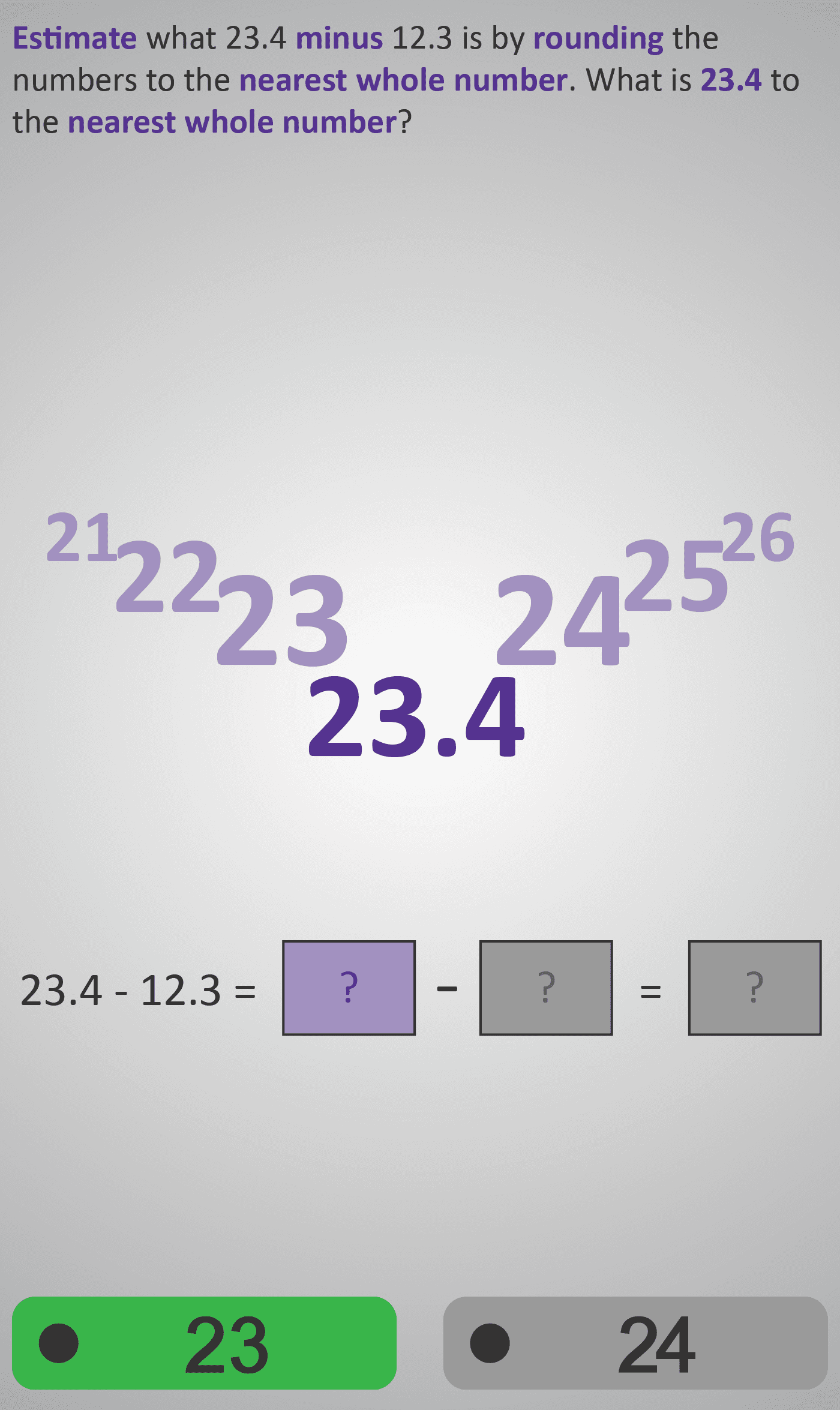
In this Phlow, learners practise estimating subtraction results by rounding each number to the nearest whole number before subtracting. The example begins with:
23.4 − 12.3
23.4 ≈ 23, 12.3 ≈ 12
23 − 12 = 11
This approach allows learners to estimate efficiently and check whether answers are reasonable. By simplifying numbers through rounding, they strengthen their understanding of place value and develop confidence performing mental calculations. The visuals guide learners step-by-step — first rounding the larger number, then the smaller, before carrying out the subtraction.
By the end, students can confidently use rounding to estimate subtraction problems, deepening their number sense and understanding of how estimation helps verify results in everyday contexts like budgeting or comparing prices.
Prerequisite Knowledge Required
- Estimate 3A – Estimating Addition by Rounding.
- Estimate 3B – Estimating Division by Rounding.
- Rounding 2A – Rounding to the Nearest Whole Number.
- Subtraction 2B – Subtracting Whole Numbers.
- Understanding how to round decimals to the nearest whole number.
- Familiarity with basic subtraction using whole numbers.
- Awareness that estimation produces approximate, not exact, answers.
- Confidence deciding when to round up or down based on the tenths digit.
Main Category
Number Sense / Estimation
Estimated Completion Time
Approx. 8–10 seconds per question (3 screens total). Total Time: 2–3 minutes.
Cognitive Load / Step Size
Low to Moderate — each question isolates one key step: rounding the first number, rounding the second, then subtracting. The consistent structure from earlier estimation Phlows supports transfer and fluency while keeping new cognitive demand minimal.
Language & Literacy Demand
Moderate — essential mathematical vocabulary (estimate, minus, round, nearest whole number) is colour-coded for visibility. Repetitive phrasing reinforces understanding and accessibility for all learners, reducing reading complexity.
Clarity & Design
- Visual layout mirrors earlier estimation Phlows for consistency and confidence.
- Ascending number lines illustrate rounding choices clearly.
- Boxed subtraction equations separate each action (round–round–subtract).
- Clean design ensures focus on the estimation process without distraction.
Curriculum Alignment
Irish Junior Cycle Mathematics:
- Strand 1 – Number
- Strand 2 – Measures (Estimation and Accuracy)
- Learning Outcomes:
- Round numbers, including decimals, to the nearest whole number.
- Estimate subtraction results using rounded values.
- Use estimation to evaluate the reasonableness of answers.
Engagement & Motivation
High — the Phlow feels intuitive and rewarding as learners apply a familiar estimation process to subtraction. Quick feedback reinforces confidence, and success builds automaticity and enjoyment of number reasoning.
Error Opportunities & Misconceptions
- Forgetting to round both numbers before subtracting.
- Rounding in the wrong direction (e.g. 23.4 → 24).
- Confusing estimation with exact calculation.
- Subtracting in reverse order (smaller − larger).
The Phlow’s step-by-step visual format addresses each misconception directly, modelling correct rounding and operation order before independent practice.
Transferability / Real-World Anchoring
High — estimation in subtraction connects to budgeting, comparing prices, and calculating change. It builds learners’ confidence in reasoning flexibly with numbers and reinforces independence in daily numerical decision-making.
Conceptual vs Procedural Balance
Balanced — learners understand why rounding helps simplify subtraction while practising how to perform it efficiently. Conceptual understanding and procedural fluency work hand-in-hand.
Learning Objectives Addressed
- Round decimal numbers to the nearest whole number.
- Estimate subtraction results by rounding both values.
- Judge the reasonableness of answers through estimation.
- Apply estimation to real-world and problem-solving contexts.
What Your Score Says About You
- Less than 5: You may need to review rounding rules before subtracting — check whether to round up or down.
- 6–7: You understand rounding but could slow down to ensure accurate subtraction.
- 8–9: Excellent reasoning — you can estimate and check results effectively.
- 10 / 10: Outstanding! You estimate subtraction results confidently, showing strong number sense and mental flexibility.