
Exchange 3A
Overview
In this Phlow, learners are introduced to currency exchange — converting an amount from one currency to another using a given exchange rate. The example begins with a realistic scenario:
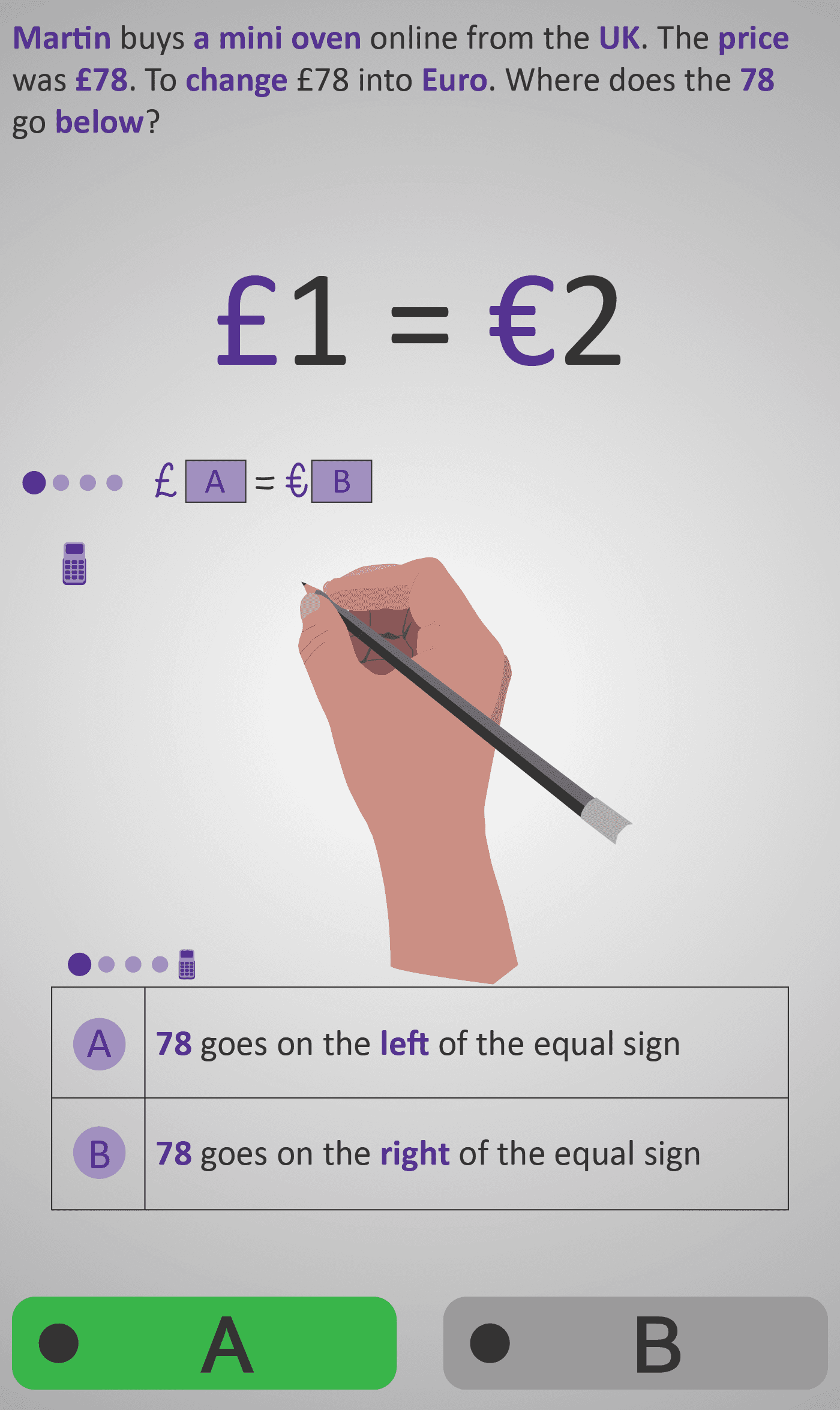
Martin buys a mini oven online from the UK. The price was £78. The exchange rate is £1 = €2. How much is the oven in Euro?
Students are guided step-by-step through the reasoning process:
- Identify the starting currency (£78) and place it correctly in the equation.
- Understand that the rate £1 = €2 means “each pound equals two euros.”
- Multiply the pound amount by 2 to find the equivalent in euros.
£1 = €2 ⇒ £78 = €(78 × 2) = €156
Each screen isolates one reasoning step — placement, operation, factor, and calculation. Clear purple highlights and an animated equal sign reinforce proportional thinking and build intuitive understanding of exchange rates.
By the end, learners can confidently apply a one-step proportional rule in real-world contexts and know when to multiply to convert from the smaller-value currency to the larger-value one.
Prerequisite Knowledge Required
- Proportion 2B – Using “for each” Relationships.
- Multiply 3A – Multiplying Whole Numbers.
- Money 2A – Reading Prices and Units.
- Estimate 3C – Estimating Multiplication by Rounding.
- Understanding multiplication as repeated addition or scaling.
- Recognising that exchange rates describe a proportional relationship.
- Ability to substitute values into simple equations.
- Basic familiarity with £ and € symbols and what conversion means.
Main Category
Number Sense / Applied Contexts
Estimated Completion Time
Approx. 10–12 seconds per question (5 screens total). Total Time: 4–5 minutes.
Cognitive Load / Step Size
Moderate — each step isolates one logical action: identifying the correct side, recognising the operation, selecting the factor, and solving. The structure builds understanding gradually while maintaining focus and avoiding overload.
Language & Literacy Demand
Moderate — key mathematical and financial terms (exchange rate, multiply by, equals, convert) are repeated and paired with visuals. Simple sentence structure and real-life context (buying online) increase accessibility and engagement.
Clarity & Design
- Consistent layout with large, clear currency symbols.
- Centralised equations and visible exchange rates support focus.
- Animated handwriting reinforces the logical flow of solving.
- Distinct purple highlighting connects currency pairs visually.
Curriculum Alignment
Irish Junior Cycle Mathematics:
- Strand 1 – Number
- Strand 3 – Measures & Financial Maths
- Strand Unit: Money, Ratio & Proportion
- Learning Outcomes:
- Use proportional reasoning to convert between currencies.
- Understand and apply exchange rates accurately.
- Multiply quantities by a rate to find equivalent values.
Engagement & Motivation
High — learners engage with an authentic, real-world scenario. The process feels relevant and rewarding as they see how maths applies directly to shopping, travel, or managing money.
Error Opportunities & Misconceptions
- Multiplying or dividing in the wrong direction.
- Placing the starting value on the wrong side of the rate.
- Swapping the conversion rate (£1 = €2 → €1 = £2).
- Treating exchange as addition rather than multiplication.
The Phlow design directly addresses these through guided choices, side-by-side comparisons, and highlighted reasoning steps.
Transferability / Real-World Anchoring
Very High — the concept transfers immediately to online shopping, travel, budgeting, and financial literacy. Learners gain practical numeracy skills that are directly applicable outside school.
Conceptual vs Procedural Balance
Strongly balanced — learners develop conceptual understanding of proportional relationships while mastering the step-by-step procedure for currency conversion. They understand both why and how.
Learning Objectives Addressed
- Identify which currency amount to convert.
- Apply the correct exchange rate using multiplication.
- Write and interpret proportional equations.
- Check results for reasonableness in context.
What Your Score Says About You
- Less than 5: Review how exchange rates work — each “1 of this” equals “X of that.”
- 6–7: You understand the rule but may need to confirm direction (multiply vs divide).
- 8–9: You’re confident applying rates correctly — solid understanding of proportional reasoning.
- 10 / 10: Excellent! You can convert between currencies quickly and accurately — a vital real-world skill mastered.