
Exchange 3B
Overview
In this Phlow, learners continue developing their understanding of currency exchange, this time focusing on when to divide instead of multiply. The example introduces a realistic scenario:
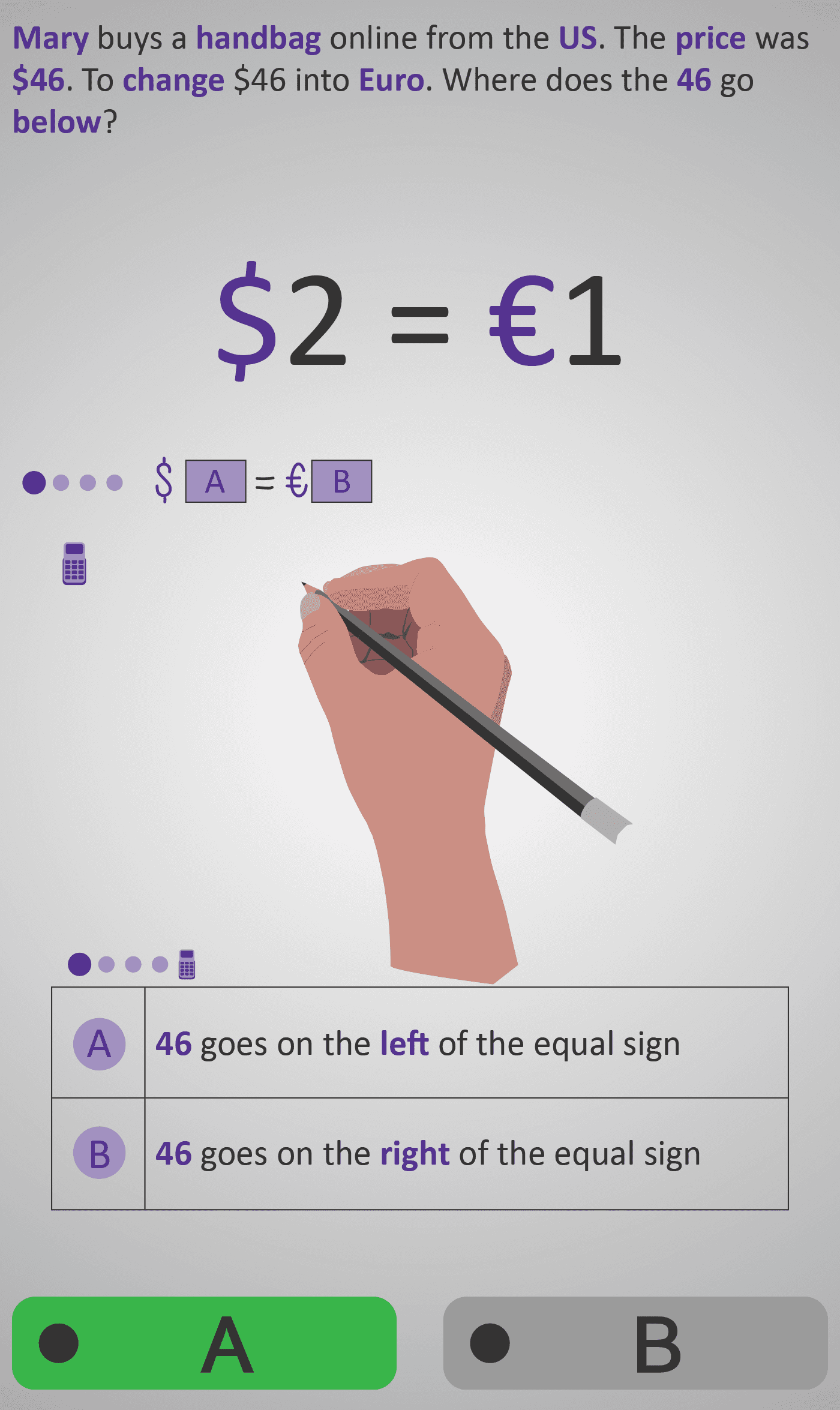
Mary buys a handbag online from the US. The price was $46. The exchange rate is $2 = €1. To change $46 into Euro, where does the 46 go, and what do you do with it?
Students are guided step-by-step through the reasoning process:
- Place the given amount correctly — since $46 is the starting currency, it goes on the left-hand side of the equation.
- Understand the relationship — each €1 equals $2, so for every 2 dollars, there is 1 euro.
- Divide the dollar amount by 2 to find the euro value.
$46 = €(46 ÷ 2) = €23
Each screen isolates one part of the reasoning chain — positioning, choosing the correct operation, selecting the divisor, and finding the result. This structure helps learners internalise why division is used when converting from the larger-value currency (USD) to the smaller-value one (EUR).
By the end, learners understand that when the exchange rate tells us how many dollars equal one euro, we divide to convert from dollars into euros. They gain confidence recognising when to multiply or divide depending on the conversion direction.
Prerequisite Knowledge Required
- Exchange 3A – Converting Pound to Euro (Multiplying by the Exchange Rate).
- Divide 3A – Dividing Whole Numbers.
- Proportion 2B – Understanding “for each” Relationships.
- Money 2A – Recognising Currency Symbols and Values.
- Understanding of multiplication and division as inverse operations.
- Familiarity with the meaning of an exchange rate and proportional reasoning.
- Ability to identify which currency is the base unit (e.g., $2 = €1 means 2 dollars make 1 euro).
- Awareness that converting to the smaller-value currency involves division.
Main Category
Number Sense / Financial Mathematics
Estimated Completion Time
Approx. 10–12 seconds per question (5 screens total). Total Time: 4–5 minutes.
Cognitive Load / Step Size
Moderate — this Phlow mirrors the structure of Exchange 3A but reverses the operation. Each screen presents one decision point: where to place the number, which operation to use, or how to calculate. This gradual structure reinforces transferable understanding, not memorisation.
Language & Literacy Demand
Moderate — key terms like divide, multiply, equals, and convert are colour-coded and reinforced visually. The narrative (Mary buying a handbag) anchors meaning in a familiar context, reducing abstraction while improving comprehension.
Clarity & Design
- Consistent with Exchange 3A to reinforce familiarity.
- The exchange rate ($2 = €1) remains fixed on-screen as an anchor point.
- Visual cues highlight when to divide rather than multiply.
- Stepwise reveal and animated handwriting guide learners through the process clearly.
Curriculum Alignment
Irish Junior Cycle Mathematics:
- Strand 1 – Number
- Strand 3 – Measures & Financial Maths
- Strand Unit: Money, Ratio & Proportion
- Learning Outcomes:
- Use division to convert between currencies when given an exchange rate.
- Apply proportional reasoning to real-world financial contexts.
- Identify which operation (multiply or divide) to use based on conversion direction.
Engagement & Motivation
High — the scenario feels authentic and relatable. Students stay motivated as they connect maths to real-world spending, travel, and online shopping. Interactive steps and feedback promote self-correction and confidence in applied numeracy.
Error Opportunities & Misconceptions
- Multiplying instead of dividing when converting to Euro.
- Placing the starting amount on the wrong side of the rate.
- Reversing the exchange rate ($2 = €1 → €2 = $1).
- Treating conversion as addition or subtraction instead of division.
The Phlow’s guided visual logic directly addresses these, showing how each incorrect operation changes the result and why division gives the correct answer in this context.
Transferability / Real-World Anchoring
Very High — these skills apply directly to travel, online shopping, currency conversion, and budgeting. Learners understand both the mathematical process and the logic behind using multiplication or division.
Conceptual vs Procedural Balance
Strongly balanced — the Phlow builds conceptual reasoning about proportional relationships while reinforcing the procedural accuracy of dividing when converting toward the smaller-value currency.
Learning Objectives Addressed
- Recognise conversion direction (from dollars to euros).
- Select and apply the correct operation (division).
- Use proportional reasoning to calculate exchange values.
- Evaluate whether results make sense for given rates.
What Your Score Says About You
- Less than 5: Review when to divide or multiply — focus on which currency is larger in value.
- 6–7: You understand the relationship but may mix up multiply vs divide — review directionality.
- 8–9: You can apply division accurately — strong grasp of exchange rate logic.
- 10 / 10: Excellent! You’ve mastered when to divide or multiply in currency conversions — a key financial skill.