
Fraction 3A
Overview
In this Phlow, learners explore how to identify the lowest number that two given numbers divide into evenly — known as the Lowest Common Multiple (LCM).
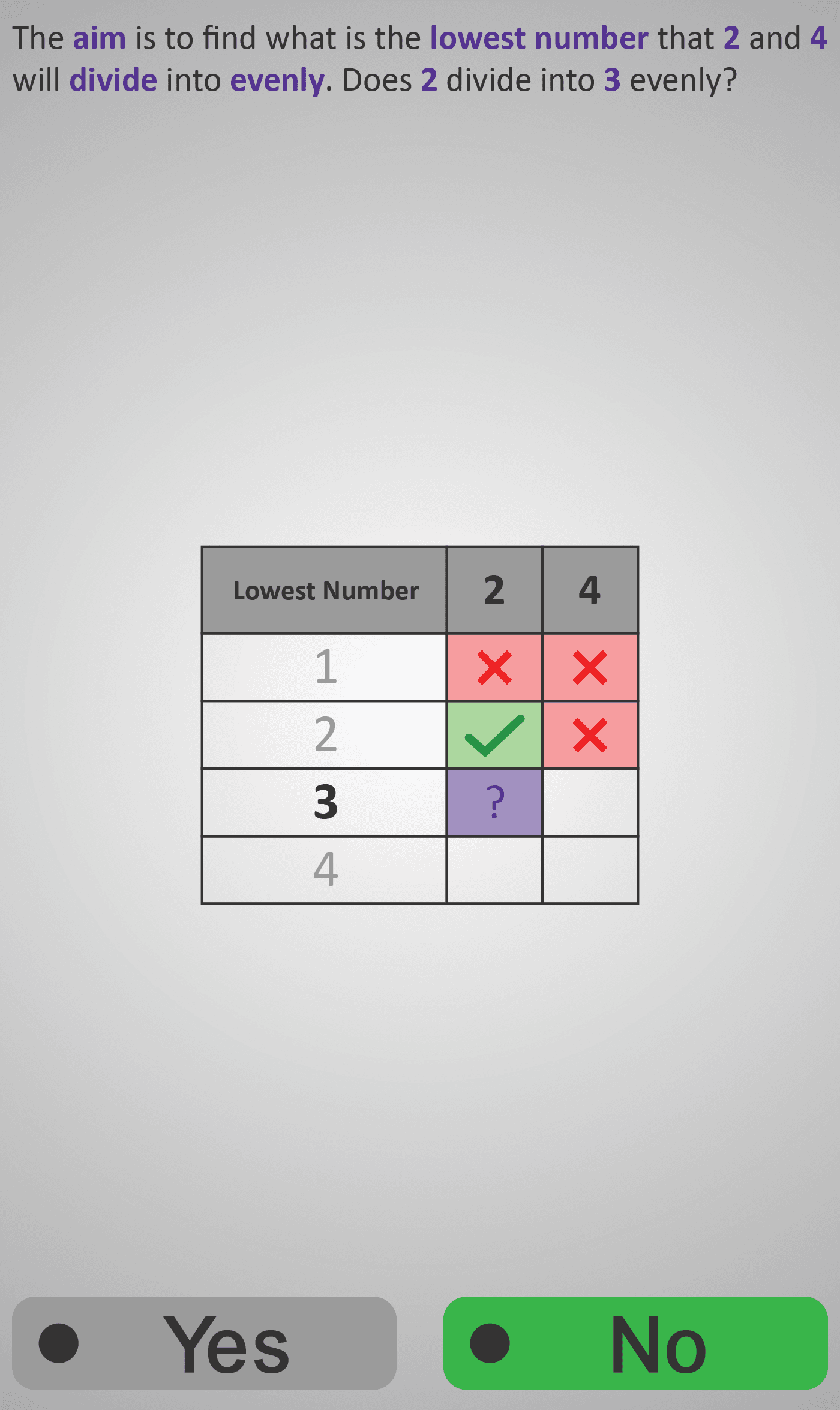
The activity begins with the numbers 2 and 4 and a small table of possible “lowest numbers” (1, 2, 3, 4). Students are guided step-by-step to test each one:
Does 2 divide evenly into 1? ✗
Does 2 divide evenly into 2? ✓
Does 4 divide evenly into 2? ✗
Does 2 divide evenly into 4? ✓
Does 4 divide evenly into 4? ✓
Through this systematic testing, learners see that 4 is the first number both 2 and 4 divide into evenly. Visual red ✗ and green ✓ markers provide immediate feedback, supporting both procedural fluency and conceptual understanding.
The Phlow’s colour-coded table, stepwise questioning, and repeated phrasing (“Does ___ divide evenly into ___?”) make the reasoning process clear and approachable. By the end, learners understand that the LCM of 2 and 4 is 4, and that finding it means locating the smallest shared multiple.
Prerequisite Knowledge Required
- Multiply 2A – Understanding Multiples.
- Divide 2A – Simple Division Facts.
- Factors 2 – What It Means to Divide Evenly.
- Understanding that division without a remainder means a number divides evenly.
- Knowledge of multiplication and its inverse relationship with division.
- Familiarity with skip counting (e.g., 2, 4, 6, 8…).
- Recognising that common multiples are shared results in multiplication tables.
Main Category
Number Sense / Fractions & Multiples
Estimated Completion Time
Approx. 10 seconds per screen (4 screens total). Total Time: 2 minutes.
Cognitive Load / Step Size
Low — each step isolates one check (e.g., “Does 2 divide into 3 evenly?”). The table format structures the logic, reducing working memory load and allowing learners to focus on the reasoning behind divisibility.
Language & Literacy Demand
Low — consistent phrasing (“Does X divide into Y evenly?”) reinforces mathematical vocabulary while maintaining accessibility. Key terms such as lowest, divide, and evenly are introduced gradually and supported visually.
Clarity & Design
- Visual grid format aids pattern recognition.
- ✓ and ✗ markers provide intuitive feedback.
- Clear progression through possible multiples ensures logical flow.
- Simple layout prevents distraction and maintains focus on reasoning.
Curriculum Alignment
Irish Junior Cycle Mathematics:
- Strand 1 – Number
- Substrand – Operations and Relationships
- Strand Unit – Fractions, Factors & Multiples
- Learning Outcomes:
- Identify common multiples of two whole numbers.
- Recognise the Lowest Common Multiple (LCM) as the smallest shared multiple.
- Apply reasoning to test divisibility systematically.
Engagement & Motivation
High — learners progress through short, binary-choice questions with immediate visual feedback. The repetition creates rhythm and satisfaction as they uncover the “lowest number” through reasoning rather than memorisation.
Error Opportunities & Misconceptions
- Confusing LCM with HCF (Highest Common Factor).
- Assuming “lowest number” means the smaller of the two numbers.
- Thinking both numbers must divide into each other instead of a shared multiple.
The Phlow corrects these through clear guided steps and contrastive examples, ensuring conceptual clarity.
Transferability / Real-World Anchoring
Moderate to High — LCM reasoning supports future learning in fractions, ratios, and repeated patterns. It forms the foundation for adding and comparing fractions with different denominators and managing synchronised events.
Conceptual vs Procedural Balance
Balanced — while learners procedurally test divisibility, the emphasis remains on conceptual reasoning about shared multiples and pattern recognition.
Learning Objectives Addressed
- Determine if one number divides evenly into another.
- Identify multiples common to two numbers.
- Find the Lowest Common Multiple (LCM) using structured reasoning.
- Build fluency in divisibility and numerical relationships.
What Your Score Says About You
- Less than 5: Review the concept of dividing evenly — try simpler pairs like (2, 3).
- 6–7: You’re understanding the logic — check each step carefully for divisibility.
- 8–9: Strong reasoning and accuracy in finding shared multiples.
- 10 / 10: Excellent! You’ve mastered how to find the LCM — an essential foundation for adding and comparing fractions.