
Fraction 3C
Overview
In this Phlow, learners discover the two-step process for finding a fraction of a number — a key bridge between fractions, multiplication, and division.
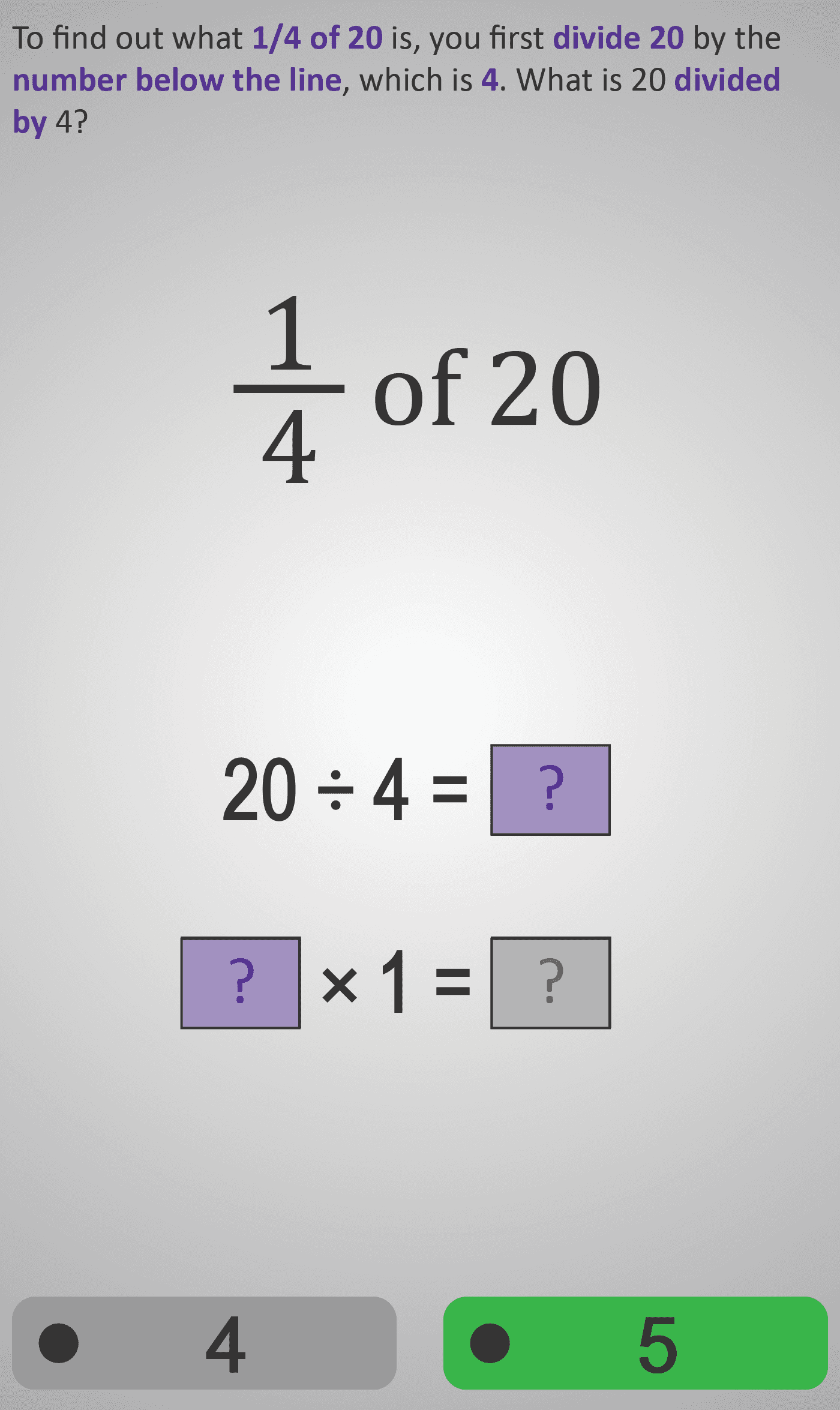
The lesson begins with a fraction such as ¼ of 20 and guides learners through each step:
- Step 1: Divide the whole number (20) by the number below the line (4) → 5.
- Step 2: Multiply that result by the number above the line (1) → 5.
The next example, ⅜ of 16, reinforces the same rule: divide 16 by 8 → 2, then multiply 2 × 3 → 6.
Each screen isolates a single action — divide then multiply — using colour and layout cues: purple for the number being operated on, grey boxes for blanks to fill, and large centred fractions for clarity. The consistent phrase “divide by the bottom, multiply by the top” builds both procedural fluency and conceptual understanding.
By the end, learners clearly see why “of” means multiply in mathematics, and how numerators and denominators interact when applied to whole numbers.
Prerequisite Knowledge Required
- Fraction 2A – What a Fraction Means.
- Multiply 2A – Multiplying Whole Numbers.
- Divide 2A – Simple Division Facts.
- Understanding the meaning of numerator (top number) and denominator (bottom number).
- Confidence with basic multiplication and division facts.
- Recognising that “of” in maths represents multiplication.
Main Category
Fractions / Operations with Fractions
Estimated Completion Time
Approx. 10 seconds per step (3 screens total). Total Time: 2 minutes.
Cognitive Load / Step Size
Low — each operation (divide → multiply) is isolated and visually reinforced before moving on. This clear sequencing supports learners in consolidating the connection between division, multiplication, and fractions.
Language & Literacy Demand
Low — consistent repetition of key phrases (number above the line, number below the line, divide, multiply) builds familiarity with essential mathematical vocabulary while keeping reading minimal.
Clarity & Design
- Minimal, uncluttered layout with strong colour contrast.
- Purple highlights mark the active number or operation.
- Each screen shows one clear step to maintain focus.
- Animations and handwriting visuals reinforce sequence and engagement.
Curriculum Alignment
Irish Junior Cycle Mathematics:
- Strand 1 – Number
- Substrand – Fractions and Decimals
- Learning Outcomes:
- Calculate a given fraction of a quantity.
- Interpret “of” as multiplication.
- Apply multiplication and division in fractional contexts.
Engagement & Motivation
High — stepwise progression and instant feedback (✓ or ✗) foster a sense of mastery. Quick, accessible examples with whole numbers allow early success, building confidence before tackling more complex cases.
Error Opportunities & Misconceptions
- Dividing by the numerator instead of the denominator.
- Multiplying first rather than dividing first.
- Thinking “of” means subtraction or addition.
The Phlow addresses these through clear, labelled steps and visual reinforcement of the correct order: divide by the bottom, multiply by the top.
Transferability / Real-World Anchoring
High — finding fractions of quantities applies to percentages, ratios, recipes, discounts, measurements, and probability. This Phlow underpins proportional reasoning and practical numeracy across many real contexts.
Conceptual vs Procedural Balance
Balanced — learners follow a clear procedure while also understanding why it works. The link between “of” as multiplication and division as sharing gives deep conceptual grounding.
Learning Objectives Addressed
- Identify the numerator and denominator in a fraction.
- Compute a fraction of a quantity using “divide then multiply.”
- Interpret “of” as multiplication.
- Apply reasoning to both unit and non-unit fractions.
What Your Score Says About You
- Less than 5: You may be reversing steps — remember “divide by the bottom, multiply by the top.”
- 6–7: You understand the rule — practise with different numerators and denominators for fluency.
- 8–9: You have strong comprehension and accuracy — you’re ready for percentages and mixed problems.
- 10 / 10: Excellent! You’ve mastered finding a fraction of a number — a foundation for ratio, proportion, and word problems.