
Functions 3A
Overview
In this Phlow, learners are introduced to the concept of a function as a rule that links each input (x) to exactly one output (y). Using the example y = x + 3, students explore how changing x affects y.
Substitution Step
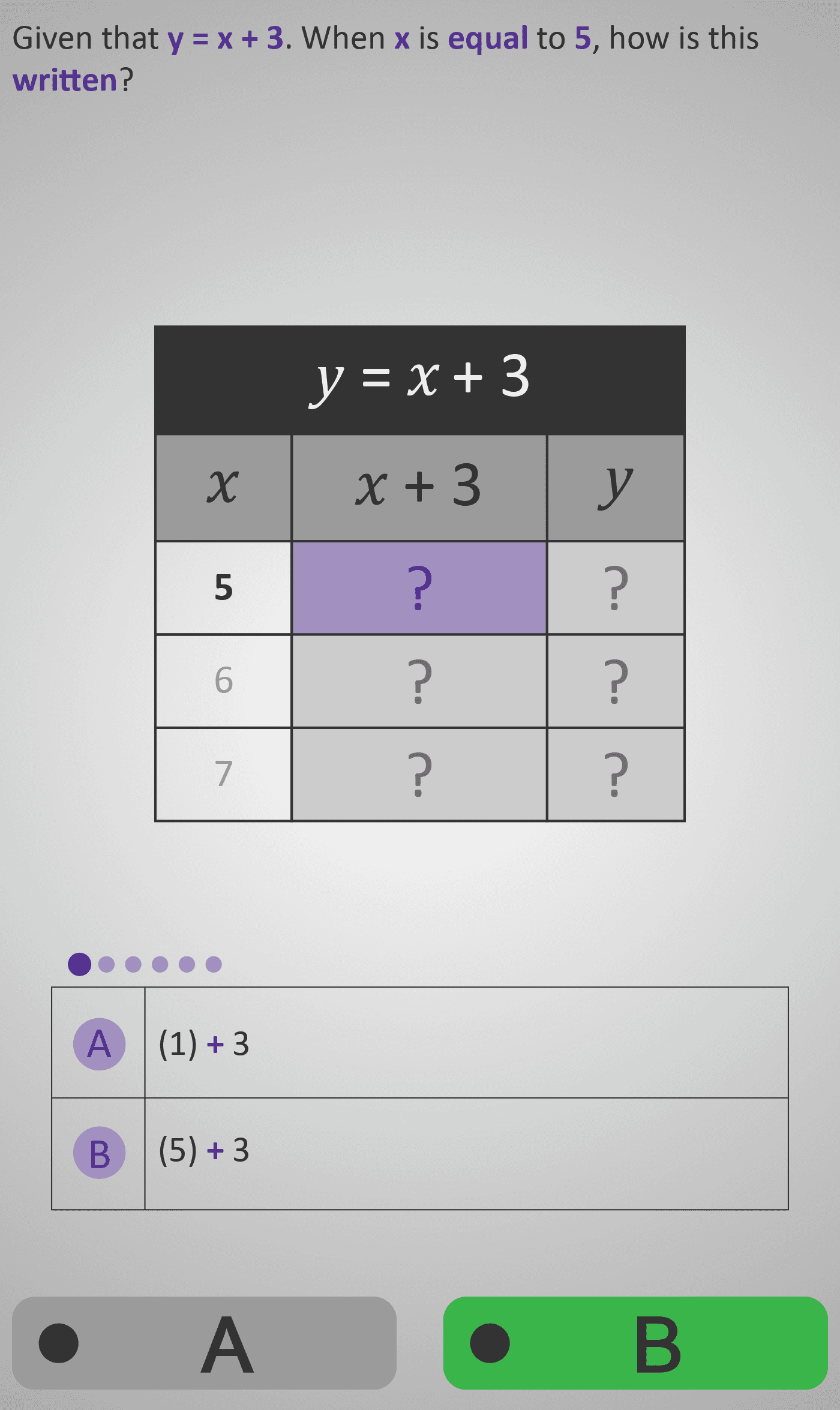
Students replace x with a specific number, such as x = 5, forming the expression (5) + 3. This demonstrates that substitution means replacing the variable with a value.
Evaluation Step
They then complete the operation to find the output: y = 8. As they substitute x = 6 and x = 7, they observe that y increases by 1 whenever x increases by 1.
Pattern Recognition
Through repeated examples, learners notice that y changes predictably with x — building intuition for linear relationships. The visual pattern in the table supports reasoning about rate of change.
Each screen isolates one step — substitution, evaluation, or pattern identification — using consistent visual cues. Purple highlights mark substituted values and outputs, while the function table grows row by row to build understanding gradually.
Prerequisite Knowledge Required
- Algebra 2A – Understanding Variables.
- Algebra 2B – Evaluating Simple Expressions.
- Add 2B – Adding Whole Numbers.
- Understanding that letters can represent numbers in algebraic expressions.
- Knowing how to substitute values into simple arithmetic operations.
- Familiarity with addition and the order of operations.
Main Category
Algebra / Functions and Graphs
Estimated Completion Time
Approx. 10–12 seconds per step (6 screens total). Total Time: 2–3 minutes.
Cognitive Load / Step Size
Low to Moderate — each concept (substitution → evaluation → pattern recognition) is separated clearly. The progressive completion of the function table reduces cognitive strain while supporting pattern discovery.
Language & Literacy Demand
Low — core algebraic terms (substitute, equal to, value of y) are introduced with repetition and supported visually. Colour cues connect mathematical symbols with meaning, reinforcing comprehension for diverse learners.
Clarity & Design
- Table format maintains consistent layout and rhythm.
- Purple highlights indicate the substituted value and calculated output.
- Incremental changes in x promote recognition of linear patterns.
- Two clearly defined answer choices ensure focus and accessibility.
Curriculum Alignment
Irish Junior Cycle Mathematics:
- Strand 4 – Algebra
- Strand Unit – Expressions, Equations & Functions
- Learning Outcomes:
- Recognise and use algebraic notation to describe patterns and relationships.
- Substitute values for variables in formulae to calculate results.
- Represent relationships between two quantities using tables and rules.
Engagement & Motivation
High — the sequential structure gives learners immediate success and visible progress. Each correct substitution reveals a growing pattern in y, prompting curiosity and confidence (“What happens when x = 8?”).
Error Opportunities & Misconceptions
- Substituting the wrong variable or in the wrong position.
- Adding incorrectly or ignoring the rule’s constant (+3).
- Forgetting that y represents the output, not another input.
The Phlow mitigates these through consistent visual feedback and clear role distinction between x (input) and y (output).
Transferability / Real-World Anchoring
Moderate to High — substitution applies in real-world formulas (e.g. s = vt, profit = revenue – cost, or cost = price × quantity + tax). This Phlow builds algebraic fluency used in science, finance, and data interpretation.
Conceptual vs Procedural Balance
Balanced — learners practise substitution procedurally while developing conceptual insight into how one variable depends on another. The repeated table updates illustrate function behaviour intuitively.
Learning Objectives Addressed
- Identify input (x) and output (y) in a function.
- Substitute numerical values into a simple rule.
- Calculate corresponding outputs accurately.
- Recognise linear growth within a function table.
What Your Score Says About You
- Less than 5: You may need more practice identifying which number replaces x or how to calculate y.
- 6–7: You understand substitution but need more consistency and confidence.
- 8–9: You recognise the pattern and apply substitution accurately — great progress!
- 10 / 10: Excellent! You can now substitute confidently and are ready to explore graphing function rules.