
Gross Pay 3A
Overview
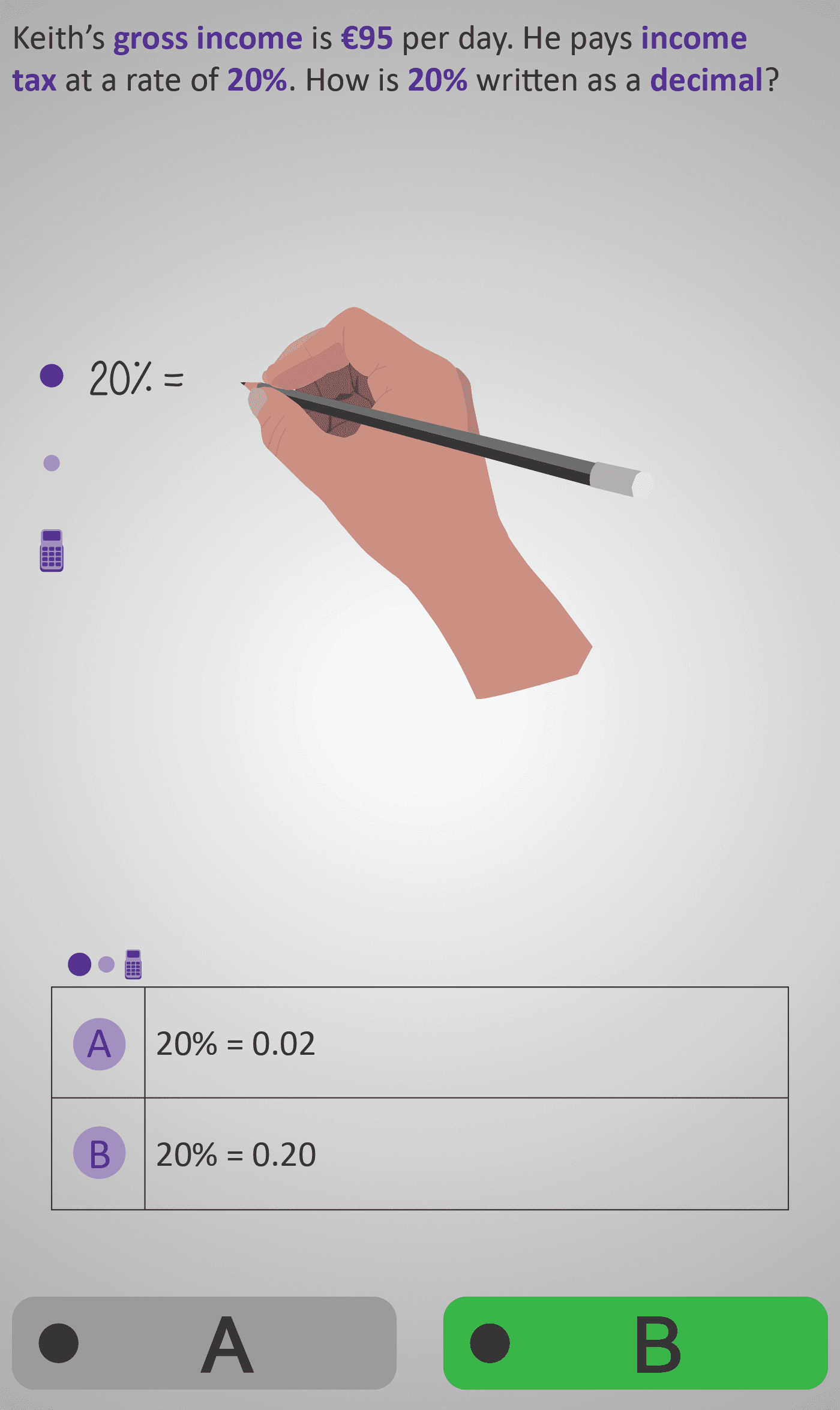
In this Phlow, learners explore how to calculate gross tax — the total amount of tax owed before deductions — based on a given percentage of income. The concept is introduced through a relatable real-world example:
Keith earns €95 per day and pays 20% income tax. The Phlow walks students step-by-step through this financial reasoning process:
- Convert the percentage to a decimal: 20% becomes 0.20, reinforcing how percentages link to decimal notation.
- Set up the operation: Students decide whether to multiply or divide 95 by 0.20, learning that “of” means multiply when finding a percentage of a value.
- Calculate the tax owed: 95 × 0.20 = 19. The visual of a hand writing the calculation helps embed procedural understanding.
Contextual anchors like gross pay, tax rate, and total owed make the maths meaningful and authentic. Learners see how percentage and decimal reasoning apply directly to everyday financial decisions.
By the end, students can confidently calculate a percentage of any amount — a foundational skill for understanding pay, taxes, discounts, and interest.
Prerequisite Knowledge Required
- Percentage 2A – Understanding Percentages.
- Decimal 2A – Converting Fractions to Decimals.
- Multiply 2B – Multiplying by Decimals.
- Understanding that “percent” means “out of 100.”
- Ability to convert percentages to decimals (e.g. 25% → 0.25).
- Confidence multiplying by decimals.
- Awareness that “of” in maths represents multiplication.
Main Category
Financial Maths / Percentages
Estimated Completion Time
Approx. 10–12 seconds per screen (3 screens total). Total Time: 1.5–2 minutes.
Cognitive Load / Step Size
Low to Moderate — each concept (convert → choose operation → calculate) appears on its own screen. Visual cues like purple highlights and handwritten equations minimise extraneous load while reinforcing attention on key operations.
Language & Literacy Demand
Low — concise, context-based language links familiar financial terms (income tax, gross pay) with mathematical reasoning. Vocabulary is introduced through meaningful use rather than abstract definitions.
Clarity & Design
- Sequential design mirrors real-life decision steps in calculating tax.
- Clear visuals of equations support comprehension and engagement.
- Purple highlights focus attention on conversion and operation selection.
- Consistent pacing across screens builds confidence and flow.
Curriculum Alignment
Irish Junior Cycle Mathematics:
- Strand 1 – Number
- Substrand – Percentages and Financial Applications
- Learning Outcomes:
- Convert percentages to decimals.
- Calculate a percentage of a given value.
- Apply percentage reasoning to real-world financial contexts such as tax and savings.
Engagement & Motivation
High — the relatable story of Keith’s daily income and tax engages learners by showing practical use. The combination of animated handwriting and realistic currency context strengthens motivation and relevance.
Error Opportunities & Misconceptions
- Writing 20% as 2% or 0.2 instead of 0.20.
- Dividing instead of multiplying when finding 20% of 95.
- Omitting the euro symbol or misinterpreting the result as non-monetary.
The Phlow prevents these through structured contrast questions (“multiply or divide?”) and instant corrective feedback.
Transferability / Real-World Anchoring
Very High — this concept applies directly to adult life: calculating income tax, discounts, VAT, tips, and interest. The skill strengthens financial awareness and numeracy confidence beyond the classroom.
Conceptual vs Procedural Balance
Balanced — learners understand why they multiply by a decimal (conceptual understanding) while mastering how to perform the calculation (procedural fluency).
Learning Objectives Addressed
- Convert percentages to decimals accurately.
- Choose the correct operation when finding a percentage of a value.
- Multiply correctly to calculate percentage amounts.
- Apply percentage reasoning to real-world income and tax problems.
What Your Score Says About You
- Less than 5: Review how to convert percentages to decimals — you may be dividing instead of multiplying.
- 6–7: You understand the idea — practise linking “of” to multiplication for accuracy.
- 8–9: Strong understanding — you’re accurately connecting percentage and decimal reasoning.
- 10 / 10: Excellent! You’ve mastered calculating tax and are ready for Net Pay 3B, where deductions and take-home pay are introduced.