
Gross Pay 3B
Overview
In this Phlow, learners build on their understanding of gross pay and tax deductions by calculating net income — the amount of pay remaining after tax.
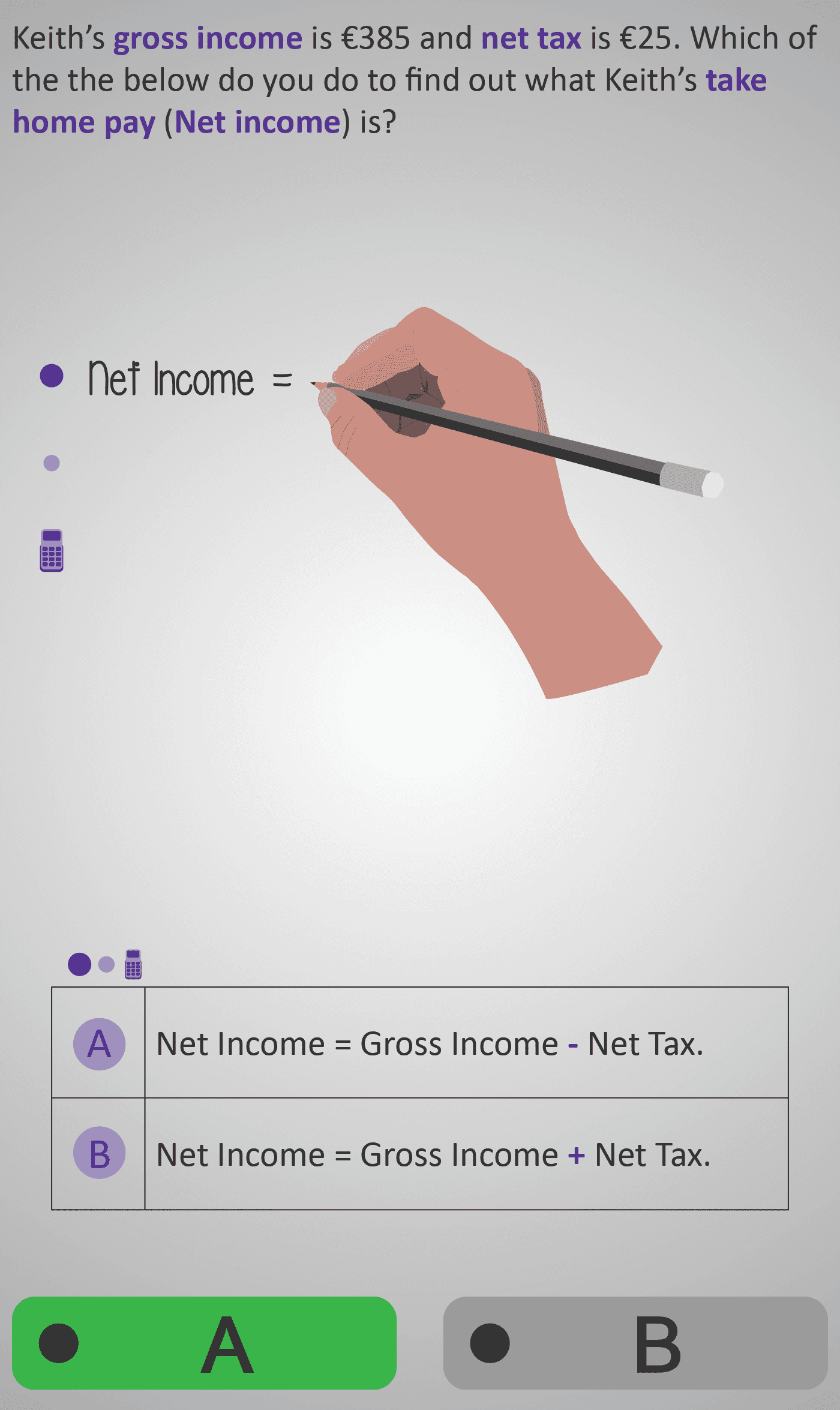
The scenario follows Keith, who earns a gross income of €385 and pays €25 in net tax. Through a clear, step-by-step process, students learn to:
- Set up the correct formula: Recognise that Net Income = Gross Income – Net Tax. This highlights that tax is deducted from total earnings to find take-home pay.
- Substitute real values: Replace the variables with Keith’s amounts — Net Income = €385 – €25.
- Calculate the result: Perform the subtraction to find Net Income = €360.
Each stage is visually scaffolded, with handwritten steps and purple highlights drawing attention to the relationship between Gross Income, Net Tax, and Net Income. The hand-writing animation reinforces the sense of “working through the problem” and supports comprehension.
By the end, learners can confidently distinguish between gross and net pay, apply the relationship formula, and interpret results meaningfully in real-life financial contexts.
Prerequisite Knowledge Required
- Gross Pay 3A – Calculating Income Tax as a Percentage.
- Subtraction 2A – Taking Away Money Values.
- Decimals 2B – Adding and Subtracting Decimals.
- Understanding of gross income as total pay before tax.
- Understanding of tax as a deduction from pay.
- Ability to subtract two-digit monetary values accurately.
- Familiarity with substituting values into simple formulas.
Main Category
Financial Maths / Income and Tax
Estimated Completion Time
Approx. 10 seconds per screen (3 screens total). Total Time: 1.5–2 minutes.
Cognitive Load / Step Size
Low — each step isolates one key action: form equation → substitute values → calculate. This pacing ensures learners grasp how tax affects pay without being cognitively overloaded.
Language & Literacy Demand
Low to Moderate — essential financial terms (gross, net, tax, take-home pay) are introduced in plain language, supported by visuals and repetition. Clear structure promotes understanding for diverse literacy levels.
Clarity & Design
- Step-by-step scaffolding reinforces clear logical sequence.
- Hand-writing animations model real problem solving.
- Consistent use of purple highlights connects key words to variables.
- Equation format (formula → substitution → calculation) supports pattern recognition.
Curriculum Alignment
Irish Junior Cycle Mathematics:
- Strand 1 – Number
- Substrand – Financial Mathematics: Income, Tax, and Deductions
- Learning Outcomes:
- Differentiate between gross and net income.
- Calculate take-home pay after deductions.
- Apply formulas to real-world financial problems.
Engagement & Motivation
High — Keith’s relatable example helps learners connect maths to real-world experiences. Seeing how tax deductions affect income fosters curiosity and financial awareness, motivating learners to apply maths beyond the classroom.
Error Opportunities & Misconceptions
- Adding tax instead of subtracting.
- Confusing gross and net pay terminology.
- Omitting the euro symbol or misreading the monetary context.
The Phlow corrects these through contrast questions (“add or subtract?”), consistent formula repetition, and clear on-screen validation.
Transferability / Real-World Anchoring
Very High — this knowledge applies directly to employment, budgeting, and payslip interpretation. Learners can generalise this reasoning to include additional deductions (PRSI, USC, etc.) and build toward financial independence and planning skills.
Conceptual vs Procedural Balance
Balanced — the Phlow connects the procedure (subtracting tax) with the concept (understanding how income is reduced by deductions). Visual structure supports both comprehension and fluency.
Learning Objectives Addressed
- Identify and use the relationship between gross income, tax, and net income.
- Subtract accurately to find take-home pay.
- Interpret results in real-life pay contexts.
- Understand and apply income terminology.
What Your Score Says About You
- Less than 5: Review how subtraction affects take-home pay.
- 6–7: You understand the concept but may mix up gross and net terms.
- 8–9: You’re accurately calculating and interpreting net income — strong understanding!
- 10 / 10: Excellent! You’ve mastered take-home pay calculations and are ready for Gross Pay 3C, where multiple deductions like PRSI and USC are introduced.