
Gross Pay 3C
Overview
In this Phlow, learners apply their understanding of percentages and deductions to calculate how much tax a person actually pays after tax credits are applied.
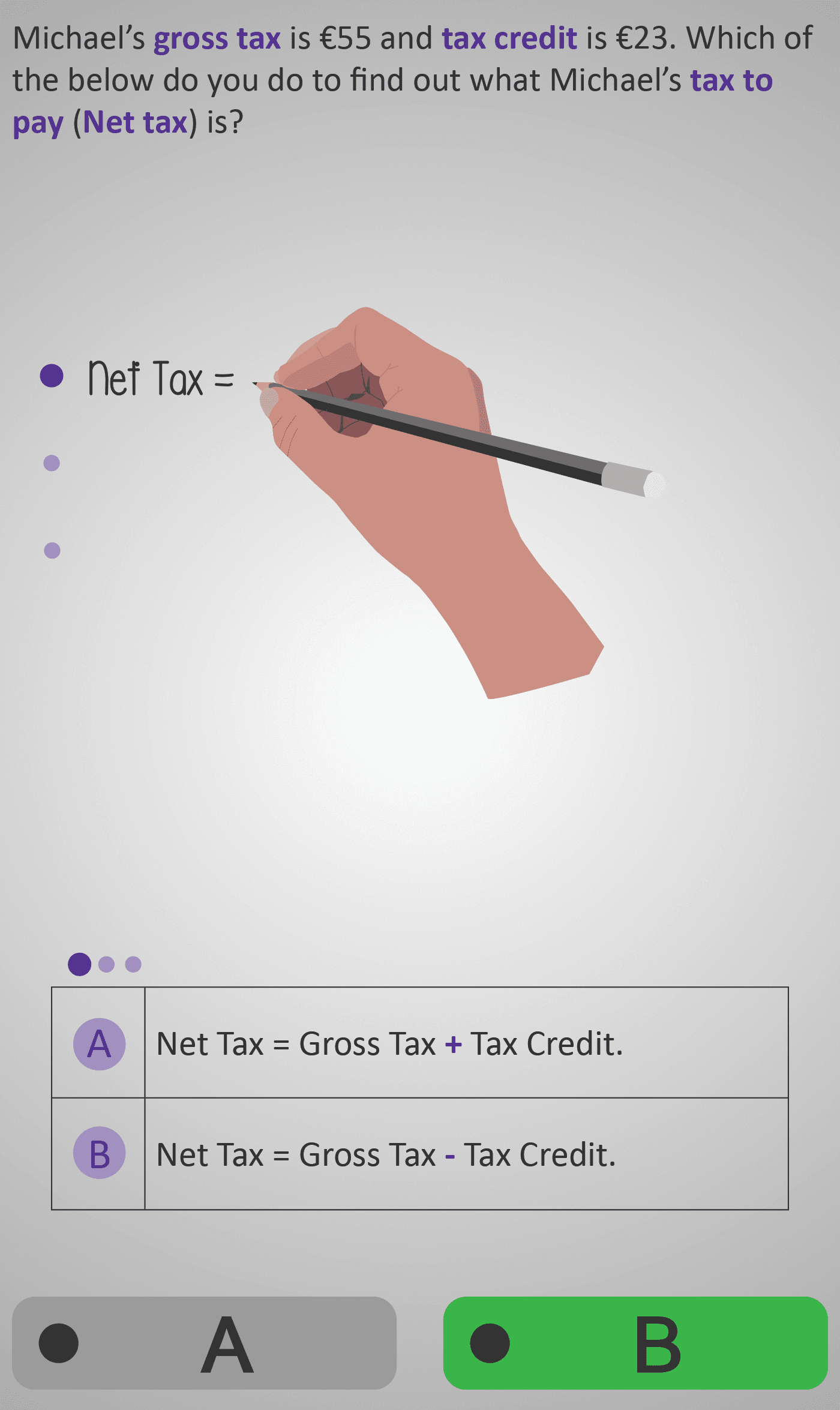
The scenario introduces Michael, who has a gross tax of €55 and a tax credit of €23. Through a clear, guided sequence, learners discover how to calculate the net tax — the amount remaining after credits are subtracted.
- Understanding the relationship: The Phlow begins with a real-world context and explains that gross tax represents the total amount before reductions, while tax credits reduce the amount owed.
- Choosing the correct operation: Students decide whether to add or subtract the tax credit, learning that credits subtract from total tax due.
- Substituting and solving: Learners substitute Michael’s figures into the formula Net Tax = €55 – €23 to calculate €32 as the net tax owed.
Visual prompts (purple highlights and an animated writing hand) guide students through each step — formula, substitution, and result — reinforcing both numerical reasoning and financial context.
By the end of this Phlow, learners can confidently interpret the relationship between gross tax, tax credits, and net tax, and explain how credits reduce tax payable in everyday financial situations.
Prerequisite Knowledge Required
- Gross Pay 3A – Calculating Income Tax as a Percentage.
- Gross Pay 3B – Calculating Net Income (Take-Home Pay).
- Subtraction 2B – Subtracting Money Values.
- Understanding that gross means “total before deductions.”
- Knowing that tax credits are subtracted from tax owed, not added.
- Ability to subtract monetary values accurately.
- Familiarity with forming and applying formulas in real-life contexts.
Main Category
Financial Maths / Income and Tax
Estimated Completion Time
Approx. 10–12 seconds per screen (3 screens total). Total Time: 1.5–2 minutes.
Cognitive Load / Step Size
Low to Moderate — each screen focuses on one reasoning step: understanding the relationship, substituting known values, then performing subtraction. This sequencing maintains clarity while gradually deepening understanding.
Language & Literacy Demand
Low — key financial terms (gross tax, tax credit, net tax) are introduced in plain language and reinforced visually. Simple sentence structures and repetition aid comprehension and retention.
Clarity & Design
- Sequential layout mirrors real-world pay slip reasoning.
- Formula → substitution → result flow reinforces structure and logic.
- Purple highlights focus attention on variable relationships.
- Minimalist design ensures focus on mathematical meaning.
Curriculum Alignment
Irish Junior Cycle Mathematics:
- Strand 1 – Number
- Substrand – Financial Mathematics: Taxation and Deductions
- Learning Outcomes:
- Identify and calculate tax owed after credits are applied.
- Recognise the relationship between gross tax, credits, and net tax.
- Apply addition and subtraction within personal finance contexts.
Engagement & Motivation
High — the context of tax credits and pay slips makes the learning meaningful and relevant. Students develop financial literacy while gaining confidence in applying maths to real-life decisions about earnings and deductions.
Error Opportunities & Misconceptions
- Adding instead of subtracting the tax credit.
- Reversing gross and net values.
- Misinterpreting tax credit as extra income.
The Phlow resolves these through explicit contrast questions (“add or subtract?”) and colour-coded highlighting of the correct operation.
Transferability / Real-World Anchoring
Very High — learners can directly apply this knowledge to interpreting payslips, managing budgets, and understanding how government tax reliefs work. It provides a foundation for advanced topics like PRSI, USC, and cumulative tax systems.
Conceptual vs Procedural Balance
Balanced — learners develop both the conceptual understanding (why credits reduce tax) and procedural fluency (how to apply subtraction in formula form).
Learning Objectives Addressed
- Write and interpret the formula Net Tax = Gross Tax – Tax Credit.
- Substitute and solve to find net tax accurately.
- Interpret subtraction as reducing total tax payable.
- Link calculations to financial meaning in real-world contexts.
What Your Score Says About You
- Less than 5: Review the difference between gross tax and tax credits — you may be adding instead of subtracting.
- 6–7: You’re close — double-check which figure represents the deduction.
- 8–9: Strong understanding — you can now apply subtraction accurately to tax situations.
- 10 / 10: Excellent! You’ve mastered how tax credits reduce tax owed and are ready for Gross Pay 3D, which combines all pay, tax, and credit elements together.